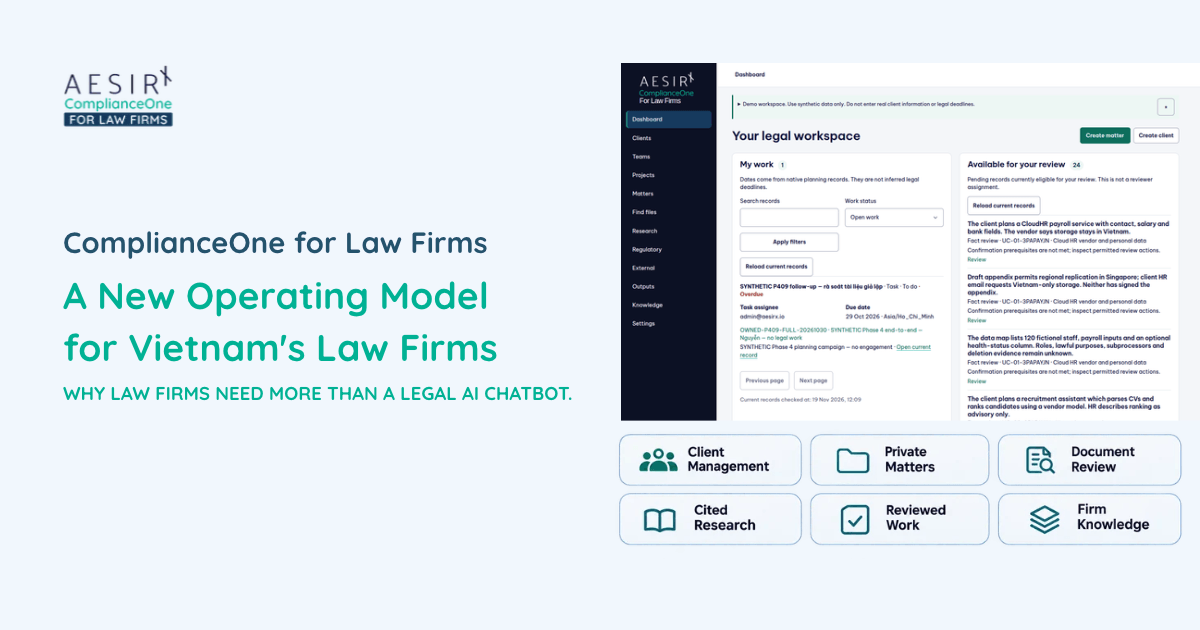
TL;DR: Why law firms need more than a legal AI chatbot: connected Matters, grounded legal research, firm-controlled deployment and a practical bridge from professional advice to enterprise compliance.
A corporate client wants to launch an AI-powered service. Another needs advice on a cross-border data transfer. A third is negotiating a supplier agreement that touches customer information, liability and regulatory exposure.
The questions sound familiar. But delivering useful legal advice requires much more than generating an answer. A firm must understand the client and engagement, identify potential conflicts, control who can see the Matter, examine the relevant documents, establish which legal sources apply, prepare recommendations, and approve what is ultimately delivered.
That is why the future of legal AI in Vietnam is not simply a better chatbot. It is a more connected, accountable way to run legal work from the first client enquiry to the final advice.
AesirX ComplianceOne for Law Firms is built around that operating model: a dedicated, firm-controlled workspace connecting clients, private Matters, documents, source-grounded research, reviewed work products and the firm's own knowledge. Forseti AI supports the work; the lawyer remains responsible for the judgment.
The problem is not just the time spent drafting
Consider the journey behind a routine commercial engagement. A new enquiry arrives by email. The team establishes who the parties are. Someone checks conflicts, confirms the scope of work, searches for the latest documents and retrieves the firm's standard positions. A junior lawyer prepares an analysis. A partner reviews it, queries the legal authorities and sends it back for revision.
Generative AI can make one of those steps faster. But if the client context lives in email, conflict information in spreadsheets, working files in shared folders and legal research in separate tools, the firm still has the same coordination and control problem.
The real opportunity is to keep the assignment, its source material, the review process and the work product connected. That makes legal work easier to supervise, repeat and scale without sacrificing the professional responsibilities on which clients depend.
One connected journey: client, Matter, research, advice
1. Begin with the client, not a generic prompt
ComplianceOne for Law Firms organizes work around named clients and private legal Matters, including assigned teams, documents, instructions and supporting tasks. Access is governed by the current user's permissions and Matter membership; administrative access does not automatically provide visibility into privileged files.
The next-stage intake improvements add conflict-of-interest screening that recognizes party aliases and Vietnamese names written with or without diacritics, records a human reviewer's decision, and supports preparing lawyer-approved engagement letters. The system is designed to warn and document, not to decide a conflict or sign an engagement on the firm's behalf.
2. Work with the actual documents and legal sources
Lawyers need more than persuasive language. They need to know what the proposed answer is based on. Matter-linked document review and cited research let a reviewer inspect the underlying material, assess source coverage and identify missing information before relying on an AI proposal.
Existing configured connections to Microsoft and Google environments, including Outlook/SharePoint and Gmail/Drive, help bring familiar document and collaboration sources into the workflow. Availability and access depend on the particular integration, deployment and permissions.
The product roadmap extends these capabilities with coverage-aware search, quotation checks, stronger Word tracked-change handling and contract playbooks reflecting a firm's standard, fallback and unacceptable positions. These enhancements are subject to release validation rather than assumed to be available in every deployment today.
3. Put Forseti AI to work within professional boundaries
Forseti AI is not positioned as a substitute for a supervising lawyer. It assists with permitted research, drafting, document analysis and preparation of reviewable work. The governing principle is straightforward: AI prepares and explains; authorized professionals evaluate and decide.
A useful legal AI output should make its limitations visible. What has been checked? Which quotation matches the source? What information is missing? Which legal question still requires counsel's judgment?
The Law Firms roadmap strengthens these explicit "Not checked", "Questions" and "Decisions for you" controls, together with reviewer records and pre-send checks.
This approach is part of a broader investment in governed AI. In our November 18 update, we announced 60 practitioner jobs, 70 built-in AI workflows, 60 specialist chat playbooks and six personas in the main ComplianceOne GRC platform.
Those figures describe the wider Forseti environment, not 70 completed Law Firms advisory workflows. The legal product is being extended with dedicated, lawyer-reviewed Matter workflows.
4. Turn approved work into reusable firm knowledge
A firm's established drafting positions, checklists, approved templates and reviewed interpretations are valuable institutional assets.
ComplianceOne supports deliberately selected and versioned firm knowledge so colleagues can find suitable material for a new assignment.
Private client Matters do not automatically become a shared knowledge base. Publication, source rights, audience and professional suitability remain explicit decisions.
The aim is to preserve what the firm knows without blurring confidentiality boundaries.
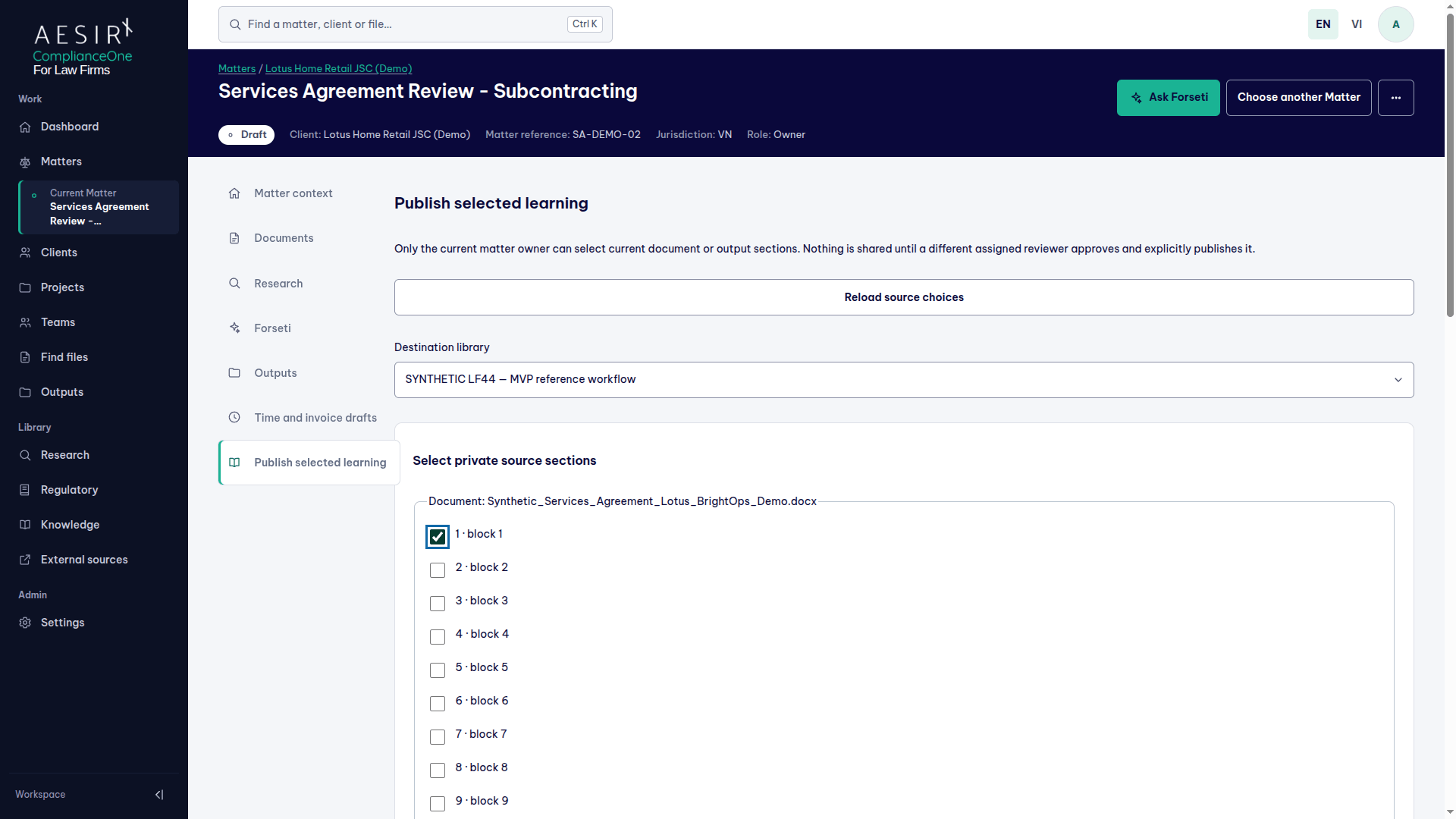
ComplianceOne lets firms select material from private Matters for separate review and controlled publication into Firm Knowledge
Built for the regulatory reality facing Vietnamese clients
Vietnam's regulatory environment has become more demanding across privacy, AI, cybersecurity, data governance, digital transactions and sector-specific obligations.
The Personal Data Protection Law took effect on January 1, 2026, and the Law on Artificial Intelligence took effect on March 1, 2026, with transitional arrangements for certain existing AI systems.
For law firms, these developments create recurring advisory work: reviewing processing agreements, assessing data transfers, helping clients understand incident response duties, evaluating AI systems and translating legal obligations into practical recommendations.
The regulatory foundation is already there.
ComplianceOne for Law Firms includes the same library of more than 175 supported Vietnamese regulatory frameworks as the main ComplianceOne GRC platform. It is not necessary to rebuild that legal source foundation from scratch for the legal product.
That does not mean every framework already has a dedicated automated legal-opinion workflow.
The first ten specialist legal-advisory workflows in the current Law Firms roadmap focus on the Personal Data Protection Law and AI Law, including data-processing agreement review, breach-notification analysis, AI-system classification support and cross-border transfer assessment preparation.
Further legal-advisory workflows can build on other supported regulatory sources as demand and legal validation permit.
This distinction is important. A library provides the source foundation; a lawyer-approved advisory workflow adds a governed method for applying that source to a specific set of client facts.
Effective dates, source versions, unresolved facts and applicability still have to be assessed by counsel.
A practical example: from PDPL advice to operational action
Imagine a client asks whether a proposed outsourcing agreement and international data flow can proceed under Vietnam's privacy requirements.
The firm creates or opens the client's private Matter, attaches the draft agreement and supporting facts, and identifies the questions needing legal analysis.
Forseti assists with the permitted document review and source-grounded research. The output distinguishes the contractual provisions found, the legal sources considered, missing facts and the decisions the lawyer must make.
The responsible lawyer verifies the sources, resolves the outstanding questions and approves a recommendation for the client.
The result may be a revised agreement, an advisory memorandum, a list of conditions or an action plan. Internal work and client disclosure remain separate, with only deliberately selected materials shared.
Sometimes that advice is the end of the assignment. Sometimes it is the beginning of an operational compliance programme.
A corporate client may need to assign responsibilities, manage controls, gather evidence, maintain assessments and demonstrate implementation over time.
That is where the separate 30-module AesirX ComplianceOne GRC platform can become relevant.
A law firm can remain the client's independent legal adviser while the corporate client operates its own GRC deployment. The products have separate contracts, infrastructure and permissions; privileged Matter records are not automatically transferred between them.
The distinction is commercially important:
The law firm provides the advice; the enterprise operates its compliance programme.
AesirX provides software for both environments without making legal judgment or becoming the firm's client-data custodian merely by supplying a self-hosted product.
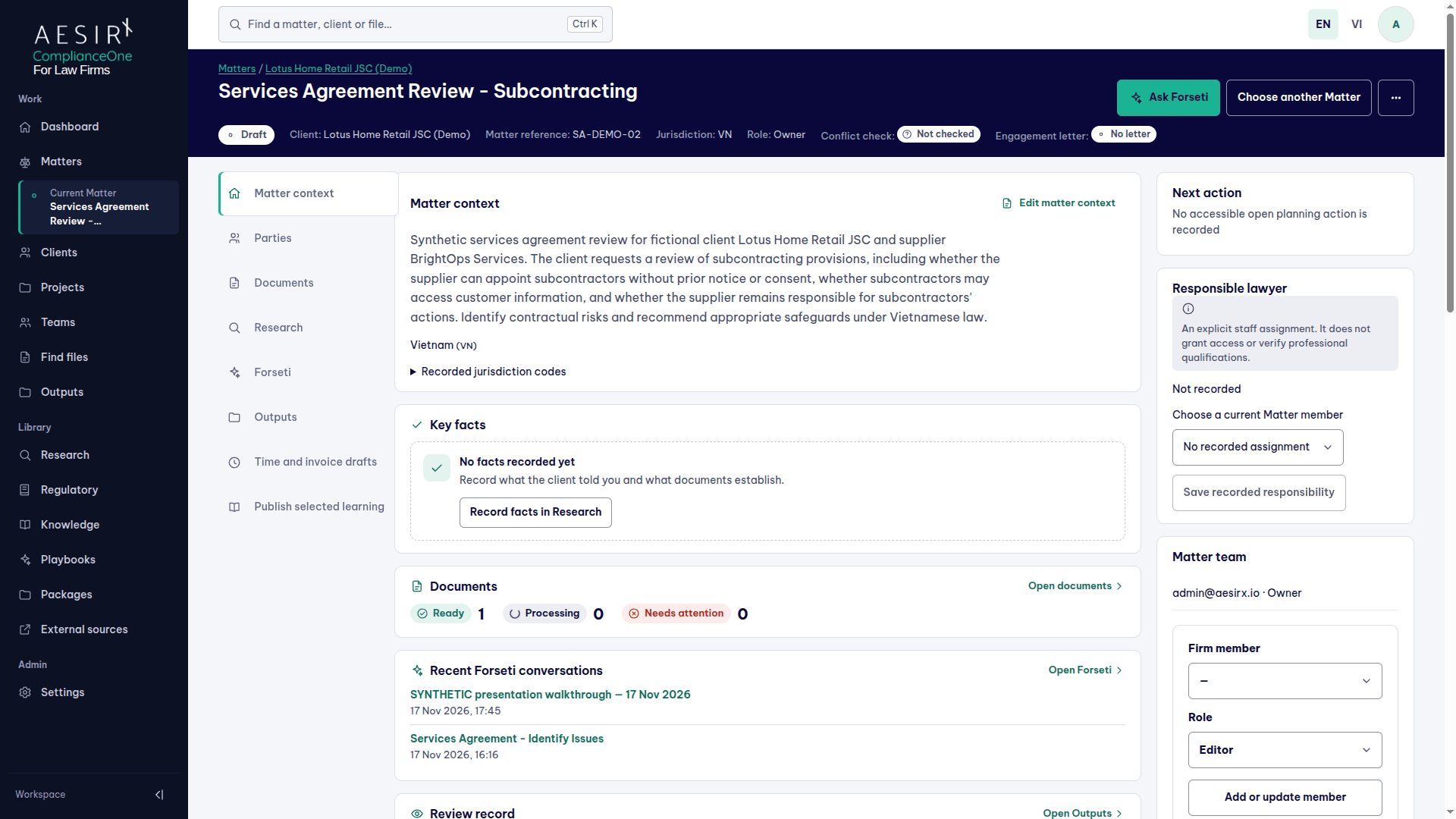
ComplianceOne for Law Firms connects client context, documents and AI-assisted legal work within a private Matter workspace.
Confidentiality requires control over both hosting and AI
Law firms cannot evaluate AI solely on the quality of a generated answer.
They also need to know who operates the software, where documents are stored, which service receives data when an AI task runs, and which contractual protections apply.
ComplianceOne for Law Firms is designed for self-hosted, firm-managed deployment. The firm can operate the application and its documents on infrastructure under its control, subject to the agreed installation and operating configuration.
With Bring Your Own Keys (BYOK), the firm connects its own account with a supported AI provider or compatible model endpoint.
It manages the provider relationship, credentials and model choice rather than being forced into a single bundled AI service. Compatible configurations can include commercial, appropriately self-hosted or sovereign models.
Self-hosting does not mean an external AI service never receives data.
When the firm invokes a connected model, the provider receives the content necessary for that request. Retention, training use, residency and contractual protections depend on the chosen provider, account and configuration.
Those choices should be reviewed before real client information is introduced.
Enterprise-grade working methods at a price a firm can deploy widely
AI delivers less organizational value when only a few lawyers can afford to use it.
A practical legal operating platform should be economically accessible across the team, from associates to supervising partners and operations staff.
ComplianceOne for Law Firms starts at USD $300 per month for up to three seats. Each additional seat is USD $50 per month.
A ten-seat firm therefore pays USD $650 per month in software licence fees ,or USD $7,800 annualized.
The firm pays separately for its chosen AI provider's usage, hosting and any applicable implementation or operating services.
This is a transparent licence-price proposition, not a promise that total ownership costs are identical across different legal AI products.
The commercial purpose is to make connected legal workflows and supervised AI adoption realistic for boutique and mid-sized Vietnamese firms, not only for a small group of specialist users.
What we are expanding next
The Law Firms roadmap is organized into five waves: a redesigned interface and Matter workspace; stronger intake, conflicts, engagement and review controls; advanced contract and evidence workflows; dedicated PDPL and AI Law advisory workflows; and additional capabilities for delegated reading, lawyer transitions and reusable knowledge packages.
Those improvements are being developed and validated as product releases.
The goal is a complete intake-to-advice operating environment, but no firm should be asked to treat an unverified roadmap feature as a live capability.
Pilot activation is subject to end-to-end testing, source checks, confidentiality controls and participating lawyers' approval of relevant advisory workflows.
Start with one representative Matter, not an AI promise
The right way to evaluate legal AI is to test the entire assignment.
Begin with synthetic clients and a representative contract, privacy or AI-governance Matter. Follow it through preparation, research, Word review, source checking, lawyer sign-off and controlled delivery.
Measure what matters to the firm: total time to approved work, correction effort, citation reliability, confidentiality controls, repeatability and whether the team chooses to keep using the method.
A faster first draft is not enough if the review burden simply moves elsewhere.
AesirX can discuss a focused 30-day pilot using a synthetic demo environment, or a firm-controlled deployment where the law firm manages its own infrastructure and AI-provider arrangements, subject to the agreed rollout and security requirements.
Better legal AI should help a firm deliver trusted advice, preserve its institutional knowledge and serve more clients without giving up control of the work.
That is the operating model we are building with AesirX ComplianceOne for Law Firms.
Explore ComplianceOne for Law Firms: https://aesirx.io/compliance-one/law-firms
or a focused pilot with the AesirX team.