
DPO Radio
 VIETNAM ELECTRONIC ID & AUTHENTICATION LAW [DRAFT]
Track consultation changes, assess operational impact, and organize readiness evidence across identity, privacy, security, AI, and provider governance.


Vietnam's Ministry of Public Security opened consultation on the Draft Law on Electronic Identification and Authentication from 13 July to 2 August 2026. The draft has no assigned law number or final effective date and may change before promulgation.
Its proposed scope reaches beyond identifying people and organizations. It also covers physical objects, products, data, digital resources, applications, software, services, digital assets, intellectual property rights, events, transactions, interactions, and physical or virtual spaces.
That breadth creates a cross-functional readiness challenge. Identity owners, privacy teams, cybersecurity teams, AI governance leads, service operators, and vendor managers may need a shared view of identifiers, lifecycle events, authentication decisions, evidence, incidents, and provider dependencies.
ComplianceOne keeps this work in a draft-readiness track. Teams can prepare and review evidence while preserving the distinction between consultation proposals and requirements that are legally in force.
show_des
People, organizations, objects, data, digital resources, software, services, assets, events, transactions, interactions, and spaces.
Unique identifiers, registration, verification, issuance, updating, suspension, termination, linking, and traceability.
Centralized, intermediary, and self-sovereign authentication.
Three risk-based levels using knowledge, possession, and inherent-characteristic factors.
Purpose limitation, factor minimization, consent, temporary factor retention, authentication logs, and Vietnam storage readiness.
Independently verifiable certificates, subject-controlled sharing, combined presentation, and selective disclosure.
Proposed conditions for domestic providers and foreign providers serving Vietnam.
Anti-spoofing, independent evaluation, bias and reliability review, adversarial resistance, monitoring, explainability, decision logs, and incident response.
The draft also proposes synchronization and retention rules and an 18-month transition measured from a future effective date. These are readiness markers, not current compliance deadlines.
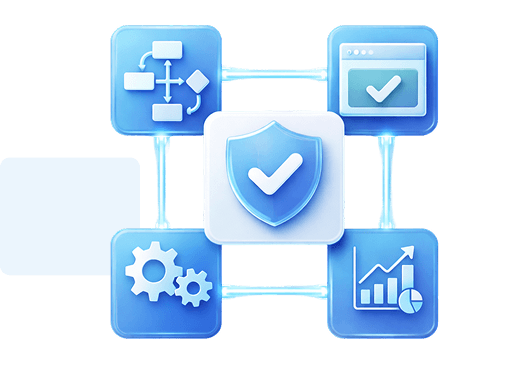
Teams can build an electronic identity inventory covering each proposed object category, assign accountable owners, and connect identifiers to lifecycle, source, assurance, and linkage evidence. Records can show how an object relates to its lawful owner or manager and how a transaction relates to its participants, time, location, and context.
Authentication assessments help teams document transaction risk, the selected authentication model, the proposed assurance level, and the factors used. Privacy review can record necessity, consent, minimization, and temporary retention decisions alongside authentication evidence.
Readiness records support electronic attestations and selective disclosure, domestic and cross-border provider assessment, controlled testing, AI identity-system controls, and incident handling. Each record remains clearly marked as preparatory work based on a consultation draft.
Related duties can be linked to Vietnam's personal data protection, Data Law, Cybersecurity Law, AI Law, Electronic Transactions Law, E-Commerce Law, and Telecommunications Law without duplicating evidence or merging their legal status.
 Program Governance
Assigns ownership, review, approval, and recurring change checks.
Explore Program Governance Data Mapping
Connects identity sources, systems, providers, storage, and data flows.
Explore Data Mapping Vendor Risk
Connects lifecycle stages, storage, recipients, systems, and cross-border flows.
Explore Vendor Risk Incident Operations
Preserves investigation, notification, remediation, and closure evidence.
Explore Incident Operations

 Identity objects and owners are scattered across system and vendor inventories.
 Identity scope, identifiers, owners, lifecycle, and linkages stay connected.Authentication levels are selected without a consistent risk rationale.Authentication model, assurance, factors, minimization, and evidence are reviewed together.Privacy, security, AI, and provider reviews produce disconnected evidence.Provider, AI, privacy, security, and incident work shares a governed evidence chain.Draft synchronization, retention, and transition proposals are mistaken for current deadlines.Draft proposals remain visibly separate from active legal requirements.Consultation changes are difficult to compare against earlier readiness decisions.Promulgation review can compare the final instrument with the readiness baseline.
ComplianceOne records the official consultation window and links readiness work to the uploaded draft and Ministry of Public Security consultation dossier.

The readiness set uses organization-created working records. It does not present government forms, final fines, a final effective date, or final administrative procedures.

Human review remains central to legal interpretation, provider decisions, evidence approval, and any future authority interaction.
See how ComplianceOne organizes electronic identity, authentication, provider, AI, and incident readiness without overstating the draft's legal status.

Ronni K. Gothard Christiansen - Technical Privacy Engineer & CEO
Technical Compliance Expert, 32+ Years Open Source Advocate, X-BoD Open Source Matters Inc.
No. The source is a 2026 consultation draft with no assigned law number or final effective date. ComplianceOne presents it as preparatory material until an official promulgated instrument is verified.
The proposed scope includes people and organizations as well as physical objects, data, digital resources, applications, software, services, assets, rights, events, transactions, interactions, and physical or virtual spaces.
The draft proposes three risk-based levels using combinations of knowledge, possession, and inherent-characteristic factors. Readiness assessments can record the rationale without treating the levels as final law.
Yes. It describes a self-sovereign authentication model and electronic attestations that can support subject-controlled sharing and selective disclosure, subject to the final text and implementing rules.
It structures reviews of establishment, infrastructure, security, personnel, process integrity, continuity, Vietnam presence, data storage, national-system connectivity, AI controls, and incident readiness.

Test identity inventory, authentication assessment, and provider-readiness workflows with your team.

Map the draft's proposed scope to your identity systems, providers, data, and existing Vietnam duties.


The evolution of Aesir is Aesir +  (the Norse symbol for Necessity)"Needed in order to achieve a particular result"
♥Join the AesirX Privacy Newsletter. Stay Informed. Stay Compliant.
 Audit Trail