

DPO Radio

 CONNECTORS
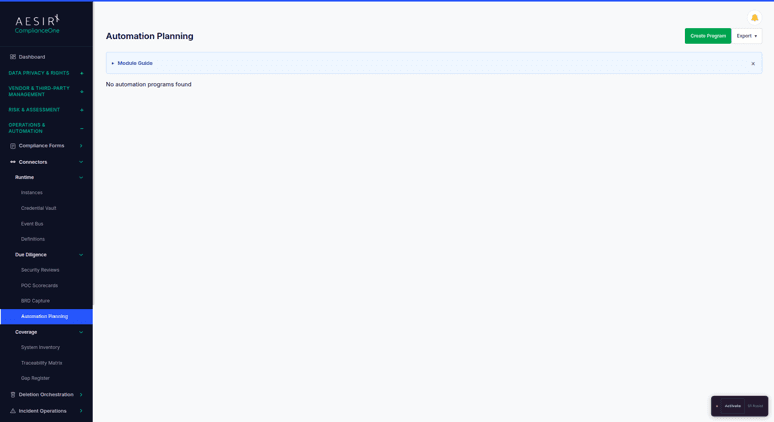
Capture business requirements, review security before deployment, score vendor connectors, and monitor health post-deployment.

Compliance operations do not exist in isolation. Organizations run their data across dozens of systems – HR platforms, CRM tools, cloud storage, ticketing systems, email services, and SSO providers. To maintain a complete compliance picture, the GRC platform must connect to these systems to pull metadata, push tasks, and sync evidence automatically. But every integration introduces risk: an unreviewed connector can expose sensitive data, an unreliable vendor API can break evidence collection, and an unmonitored connection can fail silently for weeks.
Data Governance Leads (P-VN-05) responsible for automation and connector strategy (UC-VN-19) need a structured approach to integration governance. The challenge is not just technical connectivity – it is ensuring that every integration has a documented business requirement, passes a security review before going live, is scored against reliable criteria for vendor selection, and is continuously monitored after deployment.
Without structured connector governance, organizations face a familiar pattern: integrations are built ad hoc without documented requirements, security reviews are skipped under delivery pressure, vendor selection decisions are based on incomplete information, and connector failures are discovered only when downstream compliance processes break. The result is a fragile integration layer that undermines the reliability of the entire GRC platform.
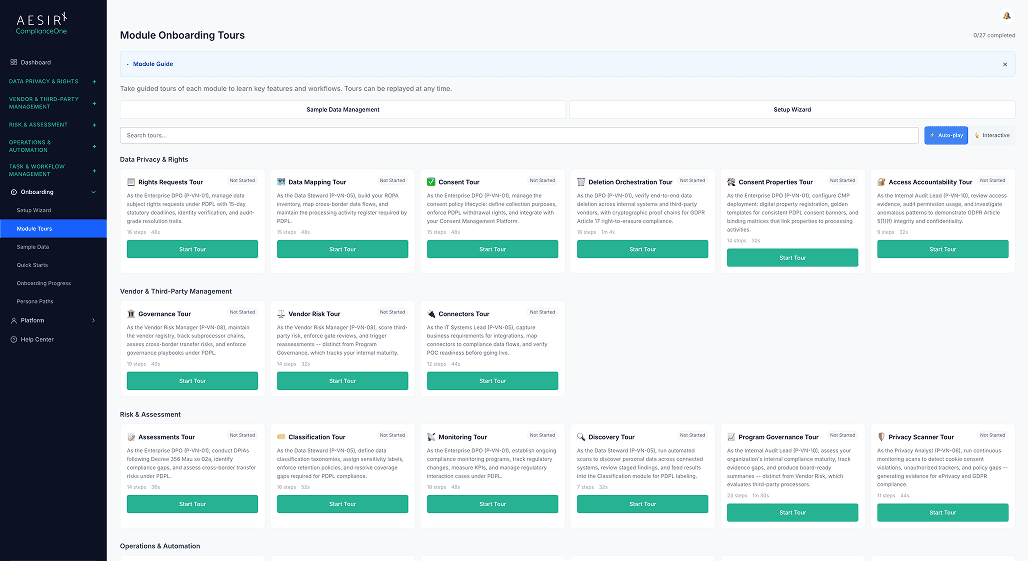
AesirX ComplianceOne Connectors provides a complete integration lifecycle – from Business Requirements Document (BRD) capture through pre-deployment security review, vendor POC scoring, and post-deployment health monitoring. Pre-built connectors for email, ticketing, SSO, and storage platforms reduce implementation time, while the workflow integration layer enables automated metadata pulls, task pushes, and evidence synchronization. Every integration is approved, assessed, and continuously verified.
Configure and manage system integrations from a central interface. Each connector instance defines the target system, connection parameters, and data flow direction. Instances can be activated, deactivated, and reconfigured without affecting other integrations.
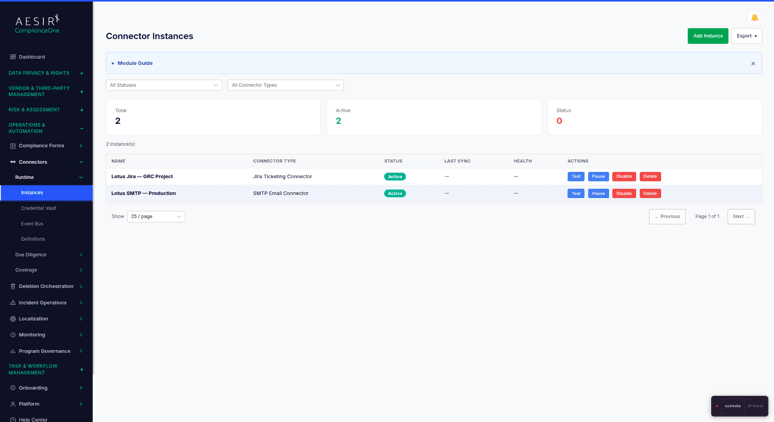
Document integration business requirements and manage them through a full lifecycle from draft to approved. Each BRD captures the business case, data flows, compliance implications, and technical requirements, ensuring every integration has a documented justification before development begins.
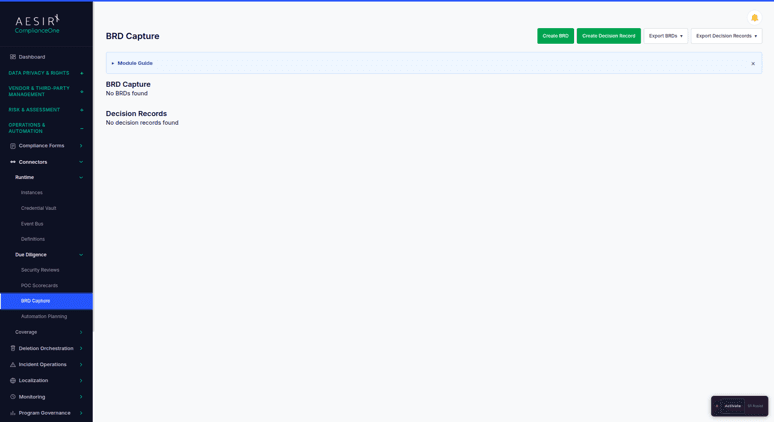
Every connector is routed through a security checklist and approver sign-off before it goes live. The security review evaluates data exposure, authentication mechanisms, encryption in transit and at rest, and access control, preventing connectors with unacceptable risk from reaching production.
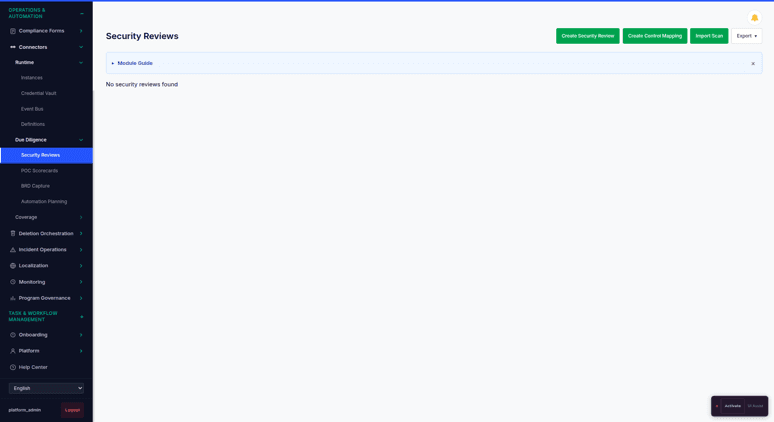
Score connector vendors across API quality, reliability, support, and cost dimensions to support procurement decisions. POC scoring provides a structured evaluation framework that replaces subjective vendor selection with documented, comparable assessments.
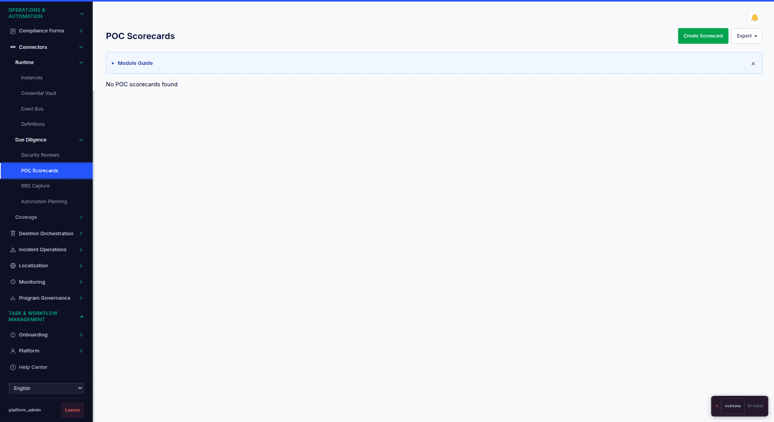
Ongoing post-deployment health checks with alerting for connectivity failures and performance degradation. The health dashboard shows the status of every active connector, identifies failing connections, and tracks performance trends so operations teams can address issues before they affect compliance workflows.
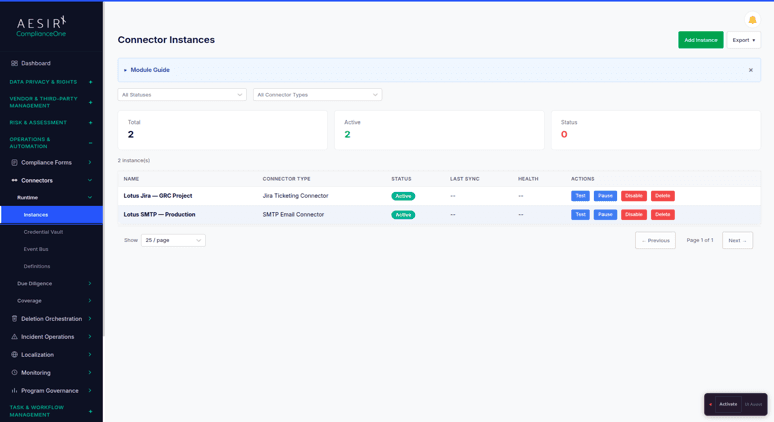
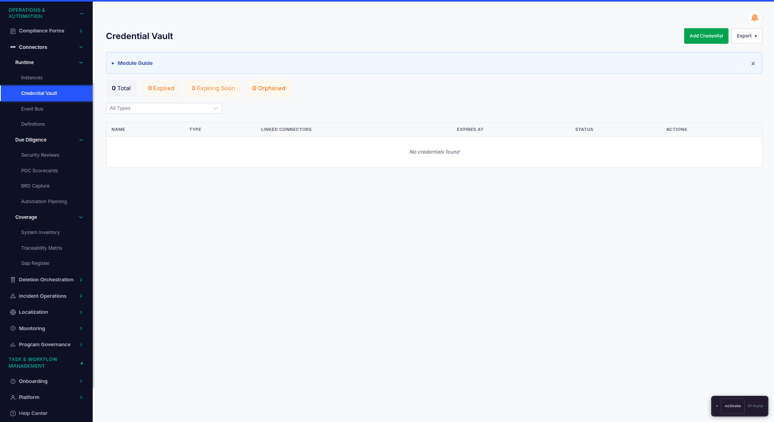
A self-hosted credential vault stores API keys, secrets, and authentication tokens used by connector instances. Credentials are encrypted at rest and accessed only by authorized connector processes, eliminating the need to store secrets in configuration files or environment variables.
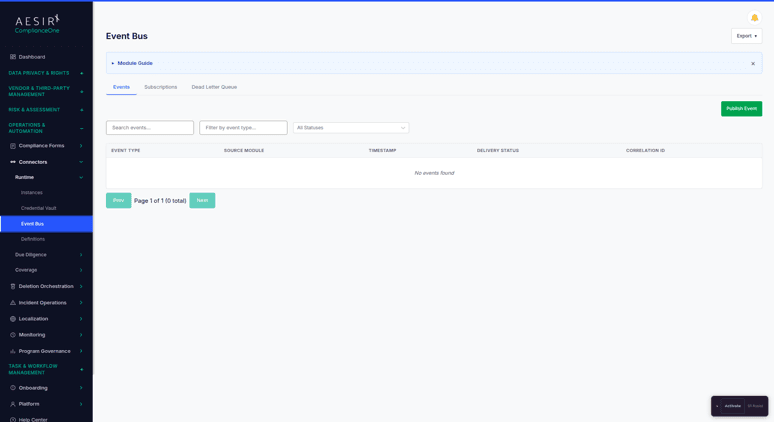
Workflow triggers based on external events enable automated compliance responses. When a connected system generates an event (a new record, a status change, an alert) the event bus can trigger downstream workflows within ComplianceOne, keeping compliance processes synchronized with operational reality.
Pull metadata, push tasks, and sync evidence automatically across connected systems. Workflow integration ensures that compliance data flows bidirectionally between ComplianceOne and external platforms, reducing manual data entry and keeping records current.


 Integrations are built ad hoc without documented business requirements or approval gates.
 Every integration has a documented BRD with a lifecycle from draft to approved.Security reviews are skipped, and connectors with unacceptable data exposure reach production.Pre-deployment security review with approver sign-off ensures no unreviewed connector goes live.Vendor selection is based on informal evaluation with no structured scoring criteria.Vendor POC scoring provides structured, comparable evaluations across API quality, reliability, and cost.Connector failures are discovered only when downstream compliance processes break.Health monitoring with alerting detects connectivity failures and performance degradation before they affect workflows.API keys and secrets are stored in configuration files with no centralized management.Self-hosted credential vault encrypts secrets at rest with controlled access per connector.
Full integration lifecycle governance – BRD capture, security review, POC scoring, and health monitoring – ensures every connector is justified, assessed, and continuously verified.

Pre-built connectors for email, ticketing, SSO, and storage platforms provide production-ready integrations that reduce implementation time for the most common enterprise connectivity needs.

Event bus and workflow integration enable automated evidence synchronization and task routing between ComplianceOne and connected systems, reducing manual data entry across the compliance program.
Enables automated evidence synchronization and metadata pulls from systems holding personal data, supporting PDPL data mapping and audit requirements.Supports data governance automation by connecting discovery, classification, and mapping workflows to source systems through governed integration channels.Pre-deployment security review ensures every integration meets cybersecurity standards before connecting to production systems.Ready to see how Connectors works with your compliance workflows? Request a personalized demo.

Ronni K. Gothard Christiansen - Technical Privacy Engineer & CEO
Technical Compliance Expert, 32+ Years Open Source Advocate, X-BoD Open Source Matters Inc.
ComplianceOne includes pre-built connectors for email, ticketing, SSO, and storage integrations. These connectors are production-ready and can be configured through the connector instances interface without custom development.
Every connector must pass through a security checklist that evaluates data exposure, authentication, encryption, and access control. An authorized approver must sign off before the connector can be activated in production. Connectors that fail the review cannot go live until issues are resolved.
Yes. The connector framework supports custom integrations beyond the pre-built set. Custom connectors follow the same governance lifecycle – BRD capture, security review, and health monitoring – ensuring consistent oversight regardless of whether the integration is pre-built or custom.
Post-deployment health checks run on an ongoing basis, monitoring connectivity, response times, and error rates. When a connector fails a health check or performance degrades beyond defined thresholds, the system generates alerts so operations teams can investigate before compliance workflows are affected.
The event bus listens for events from connected systems (new records, status changes, alerts) and triggers downstream workflows within ComplianceOne. For example, a new vendor record in an external system can trigger a vendor risk assessment task, or a system alert can create an incident intake record, keeping compliance operations synchronized with operational events.
Explore the module architecture, then speak with us about the workflows your organization needs to operationalize first.

Test connector governance with BRD capture, security review, and health monitoring on your real integrations.

Walk through your integration landscape and see how governed connectors fit your compliance automation strategy.


The evolution of Aesir is Aesir +  (the Norse symbol for Necessity)"Needed in order to achieve a particular result"
♥Join the AesirX Privacy Newsletter. Stay Informed. Stay Compliant.


 Vietnam PDPL (Law 2025)
 Vietnam Data Law
 Vietnam Cybersecurity Law 2025