
DPO Radio

 AUDIT TRAIL
Every compliance action recorded, attributed, and packaged for regulatory inspection readiness.

Regulatory inspections demand proof – not just that compliance activities were completed, but who did what, when, in what role, and whether the evidence is complete and unaltered. When auditors arrive (from the Ministry of Public Security for PDPL, or internal audit teams conducting cross-framework assessments), they expect a coherent audit record that spans every compliance module, not a patchwork of module-specific logs that must be manually correlated.
Internal Audit and Regulatory Inspection Leads (P-VN-10) face two critical challenges. First, they need to query audit events across all modules simultaneously – rights requests, DPIA assessments, vendor reviews, incident responses, and more – to build a complete picture of compliance activity within a defined audit period. Second, they need to assemble evidence packs that prove the chain of contribution: who was assigned the work, who completed it, who reviewed it, and who approved it.
Without a unified audit trail, audit preparation becomes a manual exercise in log aggregation. Teams export logs from individual modules, correlate timestamps by hand, and hope nothing was missed. Evidence packs are assembled in shared folders with no completeness scoring – the audit lead discovers missing evidence only when the auditor asks for it.
Audit Trail provides a centralized, immutable record of all platform events with a unified cross-module query interface. Contributor lineage tracks a four-role chain (assigned, completed, reviewed, approved) per case, so every action is attributed to the right person in the right role. Evidence packs follow a defined lifecycle with a 0-100 completeness score that shows exactly what is missing before submission. Audit period configuration with integrity verification confirms that no records were altered or deleted within the period, giving both internal and external auditors confidence in the record.
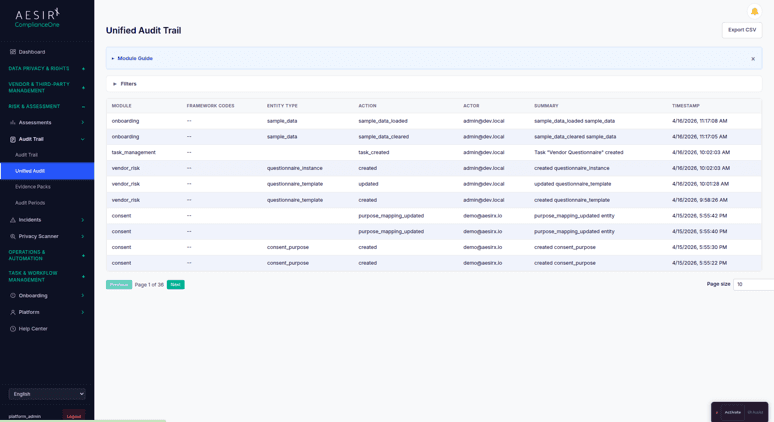
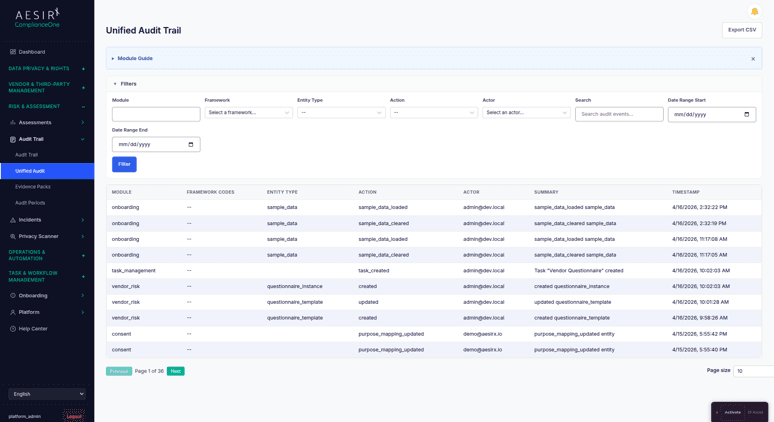
Query audit events across all ComplianceOne modules simultaneously. Combined filters let audit leads search by date range, user, action type, and module, with summary statistics that show activity distribution across the platform. This eliminates the need to check each module's log separately.
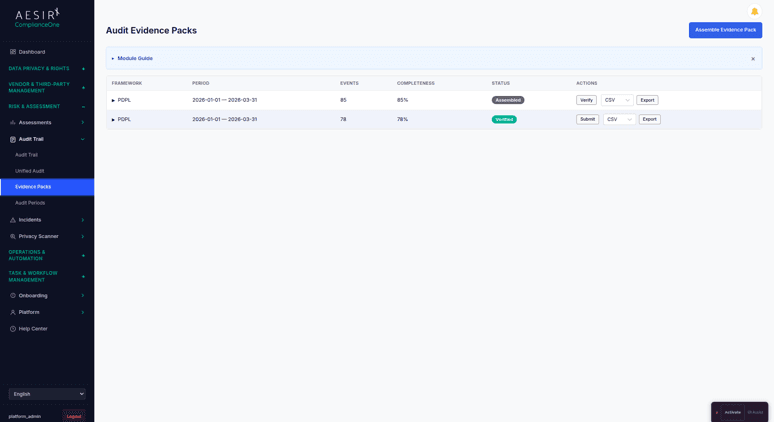
Evidence packs progress through a defined lifecycle from draft to submitted. Each pack carries a completeness score (0-100) that identifies exactly what is missing – which documents, which sign-offs, which attestations. Packs cannot be submitted until the score reaches the required threshold, preventing incomplete evidence from reaching auditors.
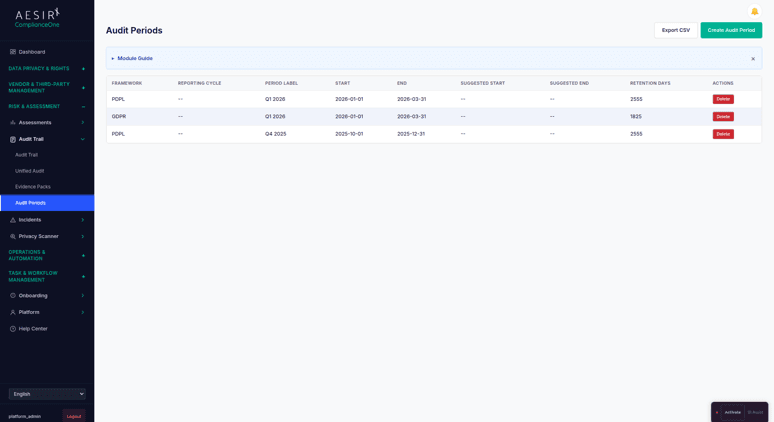
Define formal audit periods with start and end dates. Integrity checks confirm that no records within the period were altered or deleted after the period closed. This provides a verifiable guarantee that the audit record is complete and unmodified, a requirement for regulatory submission credibility.
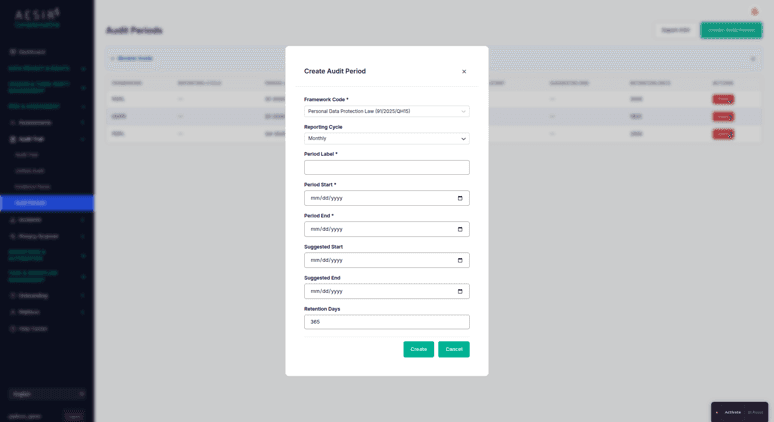
All platform events are stored in a tamper-proof centralized log. Every action records the timestamp, actor, action type, module, and before/after values. Immutability ensures that audit records cannot be retroactively modified.
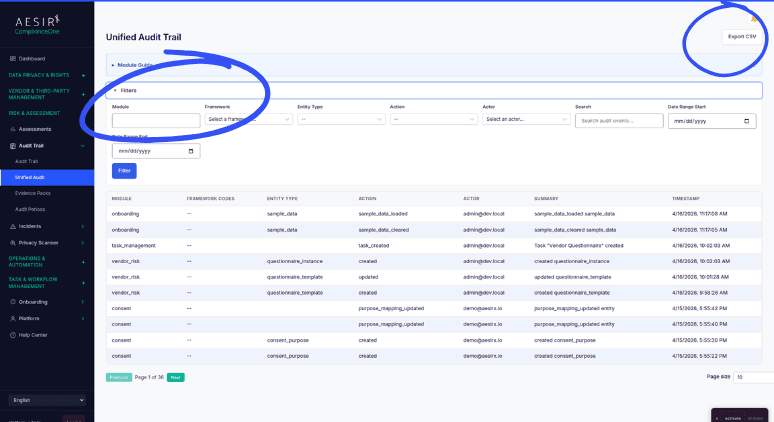
Filter audit events by date, user, action type, module, and entity. Export capabilities support JSON and CSV formats for integration with external audit tools or regulatory submission requirements.
Configure audit log retention periods to meet organizational and regulatory requirements. Retention policies ensure logs are preserved for the required duration while managing storage.


 Audit logs scattered across individual modules with no cross-module query capability.
 Unified cross-module query surfaces audit events from all modules in a single search interface.Contributor attribution limited to "last modified by" with no role-based lineage chain.Four-role contributor lineage (assigned, completed, reviewed, approved) tracked per case and section.Evidence packs assembled manually with no completeness scoring before submission.Evidence pack lifecycle with 0-100 completeness scoring prevents incomplete submissions.No integrity verification to confirm records were unaltered within an audit period.Formal audit periods with integrity verification confirm no records were altered or deleted.Audit preparation requires manual log aggregation and timestamp correlation across modules.Centralized immutable log with advanced filtering eliminates manual log aggregation.
The AuditMaturityService provides 12 dedicated methods for audit operations – from cross-module event queries and contributor lineage resolution to evidence pack lifecycle management and integrity verification.

Contributor lineage tracks a four-role chain (assigned, completed, reviewed, approved) per case, giving auditors immediate, unambiguous attribution for every compliance action.

Evidence pack completeness scoring provides a quantitative measure (0-100) of pack readiness, identifying exactly which items are missing before a pack can be submitted to auditors or regulators.
Provides immutable audit evidence for DPIA dossier submissions, with contributor lineage proving who reviewed and approved each section filed with MPS.Records incident response actions with full attribution chain for authority cooperation and post-incident evidence packages.Supports information security audit requirements with centralized logging, access event tracking, and evidence pack assembly.Provides audit evidence for trust service criteria with immutable records, contributor lineage, and integrity verification.Ready to see how Audit Trail works with your compliance workflows? Request a personalized demo.

Ronni K. Gothard Christiansen - Technical Privacy Engineer & CEO
Technical Compliance Expert, 32+ Years Open Source Advocate, X-BoD Open Source Matters Inc.
Yes. The unified cross-module audit query lets you search events from every ComplianceOne module simultaneously. You can filter by date range, user, action type, and module, with summary statistics showing activity distribution. There is no need to check each module's log separately.
Contributor lineage tracks four roles per case: who was assigned the work, who completed it, who reviewed it, and who approved it. This chain is recorded at both the case and section level, so auditors can trace responsibility for any specific compliance action.
Each evidence pack carries a score from 0 to 100 that reflects how complete the pack is. The system identifies exactly which documents, sign-offs, or attestations are missing. Packs cannot be submitted until they reach the required completeness threshold, preventing incomplete evidence from reaching auditors.
Yes. Audit periods can be configured with formal start and end dates, and integrity checks confirm that no records within the period were altered or deleted after the period closed. This provides verifiable confidence in the completeness and accuracy of the audit record.
Audit events can be exported in JSON and CSV formats. Evidence packs can be exported as structured bundles. These formats support integration with external audit tools, regulatory submission requirements, and long-term archival.
Explore the module architecture, then speak with us about the workflows your organization needs to operationalize first.

Test Audit Trail with your actual audit periods and see cross-module queries and evidence pack scoring in action.

Walk through your audit and inspection requirements and see how contributor lineage and integrity verification fit your process.


The evolution of Aesir is Aesir +  (the Norse symbol for Necessity)"Needed in order to achieve a particular result"
♥Join the AesirX Privacy Newsletter. Stay Informed. Stay Compliant.


 VN PDPL (91/2025/QH15)
 VN Cybersecurity Law (116/2025/QH15)