DPO Radio
MCP Connector Overview
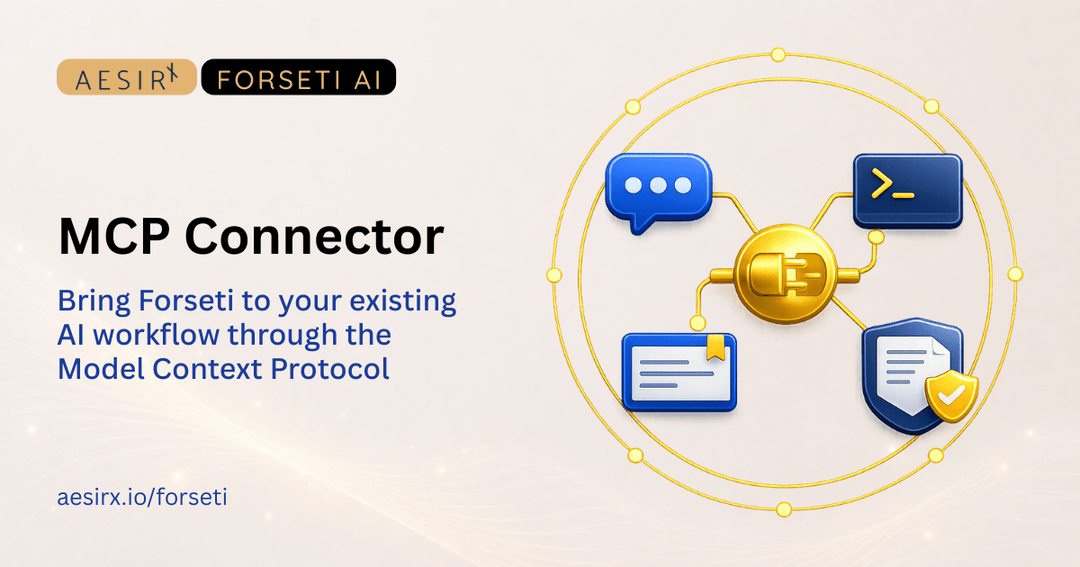
The Forseti MCP Connector implements Anthropic's Model Context Protocol so external Claude clients can call Forseti's compliance tool surface against your organisation's installed regulatory packs and your own records. Read tools run synchronously; write tools route through an in-product approval queue.


A compliance team integrating an AI advisor across multiple existing AI workflows has to answer a basic architectural question before anything else: what is exposed, what is refused, and how is each call audited? An "open access" integration that exposes every Forseti capability to every external key fails inspection on day one. An "all-or-nothing" integration that requires either a fully-permissive key or no integration at all fails adoption.
The MCP Connector is the controlled middle. It exposes a defined tool surface — eighteen read tools, nine write tools, two memory tools, and one sub-agent handoff tool — over Anthropic's open Model Context Protocol. Each key carries its own tool whitelist that scopes which of those tools the key can call. Read tools dispatch synchronously through the same internal handler the in-product chat uses, so the answers are identical. Write tools enqueue a proposal in the in-product approval queue that an admin must approve before any state changes.
The constraint set is structural, not configurable. There is no bypass for trusted keys. There is no deletion tool exposed on any key, of any scope. The memory tools are read-only. The persona-handoff tool is advisory and cannot mutate the chat session. Cross-organisation calls are impossible by construction — every key is scoped to one customer organisation.
What the connector will not do: execute a write autonomously, expose a deletion tool, surface another organisation's records, or run a tool the key's whitelist excludes.
The connector speaks the public Model Context Protocol wire format. Any client that implements MCP — Anthropic Console, Claude Code, Claude Desktop with MCP enabled, custom integrations — works without bespoke wiring. There are no ComplianceOne-specific extensions in the wire envelope.
Once authenticated, the client calls the tool-list endpoint and receives the intersection of the key's tool whitelist and the tool set the Forseti MCP surface defines. Nothing widens that intersection: there is no tier-scoped tool set and no organisation-level tool toggle. The whitelist itself is validated against the platform tool set at issuance, so a tool the platform does not expose cannot appear on a key.
Read tools dispatch synchronously through the same internal handler the in-product Forseti chat uses. The answer is identical; the underlying record permissions resolve identically. Latency is bounded by the underlying service plus the round-trip to the calling client.
Write tools enqueue a proposal in the in-product approval queue and return immediately with a pending-write identifier and a 24-hour expiry. The calling client polls a status endpoint for execution result. An admin reviews the proposal, the arguments, and the requesting key's prefix; approve executes the tool with the API-key holder's resolved permissions; decline marks the proposal declined and the tool never runs.
An MCP call is never refused because a Forseti token allowance ran out; there is no prepaid allowance. The external client runs on its own model account. Forseti's own AI features run on the provider the organisation configures, and the Usage page reports what they consumed.
Every key carries the customer organisation identifier on the row at issuance. The authentication middleware resolves the organisation from the key row, not from any client-supplied claim. There is no path for a caller to address another organisation.


 External AI assistants answer compliance questions from general training data, not from your installed regulatory packs.
 External Claude clients call your installed regulatory packs and your own records through a defined tool surface.Compliance teams duplicate work between an external AI workflow and the in-product Forseti chat.The in-product chat and the external client share the same internal handler — answers are identical.External writes — task creation, evidence attachment, edit proposals — happen outside the audit trail and are invisible to inspectors.Every external write proposal lands in the in-product approval queue with full preview, key prefix, and 24-hour expiry.Each external integration needs its own export of compliance data, with no shared tool surface or access model.One tool surface serves every external client, limited per key by a tool whitelist."Trusted key" integrations create unmonitored write paths into production records.Tenant isolation is enforced at the database row level; cross-organisation calls are impossible by construction.

Every MCP call emits the same audit event the in-product chat emits, with an explicit MCP source marker so the audit trail and the Forseti Audit Lineage view can isolate external traffic.

Read tools cannot mutate any state. Write tools cannot execute without an admin's in-product approval. No tool can transition AI-generated evidence to approved; the transition is enforced as a human action under every code path.

Cross-organisation calls are impossible by construction. The organisation identifier is resolved from the key row, never from a client-supplied claim, and the authentication middleware bcrypt-walks the active key set before any handler runs.

People use scoped OAuth and connect under their own permissions. Automated integrations can use an API key scoped to selected tools in one organisation. Both routes keep consequential writes in the approval queue.
Ready to see how an Anthropic Console session calls your installed regulatory packs and returns grounded answers in real time? Request a personalised demo.


Ronni K. Gothard Christiansen - Technical Privacy Engineer & CEO
Technical Compliance Expert, 32+ Years Open Source Advocate, X-BoD Open Source Matters Inc.
Anything that speaks the Model Context Protocol — Anthropic Console, Claude Code, Claude Desktop with MCP enabled, and custom integrations implementing the MCP wire format. There are no ComplianceOne-specific wire extensions.
No. Cross-organisation calls are impossible by construction. The customer organisation identifier is resolved from the API key row at authentication, not from any client-supplied claim. There is no path for a caller to address another organisation's data.
Yes. Read tools dispatch through the same internal handler the in-product chat uses. Latency is bounded by the underlying service plus the round-trip to the calling client.
A write tool call enqueues a proposal in the in-product approval queue and returns a pending-write identifier plus a 24-hour expiry. The calling client polls a status endpoint. An admin approves or declines the proposal; the tool only executes after approval.
No — a new organisation holds no keys, and without a key no MCP call can authenticate. There is no separate organisation-level MCP switch to turn on: the key is the gate. Keys are issued on the MCP Keys screen by an administrator holding the MCP key-issuing permission, and issue, rotation, and revocation each record an audit event. Revocation is per key and takes effect from the next request.


The evolution of Aesir is Aesir +  (the Norse symbol for Necessity)"Needed in order to achieve a particular result"
♥Join the AesirX Privacy Newsletter. Stay Informed. Stay Compliant.