

DPO Radio
 Decision 33/2026/QĐ-TTg [Active]
Screen AI systems against the official high-risk list, trigger the Decree 142 high-risk workflows, and manage transition deadlines with accountable evidence.

Decision 33/2026/QĐ-TTg was issued by the Prime Minister on 30 June 2026 and takes effect on 15 August 2026. It is an active child instrument beneath Law 134/2025/QH15, issued under the AI Law and Decree 142/2026/NĐ-CP.
Decision 33 issues Vietnam's official national list of high-risk AI systems. The appendix contains 46 high-risk AI system categories grouped across six sectors: education, ethnic and religious affairs, health, banking, proceedings, and transport. Transport holds the most, with 31 listed categories.
The AI Law remains the parent framework. Decree 142 provides the implementing duties and official forms. Decision 33 supplies the official identification layer — the list that determines which AI systems are high-risk.
Decision 33 does not replace Decree 142. When a system matches Decision 33, that match triggers the Decree 142 high-risk workflows: AI system dossier, conformity assessment and risk-management system, transparency and labeling, monitoring, and serious-incident readiness.
High-risk status is not automatic from sector alone. A system is high-risk where:
Being superficially similar to a listed category is not sufficient on its own.
| Sector | Listed categories | Examples |
|---|---|---|
| Education | 3 | Self-learning content on uncontrolled data; automated testing/ranking of learners; learner-behavior monitoring |
| Ethnic and religious affairs | 7 | Automated scoring/decisions on policy beneficiaries; identity/belief classification for management measures |
| Health | 2 | Surgery-supporting AI / surgical robots; AI-controlled surgical robots |
| Banking | 2 | Automated electronic banking transactions; automated credit-granting decisions |
| Proceedings | 1 | Wide-scale biometric identification for case resolution |
| Transport | 31 | Autonomous road-vehicle control; automated air-traffic management; runway/incursion monitoring; airport security screening |
The full 46-category list, with sector grouping and appendix references, is maintained in the regulatory pack and preserved for source traceability. English category titles are platform-prepared translations of the Vietnamese source.
| Situation | Deadline |
|---|---|
| Decision 33 effective date | 15 August 2026 |
| Existing systems (healthcare, education, finance/banking) operating before 15 August 2026 | 1 September 2027 |
| Existing systems (other listed sectors) operating before 15 August 2026 | 1 March 2027 |
| Systems put into operation within six months of 15 August 2026 | 1 March 2027 |
During transition, listed high-risk systems may continue operating unless a competent authority determines a serious-harm risk and requires suspension or termination under the AI Law.
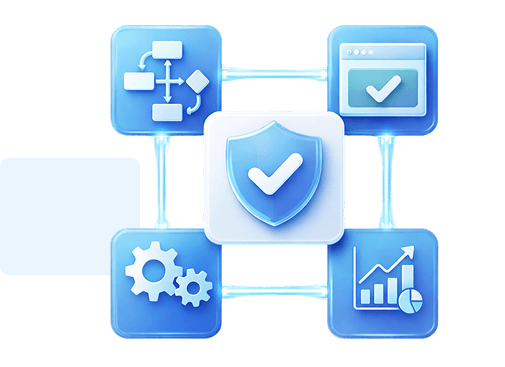
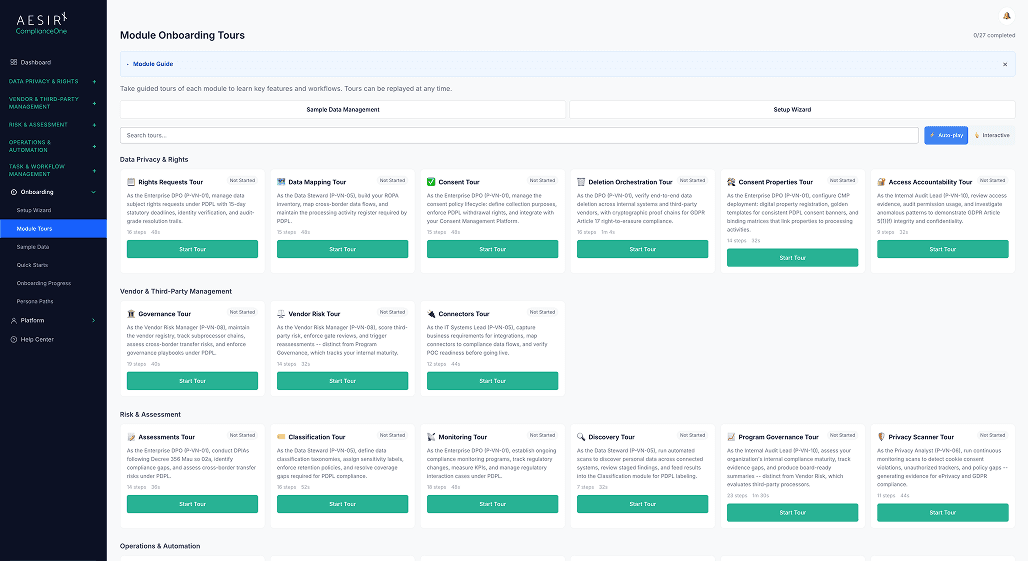
ComplianceOne uses Decision 33 as the primary high-risk screening list. Each in-scope AI system can be screened against the 46 categories and their applicability conditions, with the screening decision, rationale, and reviewer recorded.
When a system is classified high-risk, ComplianceOne triggers the Decree 142 high-risk workflows and reuses the existing AI Law / Decree 142 templates — AI system dossier, conformity readiness, transparency and labeling, monitoring, and serious-incident reporting — rather than duplicating them. Sector cross-links connect the system to banking, PDPL, Data Law, cybersecurity, or transport-infrastructure obligations where relevant.
Transition deadlines are tracked per system and sector, and human oversight is preserved: use of a listed system must not change, transfer, or exclude the authority and responsibility of competent agencies, organizations, or individuals. Human review remains required before formal evidence or submission.
 Data Classification
Records high-risk screening outcome, rationale, and reclassification history.
Explore Data Classification Program Governance
Coordinates transition deadlines, human oversight, and sector cross-links.
Explore Program Governance Incident Operations
Manages serious-incident readiness for matched high-risk systems.
Explore Incident OperationsSee how ComplianceOne screens AI systems against the high-risk list and triggers the Decree 142 workflows.

Ronni K. Gothard Christiansen - Technical Privacy Engineer & CEO
Technical Compliance Expert, 32+ Years Open Source Advocate, X-BoD Open Source Matters Inc.
Decision 33 is active. It was issued on 30 June 2026 and takes effect on 15 August 2026.
No. Decision 33 issues an official list of high-risk AI systems. It does not specify fines or penalties and is not a sanctions decree.
No. Decree 142 remains the implementing decree. Decision 33 identifies which systems are high-risk; a match triggers the Decree 142 high-risk workflows.
The appendix lists 46 high-risk AI system categories across six sectors: education, ethnic and religious affairs, health, banking, proceedings, and transport (transport has 31 categories).
Not by itself. High-risk status depends on matching a listed category and its applicability conditions, including significant-harm potential and not being excluded under the Decree 142 exclusion rule.

Test high-risk screening, Decree 142 workflow triggers, and transition-deadline tracking with your team.

Review which of your AI systems match the Decision 33 list and what evidence they require.


The evolution of Aesir is Aesir +  (the Norse symbol for Necessity)"Needed in order to achieve a particular result"
♥Join the AesirX Privacy Newsletter. Stay Informed. Stay Compliant.
 DPIA & Assessments
 Audit Trail