

DPO Radio

 CONSENT
Centralized consent policy management with withdrawal propagation, drift detection, and bidirectional CMP synchronization.

Consent is not a one-time checkbox. Under Vietnam's PDPL and the Vietnam Data Law, organizations must maintain verifiable consent records, honor withdrawals promptly, and demonstrate that their deployed consent banners match their documented policies. When consent state diverges across systems, the organization is exposed to regulatory findings it cannot defend.
Enterprise DPOs (P-VN-01) are responsible for ensuring that consent policies are current, approved, and consistently applied. Data Governance Leads (P-VN-05) manage the system-level integration between consent management platforms and internal processing records. Both roles participate in the Consent and Preference Governance workflow (UC-VN-13), which spans all system and channel owners across marketing, CRM, product, and legal teams.
Without a structured consent governance system, policies are version-controlled in documents that no one cross-references against live CMP configurations. Withdrawal requests are processed manually with no confirmation that downstream systems have stopped processing. Sensitive data consent, which requires enhanced review before activation, is handled through the same informal process as standard consent. When an auditor asks for proof that consent state across systems is consistent, the answer is a best-effort reconstruction.
Consent centralizes policy management with version control, links consent purposes to legal bases and processing activities, and maintains bidirectional synchronization with AesirX CMP Pro. Drift detection alerts when deployed banners diverge from approved policies, and a mismatch reconciliation workflow resolves discrepancies through a structured process rather than ad-hoc fixes.
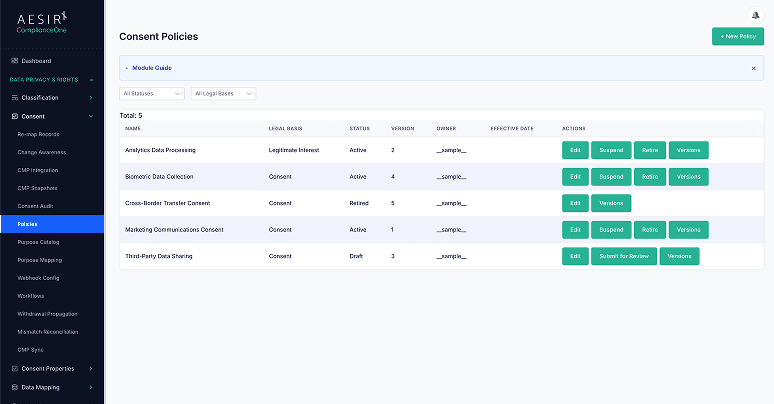
Version-controlled consent policy records with approval workflows. Each policy captures its scope, purposes, legal basis, and effective dates. Changes route through review and approval before taking effect.
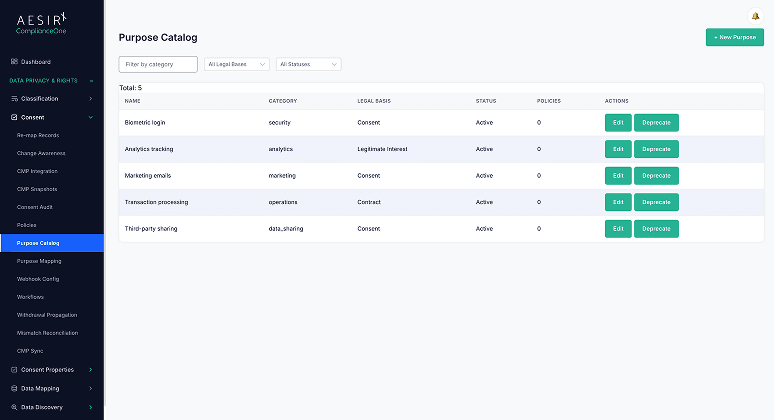
Link consent purposes to legal bases and processing activities. The catalog provides a single reference for what each consent purpose covers, why it exists, and which processing activities depend on it.
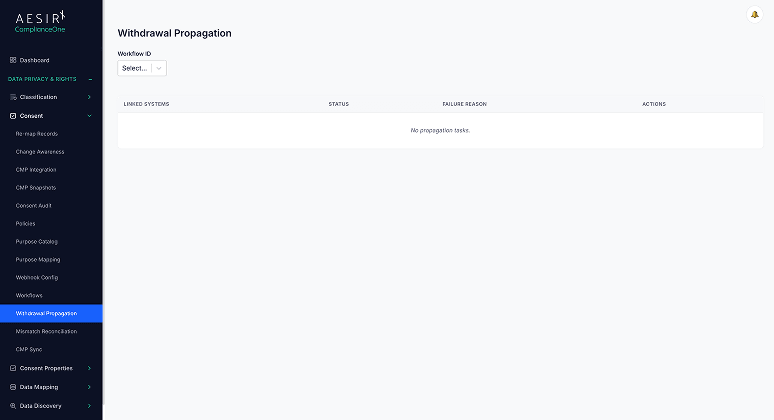
Track consent withdrawals as they flow downstream across connected systems. Each withdrawal is monitored until all receiving systems confirm they have stopped the relevant processing, creating a documented propagation chain.
Monitor deployed consent banners against approved policies. Drift detection alerts when CMP configuration diverges from the documented policy — whether through unauthorized changes, deployment errors, or version mismatches.
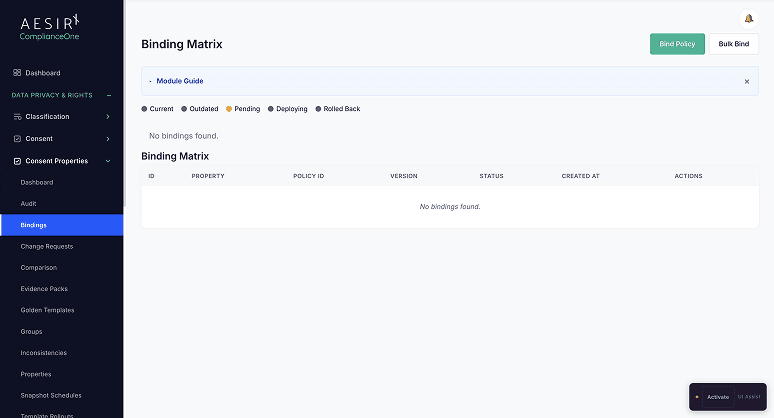
An enhanced review gate for high-risk processing categories requires additional approver sign-off before activation. This ensures that consent policies governing sensitive personal data receive the scrutiny their risk level demands.
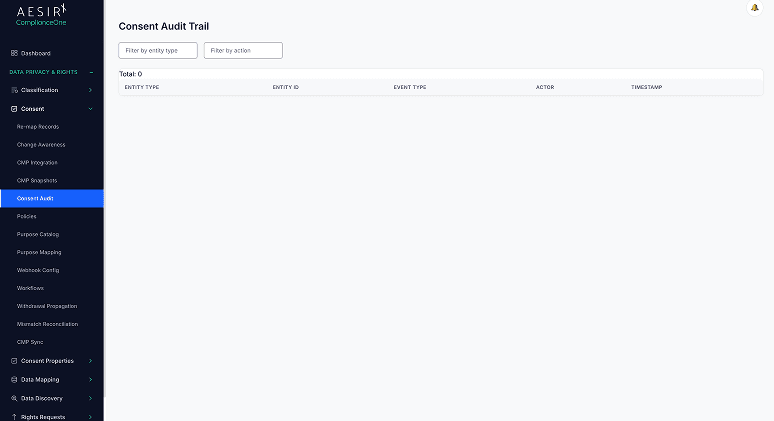
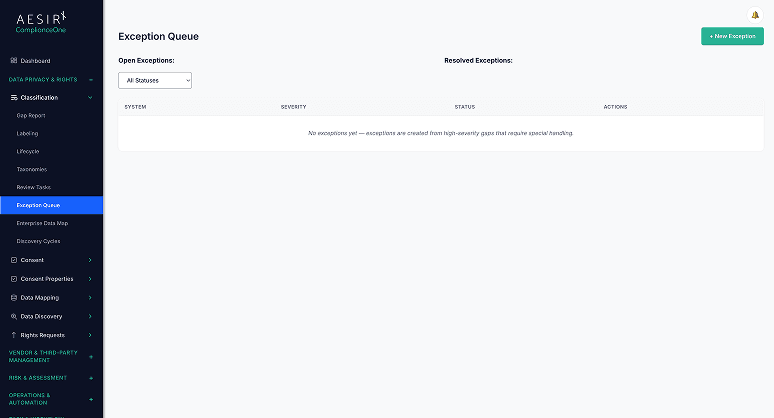
When discrepancies are identified between internal consent records and live CMP state, a structured reconciliation process routes each mismatch to the appropriate owner for resolution. This replaces ad-hoc fixes with documented, auditable corrections.
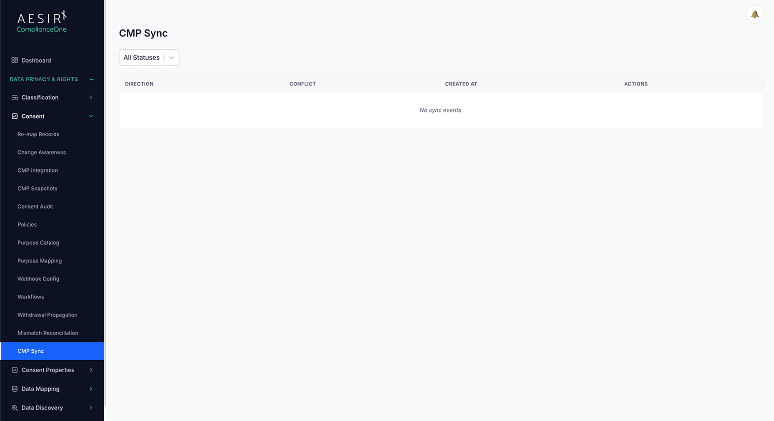
Two-way sync with AesirX CMP Pro keeps internal policy records and deployed CMP configurations aligned. Automatic conflict detection identifies when both sides have changed, and resolution routing ensures conflicts are handled by the right team.
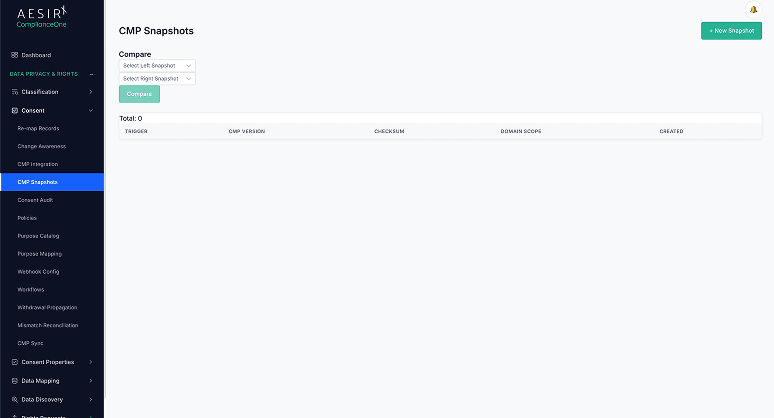
Point-in-time snapshots of consent configurations preserve the state of policies and CMP settings at any given moment. Snapshots support audit inquiries that ask "what was the consent configuration on date X?"


 Consent policies are version-controlled in documents that no one cross-references against live CMP settings.
 Version-controlled policies with approval workflows ensure changes are reviewed before taking effect.Withdrawal requests are processed manually with no confirmation that all downstream systems have stopped processing.Withdrawal propagation tracking confirms receipt across all connected systems with a documented chain.Sensitive data consent goes through the same informal process as standard consent, with no enhanced review.Sensitive data consent policies require additional approver sign-off before activation.Drift between approved policies and deployed banners goes undetected until an audit surfaces it.Drift detection alerts immediately when deployed CMP configuration diverges from approved policy.Reconciling consent state across systems requires manual investigation with no structured workflow.A structured mismatch reconciliation workflow routes discrepancies to owners for documented resolution.
Bidirectional CMP synchronization maintains alignment between internal policy records and deployed consent banners, with automatic conflict detection when both sides change independently.

Withdrawal propagation tracking follows each withdrawal downstream until every connected system confirms it has stopped the relevant processing, creating the evidence chain regulators require.

Point-in-time consent configuration snapshots answer the audit question "what was deployed on this date?" without reconstruction from logs or memory.
Maintains verifiable consent records with withdrawal propagation tracking and sensitive data consent gates required under the PDPL.Supports cross-system consent governance obligations with drift detection, mismatch reconciliation, and documented policy version history.Ready to see how Consent works with your compliance workflows? Request a personalized demo.

Ronni K. Gothard Christiansen - Technical Privacy Engineer & CEO
Technical Compliance Expert, 32+ Years Open Source Advocate, X-BoD Open Source Matters Inc.
Drift detection continuously compares the live CMP configuration against the approved policy records in the system. When a divergence is identified – whether from unauthorized changes, deployment errors, or version mismatches – an alert is raised for the responsible team to investigate.
The withdrawal is recorded and tracked as it propagates to all connected downstream systems. Each system must confirm receipt and cessation of the relevant processing. The propagation chain is documented in the audit trail as evidence of timely compliance.
Consent policies governing high-risk processing categories ( such as health data, biometric data, or financial records) route through an enhanced review gate requiring additional approver sign-off before the policy is activated. This gate is configurable based on the organization's classification.
The module provides bidirectional synchronization with AesirX CMP Pro. Two-way sync keeps internal policy records and deployed configurations aligned, with automatic conflict detection and resolution routing when both sides change independently.
The snapshot history feature captures point-in-time records of consent configurations. Auditors can review the exact policy state, CMP configuration, and purpose catalog as they existed on any given date without relying on log reconstruction.
Explore the module architecture, then speak with us about the workflows your organization needs to operationalize first.

Test Consent with your actual policies, CMP integration, and withdrawal workflows.

Walk through your consent architecture, CMP setup, and cross-system synchronization requirements.


The evolution of Aesir is Aesir +  (the Norse symbol for Necessity)"Needed in order to achieve a particular result"
♥Join the AesirX Privacy Newsletter. Stay Informed. Stay Compliant.


 Vietnam Personal Data Protection Law
 Vietnam Data Law