
DPO Radio
 VIETNAM AI LAW
Manage the active Vietnam AI Law framework, including classification, high-risk controls, transparency, incidents, conformity assessment, controlled testing, and governance evidence.

Vietnam’s AI Law, Law 134/2025/QH15, has been active since 1 March 2026. It establishes the parent governance framework for organizations developing, providing, deploying, or using AI systems in Vietnam.
Decree 142/2026/NĐ-CP is now the active implementing decree. Issued on 30 April 2026 and effective from 1 May 2026, it replaces the earlier assumption that detailed procedures and official forms were still pending. The decree adds operational detail for classification, high-risk controls, transparency, incidents, monitoring, and controlled testing.
The framework also includes supporting instruments that address specific operational areas. Decision 33 identifies official high-risk AI system categories, while Circular 05/2026/TT-BKHCN provides the National AI Ethics Framework, allowing governance, ethics, and technical evidence to remain connected without changing each instrument's legal role.
AI governance is a continuing evidence problem, not a one-time registration exercise. A system can change risk profile when its purpose, data, users, deployment context, or behavior changes. Compliance teams therefore need a current record of classification, review, controls, incidents, and decisions across the system lifecycle.
ComplianceOne connects those records in one governed process. Technical, legal, risk, and operational contributors can work on the same AI system record while human reviewers retain control over classification, assessment, and submission decisions.
Law 134/2025/QH15, active since 1 March 2026
Decree 142/2026/NĐ-CP (implementing decree, active since 1 May 2026) and Decision 33/2026/QĐ-TTg (official high-risk AI systems list, effective 15 August 2026), and Circular 05/2026/TT-BKHCN (National AI Ethics Framework, active since 10 March 2026).
Decision 33 lists 46 high-risk AI system categories across six sectors; a match triggers the Decree 142 high-risk workflows
AI system records, risk classification, reclassification, conformity assessment, transparency, labeling, monitoring, and incidents
Sandbox applications, monitoring, reporting, extensions, incident handling, and completion evidence
Eighteen Decree 142 forms covering serious incidents, state-agency impact assessment, and controlled testing workflows
Classification rationale, approvals, assessment records, control evidence, disclosures, incident records, and audit history
The law establishes the primary governance duties, including risk-based controls, transparency, incident management, and controlled testing.
Decree 142 operationalizes the law with detailed classification, high-risk, transparency, incident, monitoring, and sandbox processes. It also introduces eighteen official forms.
Decision 33 issues Vietnam's official national list of high-risk AI systems – 46 categories across six sectors (education, ethnic and religious affairs, health, banking, proceedings, transport). It is active, effective 15 August 2026, and is not a sanctions decree. High-risk status depends on a system matching a listed category and its applicability conditions; a match triggers the Decree 142 high-risk workflows. Transition deadlines apply to existing systems.
Circular 05 adds a subordinate responsible-AI and ethics guidance layer. It enriches governance evidence without replacing the law, Decree 142, or Decision 33 and is not a sanctions instrument.
ComplianceOne provides a governed record for each AI system, including purpose, ownership, deployment context, data dependencies, risk classification, review history, and linked controls. Classification and reclassification decisions retain their rationale and approval trail.
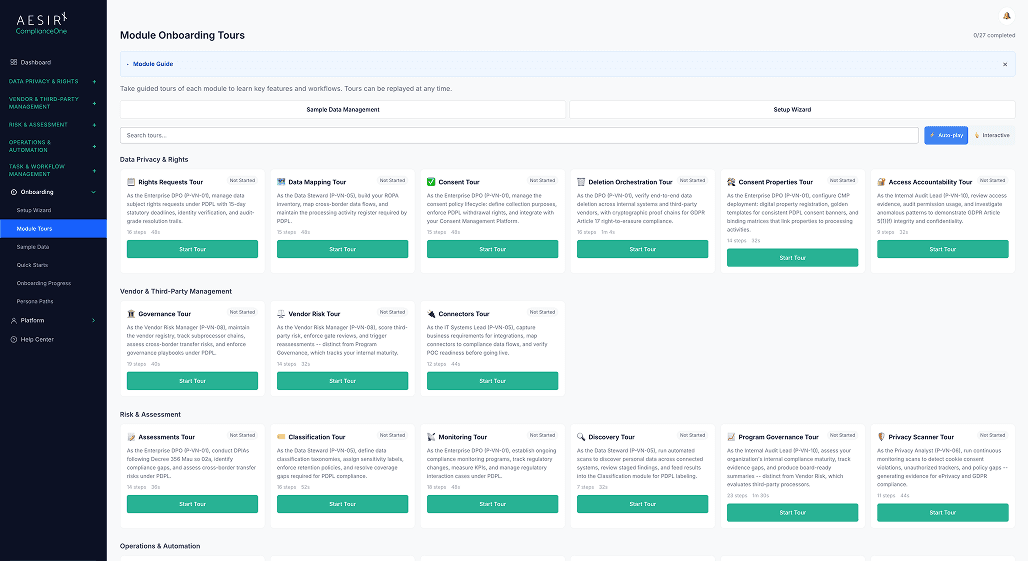
High-risk work can be coordinated through assessment and control workflows. Teams can assign contributors, collect conformity and risk-management evidence, record human-oversight measures, and track changes that require a new review.
Transparency and labeling evidence can be linked to the AI system record, while incident operations preserve investigation, notification, remediation, and closure history. Related personal data or cybersecurity events can be connected without losing their separate regulatory context.
For controlled testing, ComplianceOne supports application, monitoring, reporting, incident, extension, and completion records using the official Decree 142 forms where applicable. Human review remains required before evidence or submission material is approved.
 Data Classification
Records AI risk classification, rationale, changes, and review status.
Explore Data Classification Program Governance
Coordinates ownership, assessments, controls, and recurring reviews.
Explore Program Governance Audit Trail
Preserves classification, assessment, approval, and incident history.
Explore Audit Trail Compliance Forms
Supports Decree 142 forms and related controlled documentation.
Explore Compliance Forms Incident Operations
Manages AI incident investigation, evidence, remediation, and linked notifications.
Explore Incident Operations

 AI inventories lose context about ownership, use, data, and deployment changes.
 Each AI system has an owned, reviewable governance record.Risk classifications are recorded without their rationale or approval history.Classification and reclassification retain rationale, evidence, and approvals.High-risk controls and conformity evidence sit across disconnected teams.High-risk assessment and control work is assigned and tracked.Transparency and labeling decisions are difficult to trace to the system version.Transparency, labeling, monitoring, and incident evidence stays connected.Incident and sandbox records are assembled only after an authority request.Decree 142 forms and controlled-testing records are prepared through governed workflows.
ComplianceOne reflects the current legal stack: an active parent law and an active implementing decree, not a pending-decree placeholder.

The platform supports the eighteen official Decree 142 forms alongside the operational evidence that gives those forms context.

Human review gates preserve accountability for classification, assessment, evidence, and submission decisions.
See how ComplianceOne structures AI classification, high-risk controls, incidents, and controlled-testing evidence. Request a demo tailored to your organization's needs.

Ronni K. Gothard Christiansen - Technical Privacy Engineer & CEO
Technical Compliance Expert, 32+ Years Open Source Advocate, X-BoD Open Source Matters Inc.
Yes. The Vietnam AI Law became effective on 2026-03-01. Organizations that develop, deploy, or operate AI systems in Vietnam should already be working toward compliance. The implementing decree (which will specify official forms, filing channels, and detailed procedures) has not yet been issued, but the law's core obligations – registration, classification, transparency, and human oversight – are in effect.
No. Decree 142/2026/NĐ-CP is an active implementing decree under the Vietnam AI Law. It was issued on 30 April 2026 and took effect on 1 May 2026.
ComplianceOne's 18 internal template IDs align with the official form requirements specified by the implementing decree. Organizations using the platform receive the updated templates without needing to restart their governance documentation. Existing dossier content and classification records are preserved.
It provides operational detail for risk classification, reclassification, high-risk conformity and risk management, transparency and labeling, serious incidents, monitoring, and controlled testing. It also introduces eighteen official forms.
Circular 05 establishes Vietnam's National AI Ethics Framework. It provides responsible AI and ethics guidance that complements the AI Law, Decree 142, and Decision 33 while remaining a separate instrument with its own scope, evidence context, and review history.
The Data Classification module supports AI system classification by risk level. Organizations inventory their AI systems, assign risk classifications based on the system's purpose and data processing characteristics, document the classification rationale, and route the classification decision through an approval workflow. Each classification is captured in the audit trail with reviewer identity and approval status.
No. The platform can organize evidence and assist with drafting, but human reviewers remain responsible for approval and submission decisions.
Yes. ComplianceOne supports several Vietnam regulatory frameworks within a shared workflow engine. AI systems that process personal data are subject to both the AI Law and the PDPL. The platform manages both sets of obligations – AI classification and dossier management alongside data protection impact assessments and consent governance – with consistent audit trail coverage.
Yes. AI incident readiness is supported through the same incident operations infrastructure used for cybersecurity and personal data breaches. The incident workflow manages detection, assessment, escalation, authority notification, investigation, and remediation, with evidence chain of custody maintained throughout the incident lifecycle.
Yes. Related records can be linked so teams can coordinate response and evidence while retaining the separate requirements and history of each framework.

Test AI classification, high-risk evidence, and controlled-testing workflows with your team.

Review your AI system inventory, Decree 142 obligations, and evidence model.


The evolution of Aesir is Aesir +  (the Norse symbol for Necessity)"Needed in order to achieve a particular result"
♥Join the AesirX Privacy Newsletter. Stay Informed. Stay Compliant.