

DPO Radio

 LOCALIZATION
Configure market packs, map frameworks to modules, set submission channels and deadlines, and track lifecycle coverage across all deployed frameworks.


Regulatory compliance is jurisdiction-specific. A Vietnam-based organization operating under the PDPL, Cybersecurity Law, E-Commerce Law, and Data Law faces a different set of obligations, submission channels, and deadlines than an organization operating under GDPR. The GRC platform must adapt to each jurisdiction, translating not just language but also regulatory structure, filing requirements, and operational workflows.
Enterprise DPOs (P-VN-01) managing multi-framework compliance programs need to see which regulatory frameworks are deployed, which platform modules each framework applies to, which lifecycle stages are covered, and where gaps exist. Without this visibility, framework deployment is incomplete, organizations may configure assessment workflows but miss filing deadlines because submission channels were never set up, or deploy a framework without connecting it to the modules that actually implement its requirements.
When organizations manage framework deployment manually, the result is fragmented coverage: some frameworks are fully configured while others are partially deployed, submission channel details live in someone's notes rather than in the system, and regulatory updates are missed because there is no structured tracking process. This creates invisible compliance gaps that surface only during audits or regulatory inspections.
AesirX ComplianceOne Localization provides a structured framework deployment system: market packs pre-configured for specific jurisdictions, sector overlays that layer industry-specific obligations on top of base frameworks for tenants that need them, framework-to-module linkage showing exactly which modules and roles each framework applies to, submission channel and deadline configuration, a lifecycle coverage dashboard showing which stages are covered for each framework, and regulatory update tracking with impact assessment to ensure changes are routed to the right owners.
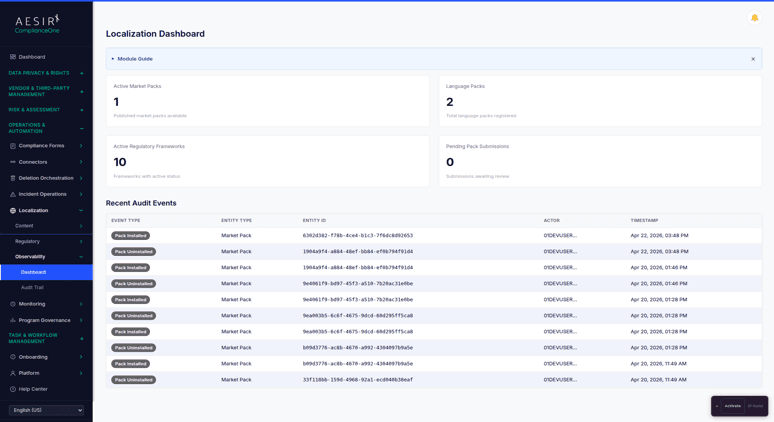
An overview of all deployed market packs showing which jurisdictions are active, how many frameworks are configured, and the overall coverage status. The dashboard provides the entry point for managing the organization's regulatory deployment footprint.
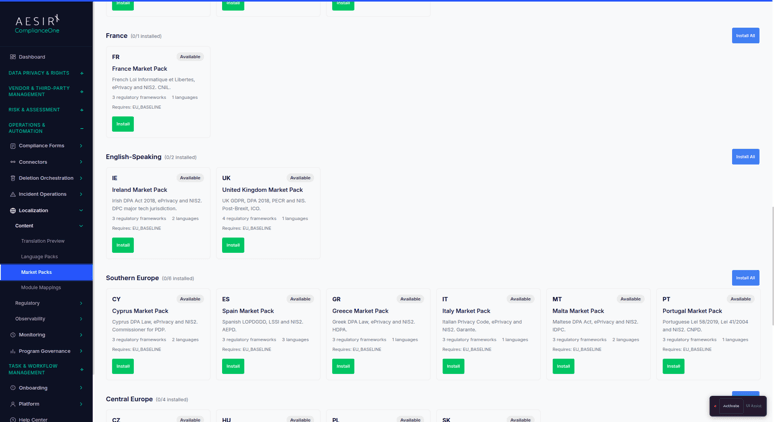
Pre-configured compliance packs for specific jurisdictions. Each market pack bundles the regulatory frameworks, translations, and configuration settings needed to operate in a particular market. Deploying a market pack sets up the jurisdiction's frameworks with their default configurations, reducing setup time from days to minutes
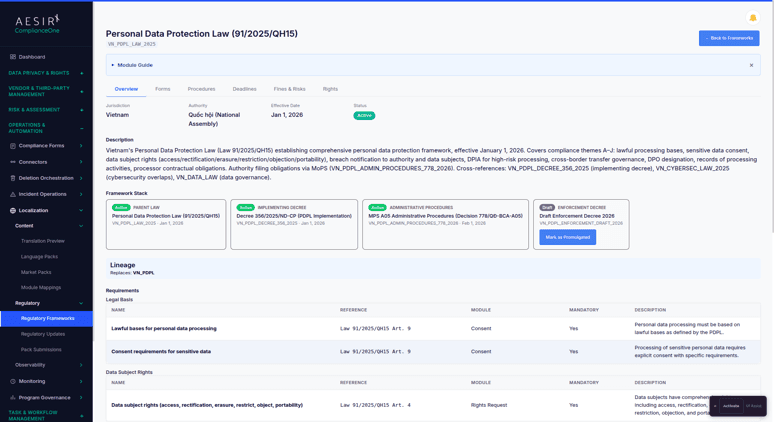
Each regulatory framework is presented alongside its supported structures and responsibilities. This view allows users to explore all parent and child frameworks in scope, with structured tabs that surface the formal regulatory details, including Forms, Deadlines, Rights, Fines, and related obligations. This provides a clear, organized reference of what each framework requires, while maintaining visibility over the roles responsible for managing those obligations.
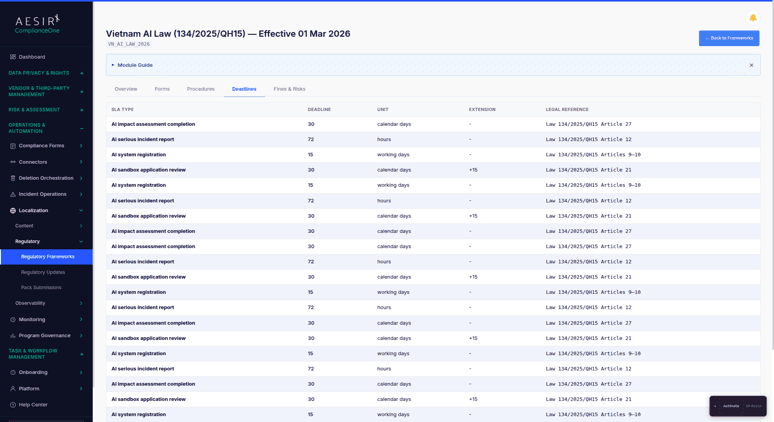
Submission channels (web portal, email, physical office) and statutory deadlines are presented as part of each framework’s structured information. These details are available within the framework tabs, providing clear visibility into how and where filings must be submitted, and within what timeframe.
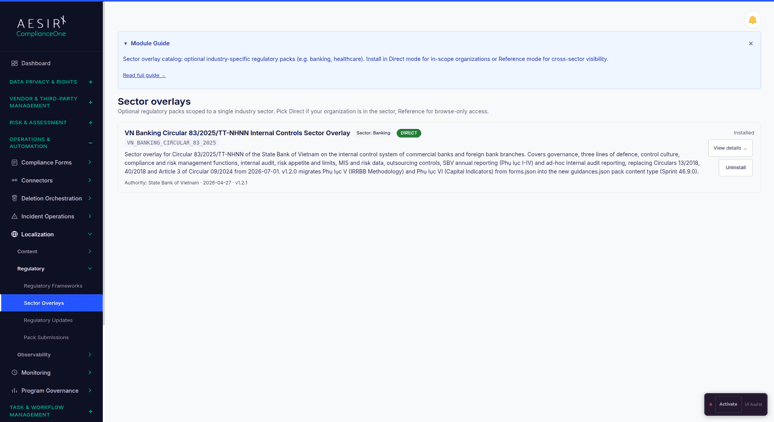
Optional regulatory packs scoped to a single industry sector, layered on top of base frameworks to show banking, healthcare, or telecom-specific controls, deadlines, and obligations only for tenants operating in that sector.


 Regulatory frameworks are deployed inconsistently with no standard configuration process.
 Market packs provide pre-configured framework bundles for rapid jurisdiction deployment.Submission channel details are stored in personal notes rather than in the system.Framework-to-module and persona linkage maps every framework to its implementing modules and responsible roles.There is no single view showing which lifecycle stages are covered for each framework.Submission channels and statutory deadlines are configured per framework and used by filing workflows.Regulatory updates are discovered ad hoc with no structured impact assessment.Lifecycle coverage dashboard shows covered stages per framework at a glance.Framework-to-module relationships are implicit, making it unclear which modules serve which obligations.Regulatory update tracking routes changes to affected module owners for impact assessment.Sector-specific obligations are invisible inside base frameworks.Sector overlays layer industry-specific controls on top of base frameworks, scoped per tenant, with VN Banking Circular 83 available now and additional sectors in development.
Six Vietnamese regulatory frameworks (PDPL, E-Commerce Law, Telecom Law, Data Law, Cybersecurity Law, and AI Law) are available as pre-configured market packs with framework-to-module linkage and submission channel defaults. The VN Banking Circular 83 sector overlay is the first implemented sector overlay in the platform, adding banking-specific internal-control obligations for tenants operating in the banking sector, layered on top of the frameworks already installed via the Vietnam market pack.

Framework lifecycle coverage dashboard provides per-framework visibility into which compliance stages (assessment, filing, review, renewal) are configured and which remain as gaps, enabling targeted remediation.

Regulatory update tracking with impact assessment ensures that when laws change, affected modules and responsible owners are identified and routed for review rather than discovered during the next audit.
Pre-configured market pack with framework-to-module linkage, MPS submission channel configuration, and lifecycle coverage tracking.Market pack with cybersecurity framework mappings, authority submission channels, and deadline configuration.Market pack with e-commerce registration framework, TMDT portal submission channel, and amendment lifecycle tracking.Market pack with AI governance framework linkage and dossier submission channel configuration.Market pack with data governance framework mappings, 11 official form templates from Decree ND 165 mapped to platform filing workflows, and annual attestation lifecycle tracking.Market pack with telecommunications framework mappings, Ministry of Information and Communications submission channel configuration, and deadline tracking for disclosure and cooperation obligations.Sector overlay for banking tenants, layering internal-control obligations on top of the base PDPL framework with Direct and Reference install modes.Ready to see how Localization works with your compliance workflows? Request a personalized demo.

Ronni K. Gothard Christiansen - Technical Privacy Engineer & CEO
Technical Compliance Expert, 32+ Years Open Source Advocate, X-BoD Open Source Matters Inc.
A market pack bundles the regulatory frameworks, language translations, submission channel defaults, and configuration settings for a specific jurisdiction. Deploying a Vietnam market pack, for example, sets up all seven Vietnamese regulatory frameworks with their default module linkages and submission channels.
Yes. Market packs provide default configurations that can be customized. Organizations can adjust which modules are linked to which frameworks, modify submission channels, and configure deadlines to match their specific operational setup.
When a regulatory framework is updated, the system captures the change and triggers an impact assessment workflow. The workflow identifies which platform modules and which personas are affected by the change, and routes review tasks to the responsible owners. This ensures regulatory changes are assessed and acted upon rather than discovered during audits.
The localization architecture supports any jurisdiction. While Vietnamese frameworks are the most fully developed market packs, the same framework-to-module linkage, submission channel configuration, and lifecycle coverage tracking applies to any jurisdiction's frameworks as they are added to the platform.
The dashboard shows, for each deployed framework, which lifecycle stages (assessment, filing, review, renewal) have active module coverage and which do not. This makes it immediately visible if a framework has assessment workflows configured but no filing workflow, or if a renewal process has not been set up, enabling targeted remediation before gaps become audit findings.
Market packs bundle all the regulatory frameworks and language packs for a specific jurisdiction. Installing a market pack automatically installs all associated regulatory packs and language packs for that market; everything an organisation needs to operate in that jurisdiction. Sector overlays are separate and independent: they are optional add-ons scoped to a specific industry, layering industry-specific controls, deadlines, and obligations on top of the base frameworks already installed via the market pack. A market pack has no relationship to sector overlays, they are installed independently based on the tenant's industry requirements.
Explore the module architecture, then speak with us about the workflows your organization needs to operationalize first.

Deploy a market pack and see framework-to-module linkage, submission channels, and lifecycle coverage in action.

Walk through your multi-jurisdiction requirements and see how localization fits your regulatory deployment strategy.


The evolution of Aesir is Aesir +  (the Norse symbol for Necessity)"Needed in order to achieve a particular result"
♥Join the AesirX Privacy Newsletter. Stay Informed. Stay Compliant.


 Vietnam Personal Data Protection Law (PDPL) – 91/2025/QH15
 Vietnam Law on Cybersecurity – 116/2025/QH15. Effective 2026-07-01
 Vietnam E-Commerce Law – 122/2025/QH15E
 Vietnam AI Law – 2026 Implementing decree pending
 Vietnam Data Law – 60/2024/QH15
 Vietnam Telecom Law – 24/2023/QH15