
DPO Radio
COOKIE COMPLIANCE FULL-DAY TEAM WORKSHOP
A full-day practical workshop for organizations that need a deeper operational review of website tracking, CMP configuration, consent flows, tag blocking, evidence, ownership, remediation priorities, and ongoing governance.
Most organizations do not fail cookie compliance because they lack a banner. They fail because the organization cannot clearly connect:
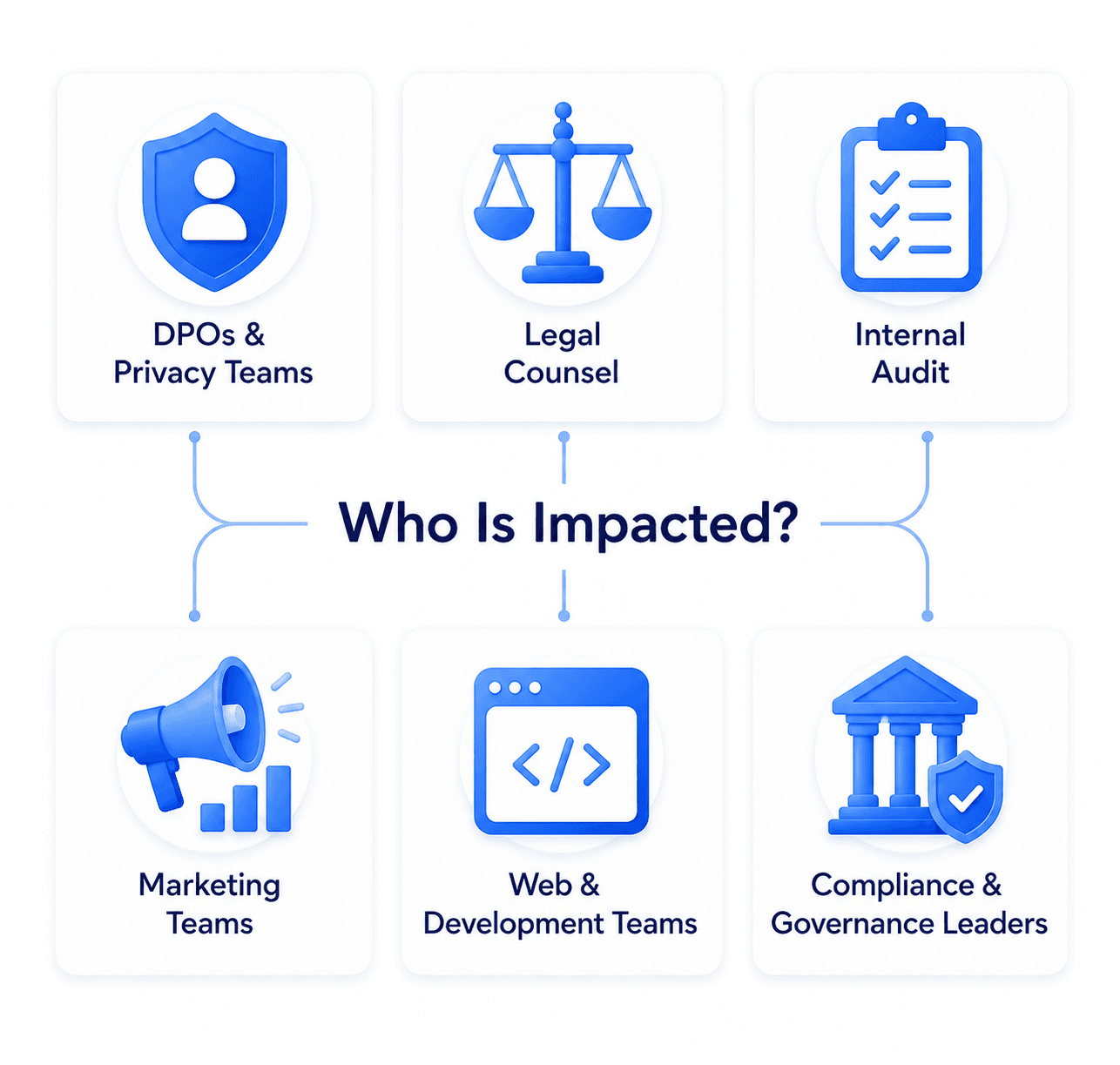
That is why cookie compliance is rarely solved by one person. It requires alignment between privacy, legal, marketing, web, technical, audit, and governance stakeholders.
A full-day workshop gives the organization time to inspect the problem properly, discuss the real trade-offs, clarify ownership, and define a practical remediation path.
The goal is to move from:
“We have a cookie banner.”
to: “We understand how website tracking is governed, controlled, evidenced, and improved.”
This version is the right option when your organization has:

The workshop follows five operational maturity markers.
1
Discover what the website is actually doing
We review cookies, pixels, trackers, scripts, tags, embedded tools, analytics services, advertising technologies, and third-party services loaded through the selected website. This includes reviewing behavior across different consent states where relevant:
The goal is to establish a practical understanding of the tracking environment.
2
Categorize tracking tech by purpose, risk, vendor, & region
We work through how the main technologies should be classified and where ambiguity may exist. This includes discussion of:
The goal is to create a shared classification logic that privacy, legal, marketing, and technical teams can understand.
3
Build defensible reasoning behind tracking decisions
Classification is not enough. The organization needs to explain why each category decision is reasonable. We review where justification may be strong, weak, unclear, or missing. This includes looking at whether:
The goal is to help the team move away from assumptions and toward defensible rationale.
4
Connect decisions to CMP settings, consent flows, & tag blocking
This is where many cookie compliance programs fail. A classification decision only matters if the implementation follows it. We review how classification connects to:
The goal is to help the technical implementation match the compliance decision.
5
Turn cookie compliance into audit-ready evidence
The full-day workshop places stronger emphasis on evidence and ownership. We define what should be documented, who should own it, and how it should be maintained. This includes evidence around:
The goal is to connect website tracking compliance to a broader
The full-day workshop is designed for larger teams or more complex website environments where a short review is not enough.
| Team | Why it Matters |
|---|---|
| DPOs & Privacy Teams | Gain a clearer technical understanding of tracking, consent, CMP behavior, evidence gaps, and governance responsibilities. |
| Legal Teams | Connect legal requirements to actual website behavior, vendor exposure, consent UX, documentation, and defensible decision-making. |
| Internal Audit | Understand control points, evidence needs, review cadence, ownership, escalation paths, and audit-readiness requirements. |
| Marketing Teams | Review analytics, campaign tracking, pixels, retargeting, conversion tools, forms, and third-party services in a practical compliance context. |
| Web & Technical Teams | Align scripts, tags, CMP categories, consent events, tag manager behavior, blocking logic, and implementation requirements. |
| Management Teams | Understand risk exposure, operational priorities, and the path toward more mature GRC implementation. |
| Compliance & Governance Leaders | Establish a practical governance model for ongoing website tracking compliance. |
After the full-day workshop, your team should have a clearer view of:

Practical summary of the key cookies, pixels, trackers, scripts, & tags reviewed during the session.
Working review of how the main technologies should be categorized.
Practical observations on consent banner flow, categories, reject/accept balance, & blocking behavior.
Identification of likely risk areas that need further review or remediation.
Clear next-step recommendations for legal, privacy, marketing, & technical teams.
Guidance on what should be documented for audit readiness.
Guidance on which teams should own classification, implementation, monitoring, documentation, & review cadence.
Clear next steps for CMP remediation, Privacy Scanner setup, ComplianceOne onboarding, or broader GRC implementation.
Depending on scope. Not a formal audit unless agreed as an additional deliverable.
Website tracking compliance is no longer only a European concern. Organizations operating across multiple markets need to understand how website tracking, consent, transparency, targeted advertising, vendor exposure, cross-border data flows, and evidence requirements affect their digital compliance. This session can be adapted for teams operating across:

The legal details differ by jurisdiction. The operational challenge is consistent:
Can the organization explain what the website does, why it does it, how users are given meaningful control, and what evidence supports the decision?
That’s the question this workshop helps your teams answer.
US$4,500–6,500
Final pricing depends on scope, no. of stakeholders, no. of websites or page types, regional complexity, preparation needs, and optional follow-up documentation.
Includes:
Optional add-ons can include:
US$995
Best for teams that need fast, practical clarity on their current tracking setup.
US$2,500–3,500
For teams that need deeper review and cross-functional alignment around a real issue.
US$4,500–6,500
For larger organisations that need governance decisions, ownership clarity, and a remediation roadmap.
Setting the Scene
Reviewing Website Tracking
Classification Workshop
Justification Review
Consent Review
Technical Implementation
Building Defensible Evidence
Remediation Roadmap
Our work connects operational compliance.
AesirX builds privacy-first compliance technology for organizations that need more than policies and static documentation.
The full-day workshop is designed for organizations that want to move from fragmented cookie compliance decisions to a more mature operational model.
It’s a practical entry point into broader operational compliance, including AesirX CMP, AesirX Privacy Scanner, AesirX Analytics, and AesirX ComplianceOne.
The 2-hour introductory session is designed for fast clarity. It helps your team understand the current state, identify likely issues, and define practical next steps.
The half-day workshop goes deeper into one website or defined website environment, with more time for stakeholder alignment, CMP review, classification discussion, and remediation priorities.
The full-day workshop is designed for more complex organizations. It gives your team time to review the tracking environment in more depth, align multiple stakeholders, discuss regional considerations, clarify ownership, review technical implementation, and define a more structured remediation roadmap.
Not by default. The full-day workshop is a practical training, review, and alignment session. It is designed to help your organization understand its website tracking environment, identify risk areas, review classification and CMP behavior, align stakeholders, and define remediation priorities.
A formal written cookie audit, detailed tracker inventory, legal memo, technical remediation plan, or evidence report can be added as a follow-up deliverable. This keeps the workshop practical and action-oriented while giving organizations the option to move into a full audit or implementation phase afterward.
Yes, but the scope should be agreed before the workshop. The full-day format is better suited than the half-day version for multi-region websites, multiple language versions, multiple business units, or several representative page types.
However, if the organization has many websites, brands, domains, markets, or complex user flows, we may recommend focusing the workshop on representative examples first and then planning a broader review or ComplianceOne implementation as a follow-up. The goal is to make the session practical, not superficial.
The best results come from cross-functional participation.
Recommended attendees include:
Cookie compliance becomes much easier when the people responsible for policy, implementation, tools, evidence, and business outcomes are aligned in the same room.
Before the workshop, it is helpful to share:
Access to internal systems is not required for the standard workshop, but having the right stakeholders present makes the session more effective. For deeper technical remediation, access can be handled separately as a follow-up implementation service.

Book a Cookie Compliance Full-Day Team Workshop.

The evolution of Aesir is Aesir +  (the Norse symbol for Necessity)"Needed in order to achieve a particular result"
♥Join the AesirX Privacy Newsletter. Stay Informed. Stay Compliant.