DPO Radio
AESIRX COMPLIANCEONE
Make named team responsibilities clear before work is delegated
Maintain practice rosters and scoped planning roles while preserving separate private Matter access.
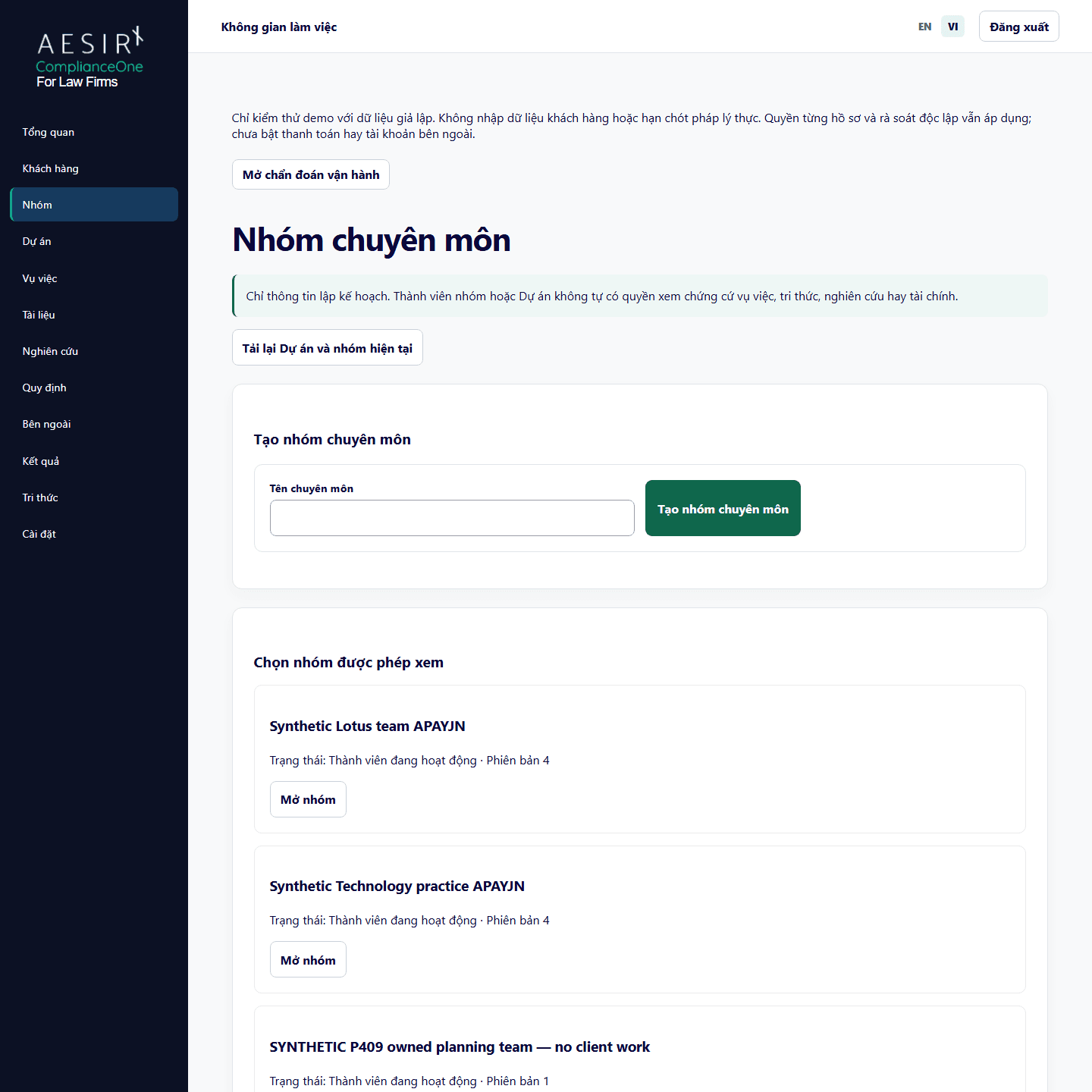

A practice team brings together people who contribute in different capacities. Its roster needs to show the named members and their scoped roles rather than relying on informal assumptions.
Practice coordinators also need to distinguish planning participation from permission to inspect confidential legal evidence. A team directory cannot make that access decision on its own.
Practice teams provide named rosters and management controls for authorized staff. They support engagement delegation while private Matters, sources and financial records retain their own access requirements.

Open an accessible team and inspect its current record. A genuinely empty list explains whether staff can create a team or need a manager to review their access.
Authorized managers can record or revoke scoped team membership. Select the intended person and role using the available named choices and pages.
Use named teams and leads in the engagement planning workflow. Review the proposed audience when linking work rather than assuming every team member should receive every private Matter.
Team archival and planning holds are deliberate controls. Check the current record after a conflict or uncertain request before deciding whether another change is needed.


 Team rosters depend on informal messages.
 Open an accessible practice team by name.Planning roles are assumed from job titles.Maintain expressly authorized scoped memberships.Delegation lacks a named current lead.Use named leads for engagement delegation.Team participation is confused with evidence access.Review private Matter grants independently.Empty lists offer no next step.Follow permission-aware creation or access guidance.

A coordinator can inspect the recorded roster and scoped roles.

An engagement can refer to a named team and lead.

Team membership remains distinct from private evidence and financial authority.
Review the workflow with representative synthetic records and the roles your firm intends to use.

Ronni K. Gothard Christiansen - Technical Privacy Engineer & CEO
Technical Compliance Expert, 32+ Years Open Source Advocate, X-BoD Open Source Matters Inc.
Team membership describes its scoped planning participation. Private Matter evidence, library, research and financial access require their own current authorization and explicit record decisions.
Currently authorized managers can use the available creation and roster controls. Staff without that authority receive guidance to ask a team manager to review access.
Scoped team records allow participation to be recorded for each named team. Staff should inspect the current roster rather than infer one universal role from a person’s job title.
Projects can use named team delegations and leads. The proposed engagement audience and any separate Matter grants must be reviewed through their authorized workflows.
Reload the current team record and inspect its members and management state before retrying. An uncertain response is not proof that the requested change did not occur.

Discuss the deployment, audience and source-rights requirements for an agreed evaluation.

See how named team roles and engagement delegation could work within your firm's access rules.


The evolution of Aesir is Aesir +  (the Norse symbol for Necessity)"Needed in order to achieve a particular result"
♥Join the AesirX Privacy Newsletter. Stay Informed. Stay Compliant.