
DPO Radio

 PROGRAM GOVERNANCE
Obligation mapping, governance document registers, cross-framework maturity assessment, and structured gap-to-remediation pipelines in one module.

Multi-regulation enterprises operating in Vietnam face a layered compliance landscape. The PDPL, Cybersecurity Law, Data Law, E-Commerce Law, Telecom Law, and AI Law each impose distinct obligations, and each organization must demonstrate not only that it is aware of these obligations but that it has assigned ownership, measured its maturity, identified gaps, and is actively remediating them.
Enterprise DPOs (P-VN-01) need a consolidated view of program health across all applicable frameworks, while Internal Audit and Regulatory Inspection Leads (P-VN-10) need structured evidence of current-state assessments, criteria sets, and gap findings to present during inspections. When program governance lives in disconnected documents – a maturity spreadsheet here, a policy register there, a gap tracker somewhere else – no one has a reliable picture of where the organization stands.
Without structured governance, obligations go unassigned. Governance documents exist but lack version control, acknowledgment tracking, or clear ownership. Maturity assessments are conducted per-framework in isolation, making cross-framework comparison impossible. Identified gaps are noted in meeting minutes but never tracked to completion. The result is a compliance program that appears active on the surface but cannot demonstrate systematic improvement or readiness for inspection.
Program Governance solves this with obligation mapping under RACI governance, a document register with lifecycle management and stakeholder acknowledgment tracking, configurable maturity models with cross-framework comparison, and a gap-to-remediation pipeline that converts findings into tracked tasks moving through planned, in progress, completed, and verified stages. The module supports the Current-State Assessment workflow (UC-VN-16) and the Governance Model and Operating Document Issuance workflow (UC-VN-17), serving DPOs, internal auditors, department data owners, and executive stakeholders.
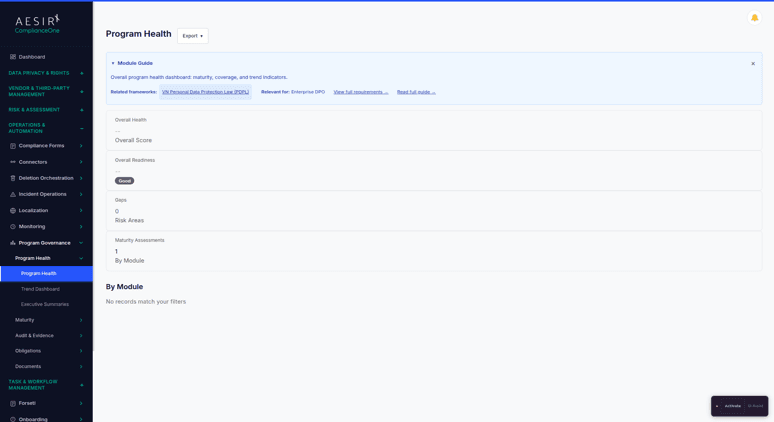
An overview of overall program status showing maturity scores, gap counts, remediation progress, and audit readiness across all frameworks. The dashboard provides leadership with a single view of compliance program health.
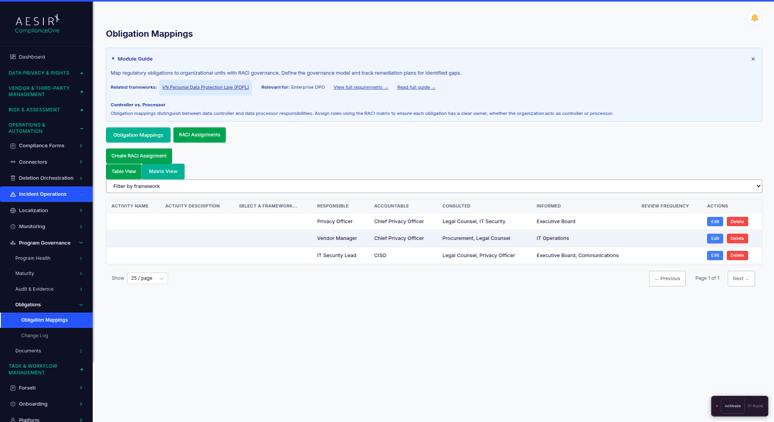
Map regulatory obligations to organizational units and assign Responsible, Accountable, Consulted, and Informed roles for each obligation. This ensures every regulatory requirement has a clear owner and that accountability is documented for audit purposes.
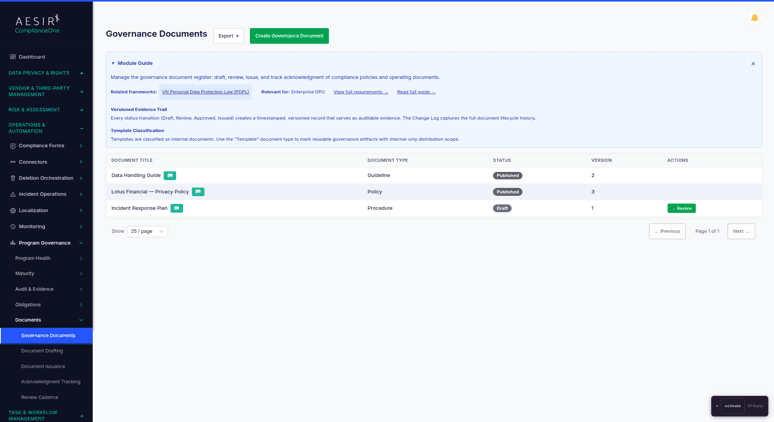
Maintain a register of all governance documents – policies, procedures, frameworks, and standards – with lifecycle management and stakeholder acknowledgment tracking. Each document records its version, approval status, effective date, and which stakeholders have acknowledged it.
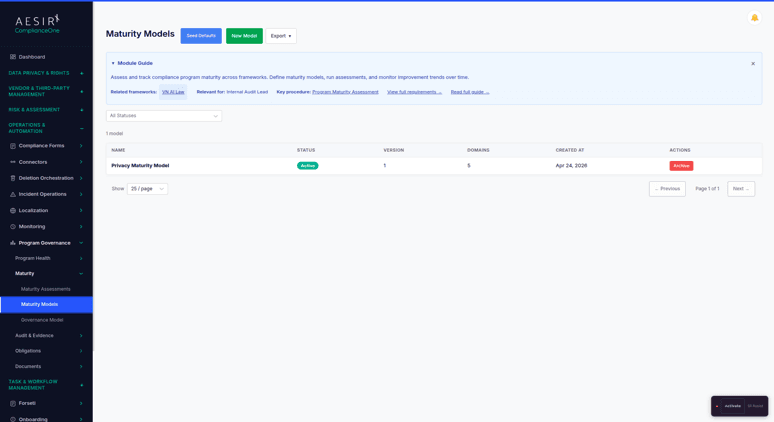
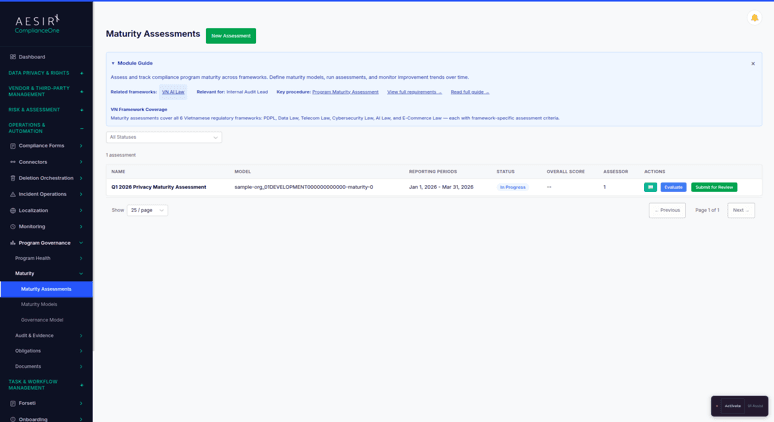
Configurable maturity assessment frameworks that define how organizational maturity is evaluated. Assessments score the organization against defined criteria and track improvements over time through trend analysis.
Compare maturity scores across multiple frameworks simultaneously in a single consolidated view. For organizations subject to multiple regulations, this eliminates the need to run separate assessments and manually cross-reference results.
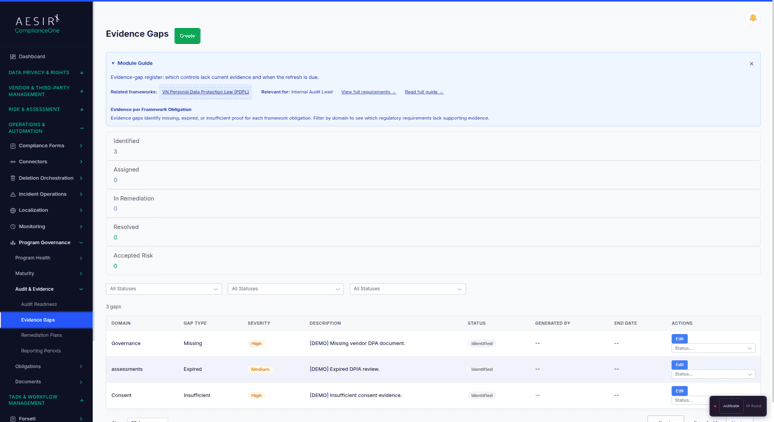
Identify missing documentation and evidence across all applicable frameworks. The gap analysis view shows exactly what is required, what exists, and what is missing, organized by framework and obligation.
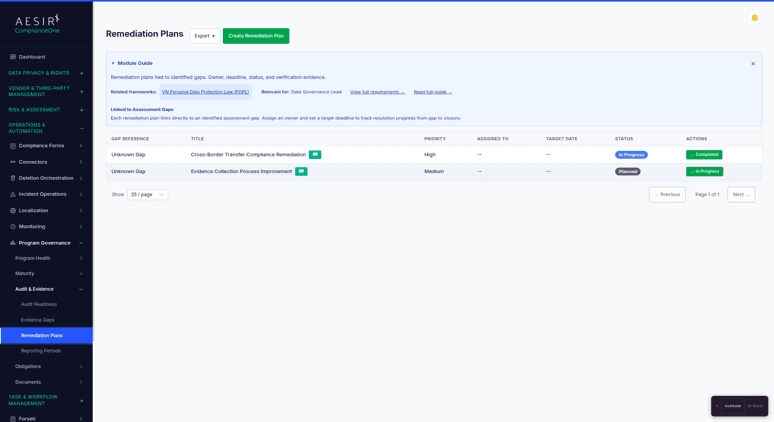
Convert identified gaps into tracked remediation tasks that move through a structured lifecycle: planned, in progress, completed, and verified. Each remediation task links back to the gap finding that triggered it, maintaining traceability from identification to resolution.
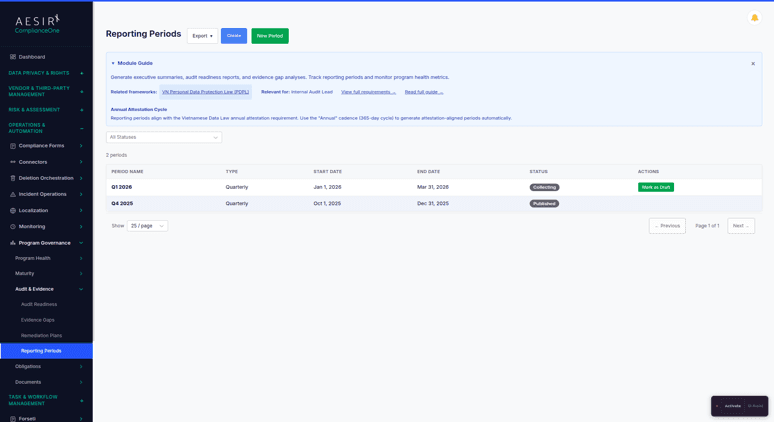
Generate board-ready summary reports organized by reporting periods. Define reporting cycles for regular board updates and produce summaries that capture program status, maturity trends, and remediation progress in a format suitable for executive stakeholders.
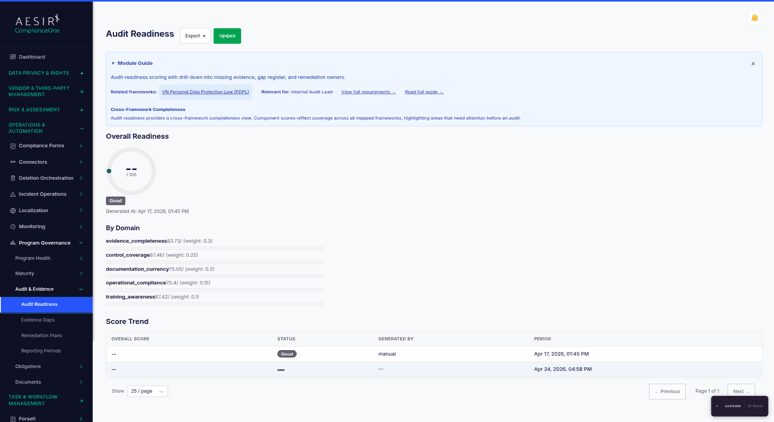
Assess regulatory audit preparedness by evaluating the completeness of evidence, the status of remediation plans, and the currency of governance documents. Readiness scoring shows the organization's inspection preparedness before an audit begins.


 Regulatory obligations are documented but not assigned to specific owners with defined accountability.
 Obligation mapping with RACI governance assigns every requirement to specific roles with documented accountability.Governance documents lack version control and acknowledgment tracking across stakeholders.The document register tracks version, approval, effective date, and stakeholder acknowledgment for every governance document.Maturity assessments are conducted per-framework in isolation with no cross-regulation comparison.Cross-framework maturity assessment compares scores across all applicable regulations in a single view.Identified gaps are recorded in meeting notes but not tracked through a structured remediation lifecycle.Gap-to-remediation planning converts findings into tracked tasks with a four-stage lifecycle from planned to verified.Audit readiness is assessed ad hoc rather than measured continuously against defined criteria.Audit readiness scoring provides a continuous measure of inspection preparedness across all frameworks.
Obligation mapping with RACI governance ensures every regulatory requirement across all seven Vietnamese frameworks has a designated owner, accountable party, and documented assignment, eliminating the ambiguity that leads to compliance gaps during inspections.

Cross-framework maturity assessment compares organizational readiness across the PDPL, Cybersecurity Law, Data Law, E-Commerce Law, Telecom Law, and AI Law in a single consolidated view, giving leadership the multi-regulation perspective needed for informed resource allocation.

The gap-to-remediation pipeline maintains traceability from identified gap to verified resolution, with each remediation task linked to its source finding so auditors can follow the complete chain of evidence.
Maps PDPL obligations to organizational roles with RACI governance and tracks maturity and gap remediation for data protection requirements.Supports current-state assessment and governance model design aligned with Decree 356 implementation requirements.Provides obligation mapping and maturity assessment for Data Law governance requirements including annual attestation support.Enables cybersecurity governance maturity assessment, obligation tracking, and gap remediation planning.Supports governance model and policy issuance for e-commerce compliance obligations.Maps telecom regulatory obligations to organizational units with documented accountability.Provides current-state assessment and gap analysis for AI governance obligations.Ready to see how Program Governance works with your compliance workflows? Request a personalized demo.

Ronni K. Gothard Christiansen - Technical Privacy Engineer & CEO
Technical Compliance Expert, 32+ Years Open Source Advocate, X-BoD Open Source Matters Inc.
Each regulatory obligation is mapped to organizational units and assigned four roles: Responsible (who does the work), Accountable (who owns the outcome), Consulted (who provides input), and Informed (who is kept updated). This assignment is documented and linked to the obligation, creating an auditable record of ownership.
Yes. Cross-framework maturity assessment displays scores from all applicable regulations in a single consolidated view. This enables direct comparison, for example, seeing that the organization scores higher on PDPL readiness than Cybersecurity Law readiness, and supports informed resource allocation decisions.
When a gap is identified during assessment, it is converted into a remediation task that moves through four stages: planned, in progress, completed, and verified. Each task links back to the original gap finding, so auditors can trace the complete path from identification to resolution.
The register maintains every governance document (policies, procedures, frameworks, standards) with its current version, approval status, effective date, review schedule, and stakeholder acknowledgment records. This provides evidence that governance documents are not just published but actively managed and acknowledged.
Audit readiness scoring evaluates evidence completeness, remediation plan status, and governance document currency across all frameworks. The score shows where the organization is well-prepared and where gaps remain, enabling targeted preparation before an inspection rather than reactive scrambling during one.
Explore the module architecture, then speak with us about the workflows your organization needs to operationalize first.

Test Program Governance with your regulatory obligations – maturity assessment, gap analysis, and remediation tracking included.

Walk through your governance program requirements and see how the module supports your multi-framework compliance.


The evolution of Aesir is Aesir +  (the Norse symbol for Necessity)"Needed in order to achieve a particular result"
♥Join the AesirX Privacy Newsletter. Stay Informed. Stay Compliant.


 Vietnam Personal Data Protection Law
 Vietnam Data Law
 Vietnam Cybersecurity Law 2025
 Vietnam E-Commerce Law 2025
  Vietnam Telecom Law 2023
 Vietnam AI Law 2026