

DPO Radio

 DATA MAPPING
Map systems, data flows, and processing activities into submission-ready RoPA records with cross-border transfer risk assessments.

Regulators expect organizations to know what personal data they hold, where it flows, why it is processed, and how long it is retained. Under Vietnam's PDPL and the Vietnam Data Law, this is not aspirational, it is a documented obligation. Organizations that cannot produce a current, accurate data inventory face inspection findings and remediation orders.
Enterprise DPOs (P-VN-01) are responsible for maintaining Records of Processing Activities and ensuring cross-border transfers have proper safeguards documented. Data Governance Leads (P-VN-05) manage the underlying systems inventory, data categories, and ownership assignments that feed into those records. Both roles need the same source of truth, but in practice they often work from disconnected spreadsheets that go stale within weeks.
Without a structured data mapping system, attestation cycles rely on email reminders that departments ignore. RACI assignments are informal and undocumented. Cross-border transfer records lack reviewer approval. When a regulator asks for a current RoPA or a transfer risk assessment, the DPO spends days assembling information from scattered sources, and the result is still incomplete.
Data Mapping provides a unified inventory of systems, data categories, processing purposes, retention policies, and data flows. Attestation cycles assign departments to periodic reviews with stale entry detection and deadline tracking, supporting the Data Discovery and Classification workflow (UC-VN-10) and the Annual Governance Attestation workflow (UC-VN-04). RACI ownership is assigned at every level – systems, flows, activities, categories, purposes, and retention policies – so accountability is explicit and auditable.
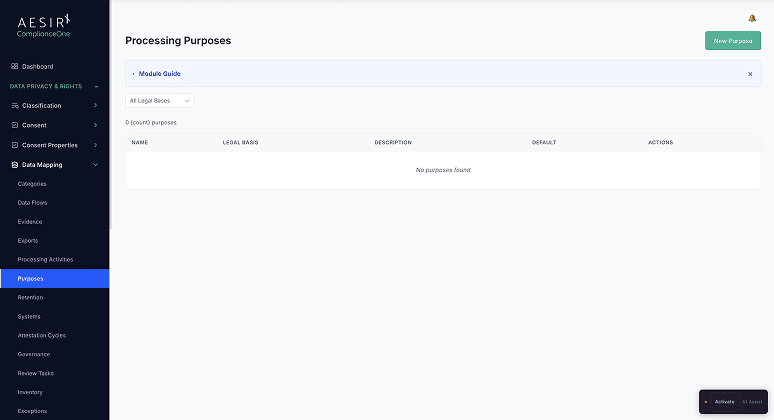
Catalog all internal and external systems processing personal data. Each system record captures its purpose, data categories handled, hosting location, and responsible owner — forming the foundation of the entire data map.
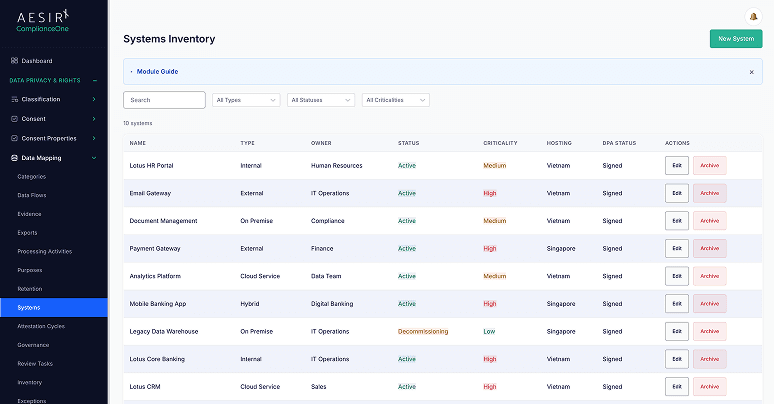
Define sensitivity levels and data types across your organization — contact information, health data, financial records, biometric data, and more. Categories link to processing activities and retention policies for traceability.
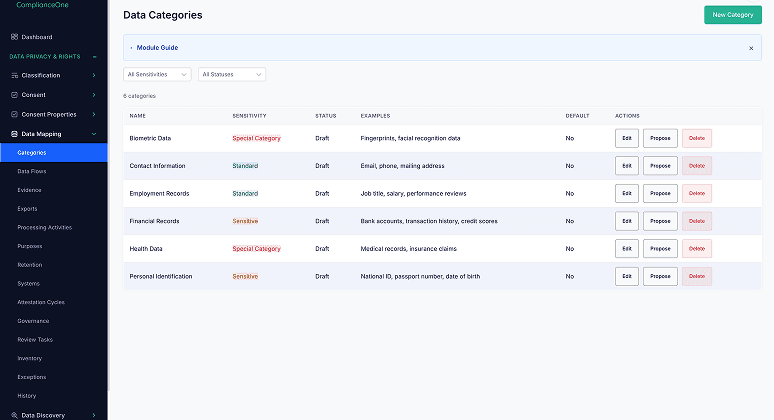
Document the legal basis and purpose for each processing activity. Link purposes to specific data categories and systems so every processing operation has a documented justification.
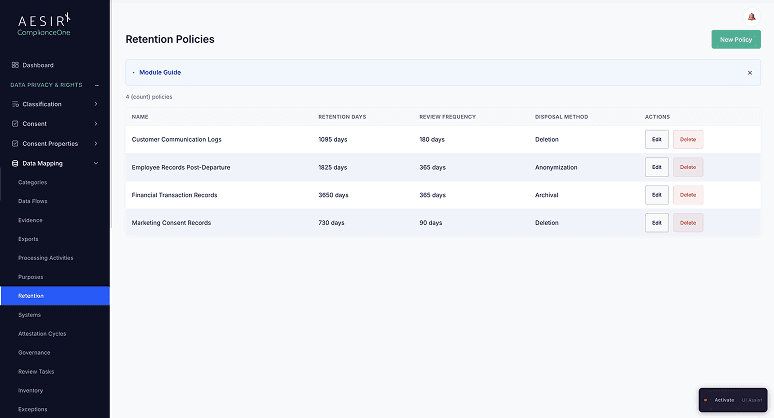
Set and track data retention periods by category. Alerts surface when data exceeds its defined retention period, enabling timely review and action.
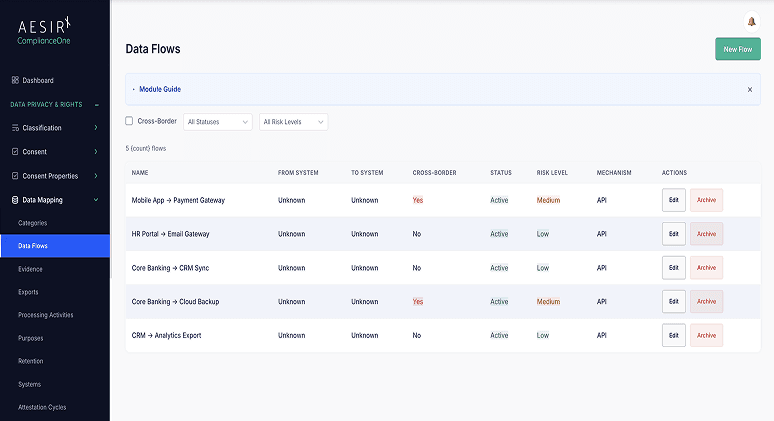
Visualize how data moves between systems, including cross-border indicators that flag international transfers. Flow records connect source systems to destination systems with transfer mechanism details.
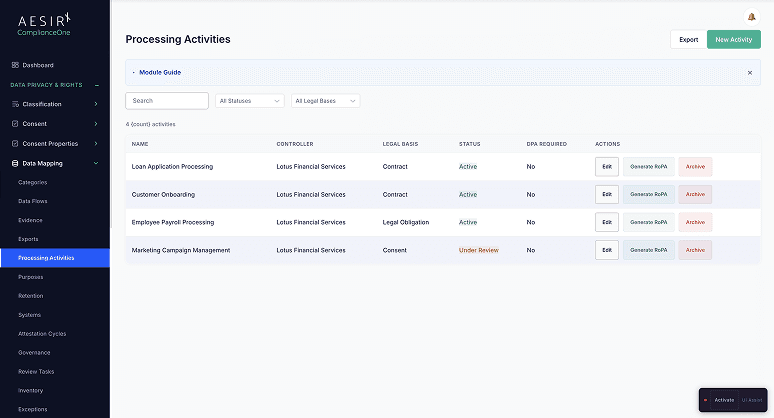
Structured records compliant with GDPR Article 30 and PDPL requirements. RoPA records aggregate system, category, purpose, retention, and flow data into exportable reports in CSV and PDF formats.
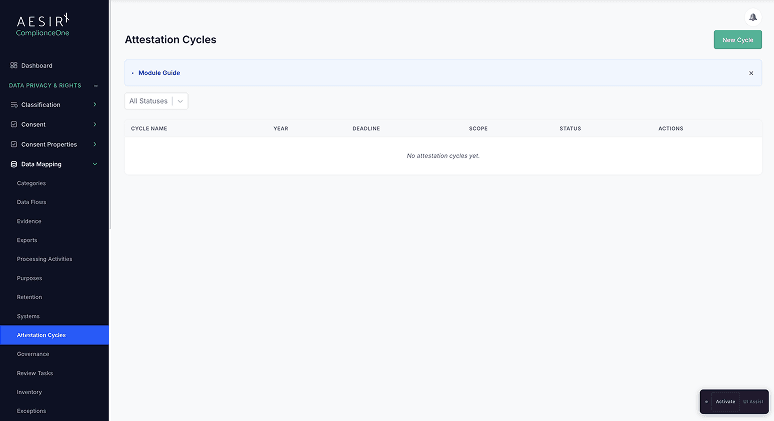
Assign departments to periodic attestation cycles with defined deadlines. Stale entry detection identifies records that have not been reviewed within the required period. Completed cycles can be packaged into submission-ready regulatory export bundles.
Assign Responsible, Accountable, Consulted, and Informed roles across systems, flows, activities, categories, purposes, and retention policies. Every element in the data map has explicit, documented ownership.
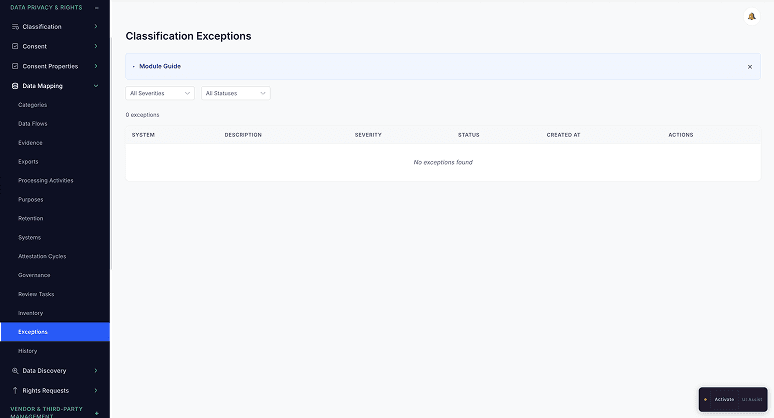
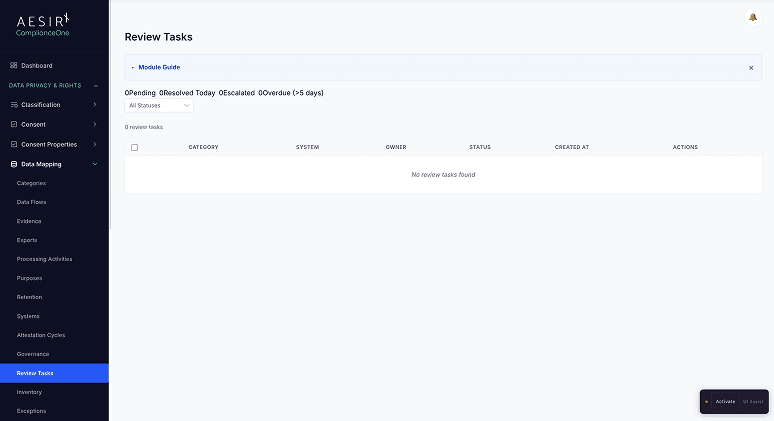
Document safeguard type, adequacy status, and route transfer records through reviewer approval before finalization. Transfer assessments connect to the data flow map so every international transfer has a corresponding risk evaluation.

 Data inventories live in spreadsheets that go stale within weeks of creation.
 A unified inventory of systems, categories, purposes, retention, and flows stays current through attestation cycles.RACI ownership is informal – no one can prove who is accountable for which data.RACI roles are assigned at every level with documented accountability visible to auditors.Cross-border transfers lack documented safeguard assessments and reviewer approval.Transfer risk assessments route through reviewer approval with safeguard type and adequacy documented.Attestation cycles depend on email reminders that departments routinely ignore.Stale entry detection flags records overdue for attestation, with deadline tracking per department.Producing a current RoPA for a regulator requires days of manual assembly from scattered sources.RoPA exports in CSV and PDF formats are generated directly from the current data map.
RACI ownership assignment covers six levels of the data map – systems, flows, activities, categories, purposes, and retention policies – ensuring no element exists without documented accountability.

Attestation cycles include stale entry detection that identifies records not reviewed within their required period, preventing the silent drift that makes data inventories unreliable over time.

Cross-border transfer risk assessments require reviewer approval before finalization, creating a documented decision record that connects each international transfer to its safeguard evaluation.
Maintains the data inventory and RoPA records required by the PDPL, with cross-border transfer risk assessments for international data flows.Supports annual governance attestation obligations with periodic attestation cycles, RACI ownership documentation, and submission-ready export bundles.Ready to see how Data Mapping works with your compliance workflows? Request a personalized demo.

Ronni K. Gothard Christiansen - Technical Privacy Engineer & CEO
Technical Compliance Expert, 32+ Years Open Source Advocate, X-BoD Open Source Matters Inc.
Attestation cycles assign departments to periodic reviews with defined deadlines. Stale entry detection automatically identifies records that have not been reviewed within their required period, surfacing them for attention before they become audit findings.
Yes. RACI ownership is assigned at six levels:- systems, data flows, processing activities, data categories, purposes, and retention policies. Each element can have distinct Responsible, Accountable, Consulted, and Informed roles.
The data flow map includes cross-border indicators for international transfers. Each transfer has a corresponding risk assessment record that documents safeguard type, adequacy status, and routes through reviewer approval before finalization.
The module generates RoPA exports in both CSV and PDF formats. Completed attestation cycles can also be packaged into consolidated regulatory export bundles ready for submission.
Confirmed discoveries from the Data Discovery module flow into the systems inventory. Classification labels from the Data Classification module link to data categories. This creates end-to-end lineage from discovery through classification to the data map.
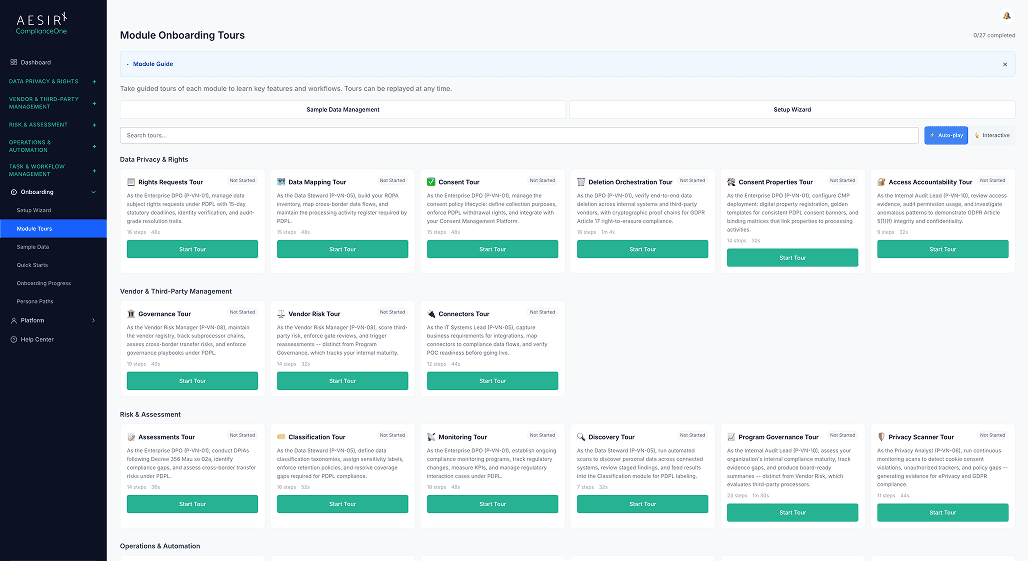
Explore the module architecture, then speak with us about the workflows your organization needs to operationalize first.

Map your data landscape with real systems, flows, and attestation cycles in a guided pilot.

Walk through your data inventory requirements, cross-border transfers, and attestation obligations.


The evolution of Aesir is Aesir +  (the Norse symbol for Necessity)"Needed in order to achieve a particular result"
♥Join the AesirX Privacy Newsletter. Stay Informed. Stay Compliant.


 Vietnam Personal Data Protection Law
  Vietnam Data Law