

DPO Radio

 PARTNER WORKSPACE
Onboard partners, define service levels, track project deliverables, customize branding, and handle support escalations from a single workspace.

Organizations that distribute their compliance platform through partners and resellers need a structured way to manage those relationships. Each partner organization has its own service tier, deliverable commitments, branding requirements, and support needs. Without a dedicated workspace, partner management fragments across spreadsheets, email threads, and generic project management tools – making it difficult to track which partner is at which service level, which deliverables are outstanding, and which support tickets need escalation.
Enterprise DPOs and platform administrators (P-VN-01) who manage partner programs need visibility into the entire partner portfolio: how many partners are active, what service tier each partner operates at, whether deliverables are on track, and where support cases are stalled. When this information is scattered, partner relationships deteriorate because commitments are missed, escalations are delayed, and branding inconsistencies create a disjointed customer experience.
AesirX ComplianceOne Partner Workspace provides a unified environment for partner and reseller management – organization onboarding, service tier configuration (Basic, Professional, Enterprise), deliverable templates and tracking, white-label brand profiles, support ticketing, workflow templates, escalation playbooks, and partner performance reporting.
An overview of all partner organizations showing active partners, service tiers, deliverable status, and support ticket volume. The dashboard provides the entry point for managing the partner portfolio and identifying which relationships need attention.
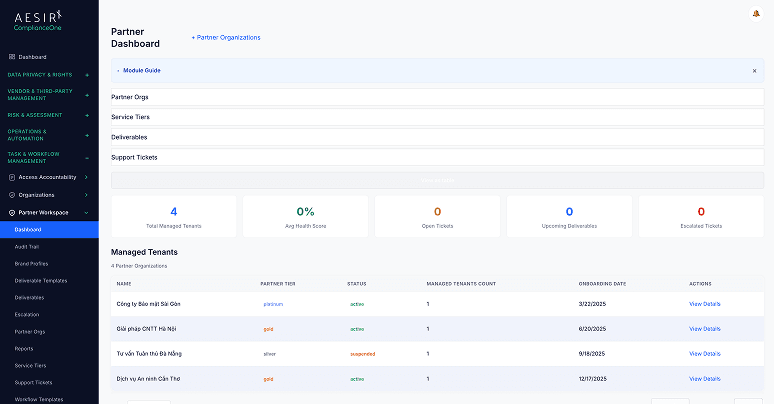
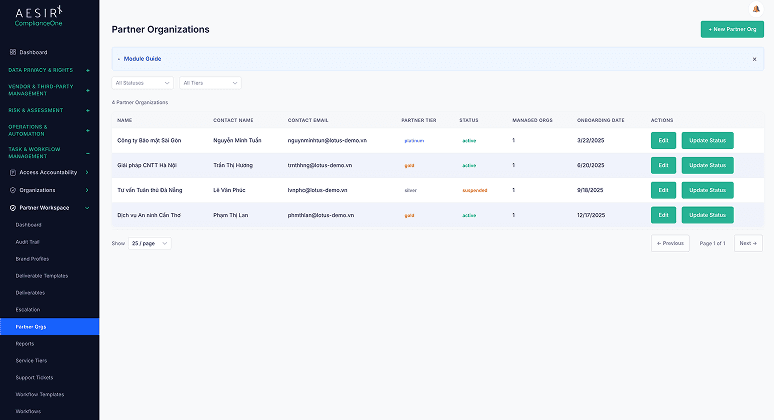
Onboard and manage partner tenants within the platform. Each partner organization is a distinct entity with its own configuration, users, and data – maintaining separation between partner operations while providing centralized visibility for the platform operator.
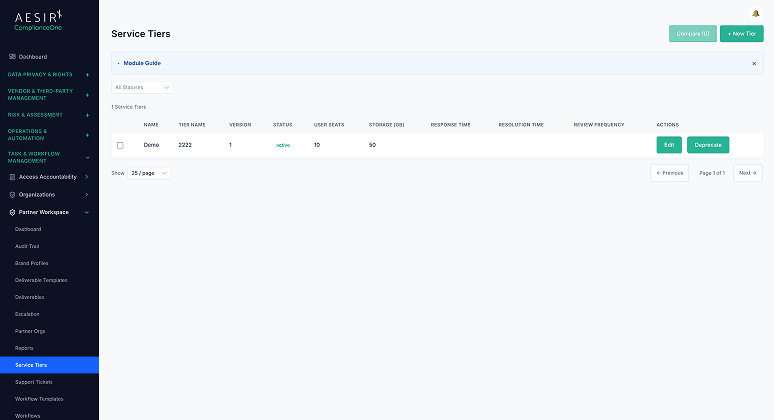
Define service levels – Basic, Professional, Enterprise – that determine what each partner receives in terms of module access, support priority, and deliverable scope. Service tiers create a clear, structured framework for partner entitlements.
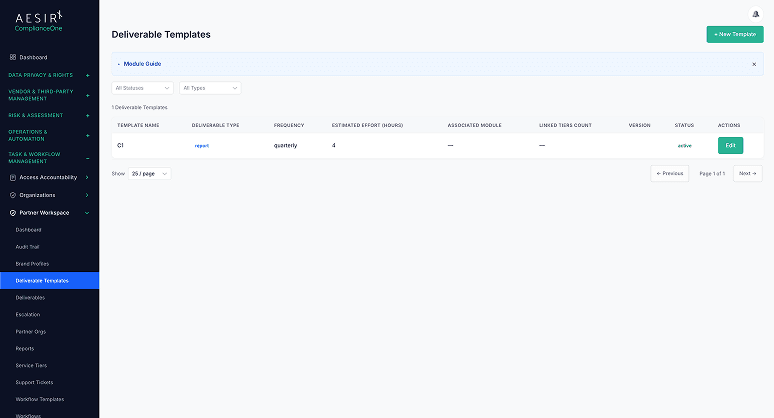
Standard deliverable definitions establish what partners should deliver in each engagement type. Active deliverables are tracked against these templates, showing progress, deadlines, and completion status for each partner project.


 Partner information is scattered across spreadsheets, email, and generic project tools.
 All partner organizations are managed in a single workspace with centralized visibility.Service tiers are informal agreements with no system-level enforcement or tracking.Service tiers are defined at the system level with structured entitlements per tier.Deliverable status is unknown until someone manually compiles updates from each partner.Deliverable tracking shows progress, deadlines, and completion status for every partner project.Support escalations are ad hoc with no defined playbooks or tracking.Escalation playbooks define procedures and support ticketing tracks every case to resolution.Partner branding is managed through one-off customization requests.White-label brand profiles provide per-partner branding customization.
Three-tier service model (Basic, Professional, Enterprise) provides a structured framework for partner entitlements that scales from small resellers to large implementation partners.

Deliverable templates combined with active tracking ensure that partner commitments are defined upfront and monitored through completion, preventing the silent drift that characterizes untracked partner relationships.

Support ticketing with escalation playbooks provides a documented support process that maintains consistent service quality across the entire partner portfolio.
Ready to see how Partner Workspace works with your partner program? Request a personalized demo.

Ronni K. Gothard Christiansen - Technical Privacy Engineer & CEO
Technical Compliance Expert, 32+ Years Open Source Advocate, X-BoD Open Source Matters Inc.
Each partner organization is a distinct tenant within the platform with its own configuration, users, and data. Partners cannot access each other's information. The platform operator has centralized visibility across all partners while maintaining strict data separation.
The three default service tiers (Basic, Professional, Enterprise) can be configured with custom entitlements, support priority levels, and deliverable scopes. Organizations can adjust tier definitions to match their specific partner program structure.
Deliverable templates define the standard work products for each engagement type. When a partner project is created, the relevant template generates a set of tracked deliverables with deadlines and completion criteria. Progress is visible to both the partner and the platform operator.
Escalation playbooks define the procedures for handling support cases that exceed normal resolution timelines or severity thresholds. Each playbook specifies escalation triggers, responsible parties, and expected response times, ensuring consistent handling of critical partner support issues.
Yes. White-label brand profiles allow per-partner branding customization, including logos and visual identity elements. This enables partners to present a branded experience to their end customers while operating on the shared platform.
Explore the module architecture, then speak with us about the workflows your organization needs to operationalize first.

Onboard a partner organization and test service tier configuration, deliverable tracking, and support workflows.

Walk through your partner program requirements and see how Partner Workspace fits your channel strategy.


The evolution of Aesir is Aesir +  (the Norse symbol for Necessity)"Needed in order to achieve a particular result"
♥Join the AesirX Privacy Newsletter. Stay Informed. Stay Compliant.