

DPO Radio

 CLASSIFICATION
Sensitivity labeling with proposed/approved workflows, exception queues, and an enterprise data map for executive reporting.

Regulators expect organizations to know the sensitivity of the data they hold. Under Vietnam's PDPL and the Vietnam Data Law, certain categories of personal data – health, biometric, financial, children's data – carry additional processing restrictions and protection obligations. An organization that cannot demonstrate consistent, approved classification of its data assets is exposed to findings in any regulatory inspection.
Data Governance Leads (P-VN-05) are responsible for establishing classification schemes, reviewing proposed labels, and maintaining an enterprise-wide view of how data is classified across departments. This role drives the Automated Data Discovery, Classification, and Labeling Review workflow (UC-VN-10), which depends on classification labels being accurate, approved, and linked to the underlying data inventory.
Without a structured classification system, sensitivity labels are applied informally or not at all. Different departments use different terminology for the same sensitivity level. When a new dataset is discovered, no one is routed to review and approve its classification. Exceptions and conflicts – where a dataset could reasonably carry more than one label – go unresolved. Leadership has no consolidated view of how data is classified across the business, making risk-based decisions difficult.
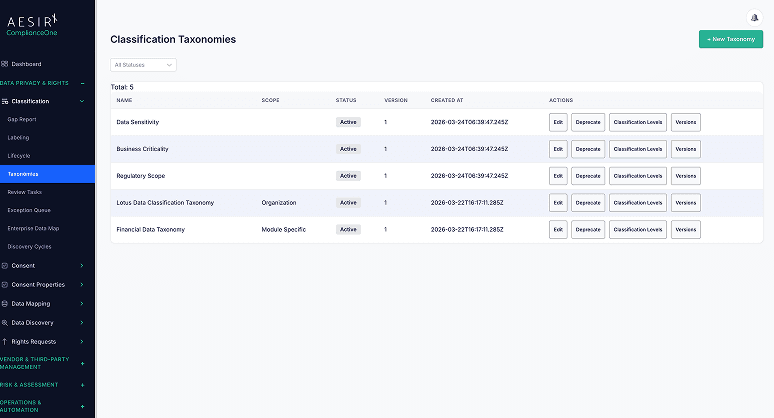
Classification provides custom taxonomy building, a label approval workflow with proposed/approved lifecycle, owner review routing based on organizational hierarchy, an exception queue for conflicts, and an enterprise data map with department-level drill-down for executive reporting.
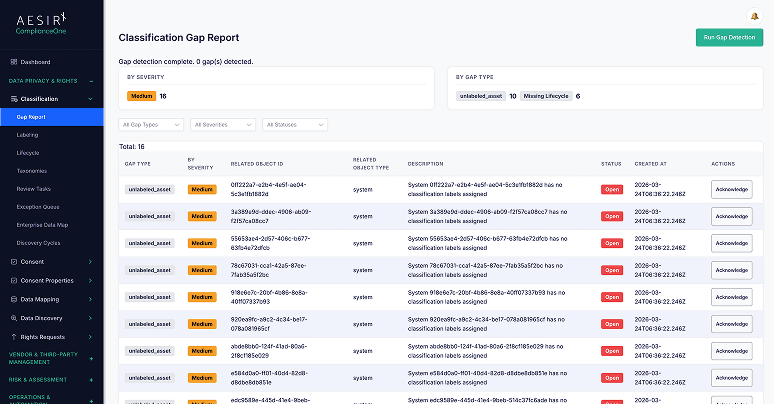
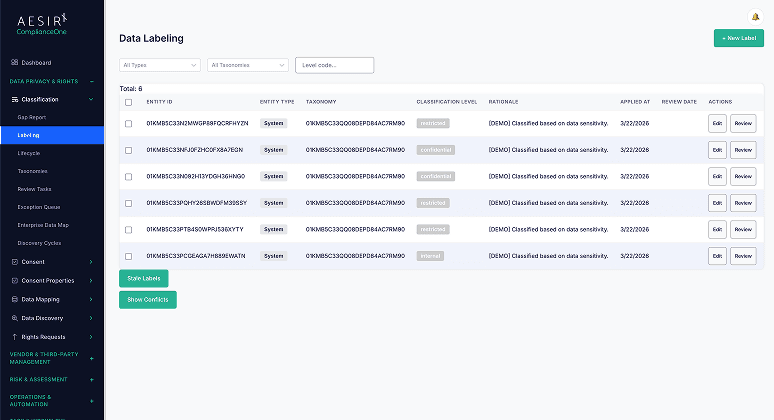
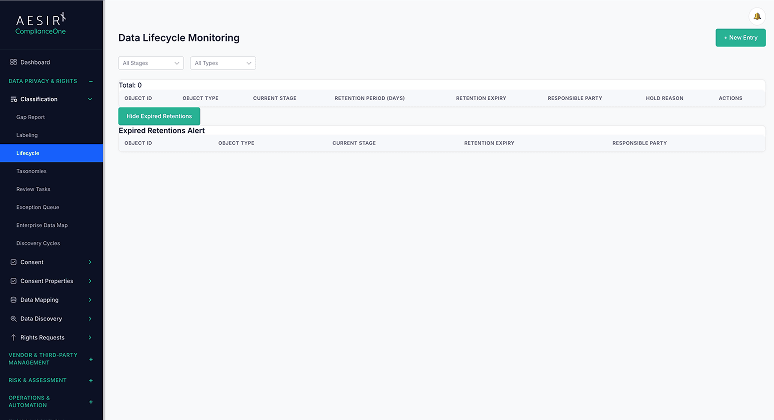


 Sensitivity labels are applied informally or not at all, with no documented approval.
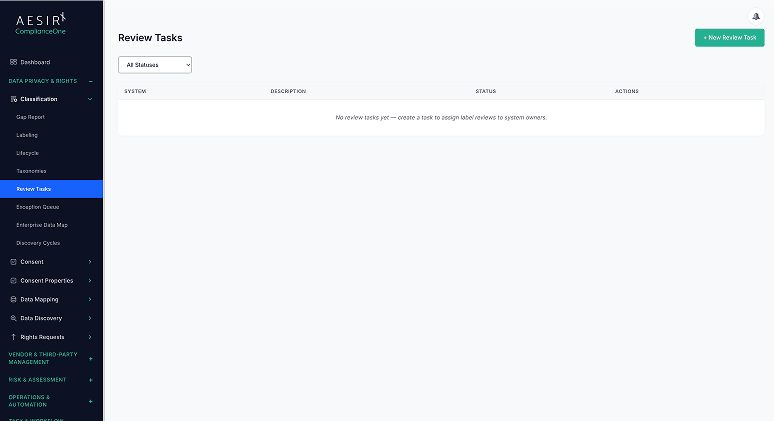
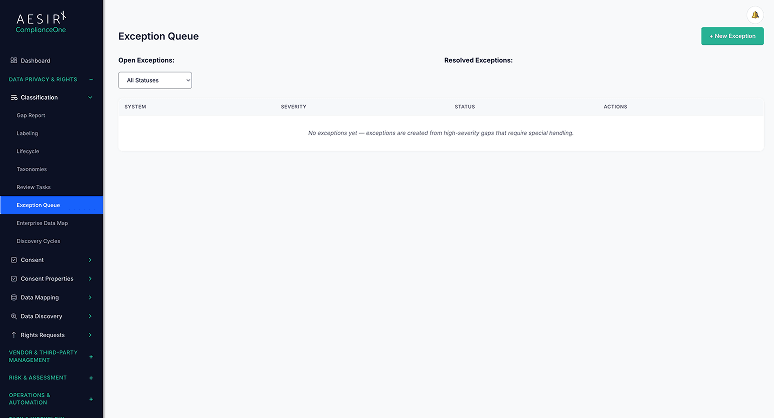
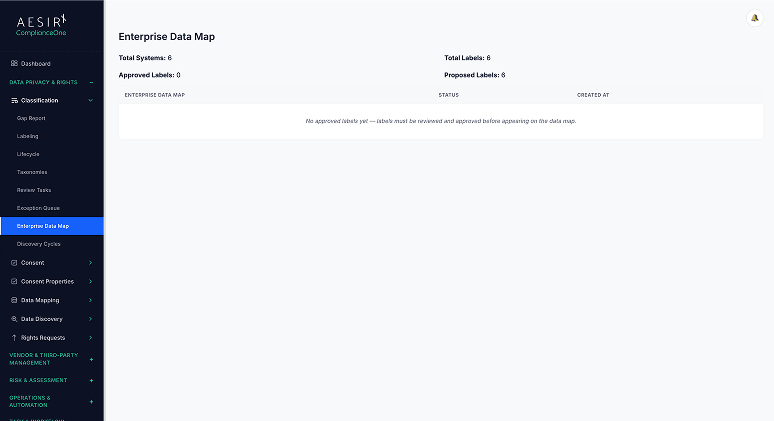
 Custom taxonomies enforce consistent sensitivity terminology across the enterprise.Different departments use different terminology for the same sensitivity level.Every label moves through a proposed/approved lifecycle with owner review before taking effect.Newly discovered datasets sit unclassified because no review routing exists.Owner review routing automatically sends proposed labels to the correct accountable person.Classification conflicts go unresolved, leaving ambiguous protection obligations.A dedicated exception queue surfaces conflicts for resolution by the data owner or DPO.Leadership has no consolidated view of data sensitivity across the organization.The enterprise data map provides department-level drill-down for executive reporting and risk decisions.
The proposed/approved label lifecycle ensures that no classification takes effect without explicit owner review, creating a documented decision record for every sensitivity label in the enterprise.

The exception queue prevents classification conflicts from being silently ignored – every conflict is surfaced, assigned, and resolved with an audit trail showing who decided and why.

The enterprise data map consolidates classification state across all departments into a single view, enabling leadership to identify concentrations of sensitive data without requesting reports from individual teams.
Supports identification and labeling of sensitive personal data categories that carry additional PDPL processing restrictions and protection obligations.Provides the classification foundation for data governance attestation, linking sensitivity labels to systems, categories, and processing activities in the data inventory.Ready to see how Classification works with your compliance workflows? Request a personalized demo.

Ronni K. Gothard Christiansen - Technical Privacy Engineer & CEO
Technical Compliance Expert, 32+ Years Open Source Advocate, X-BoD Open Source Matters Inc.
You define your own classification schemes using the taxonomy builder. Whether your organization uses three levels or seven, the taxonomy captures your specific sensitivity definitions and is applied consistently across all labeling operations.
Every new label enters a proposed state and is routed to the data owner responsible for the asset based on organizational hierarchy. The label does not take effect until the owner reviews and approves it. This prevents unauthorized classifications from being applied.
When an asset could reasonably carry more than one label, or when a proposed label conflicts with existing classifications, the conflict is surfaced in the exception queue. It escalates to the data owner or DPO for documented resolution.
When the Data Discovery module identifies a new data asset, it flows into the classification workflow automatically. The asset enters the labeling and approval process, maintaining an auditable lineage from scan finding to approved classification label.
The enterprise data map provides a consolidated organization-wide view of all classified assets with department-level drill-down. Leadership can see how data is classified across every business unit without requesting individual department reports.
Explore the module architecture, then speak with us about the workflows your organization needs to operationalize first.

Test Classification with your actual taxonomies, assets, and approval workflows in a guided pilot.

Walk through your classification requirements, organizational structure, and reporting needs with our team.


The evolution of Aesir is Aesir +  (the Norse symbol for Necessity)"Needed in order to achieve a particular result"
♥Join the AesirX Privacy Newsletter. Stay Informed. Stay Compliant.


 Vietnam Personal Data Protection Law
 Vietnam Data Law