DPO Radio
 DATA PRIVACY AND RIGHTS
Six modules that cover how your organization discovers, classifies, maps, consents, and responds to rights requests for personal data — plus a unified Data Subject Profile that ties it all together per individual.
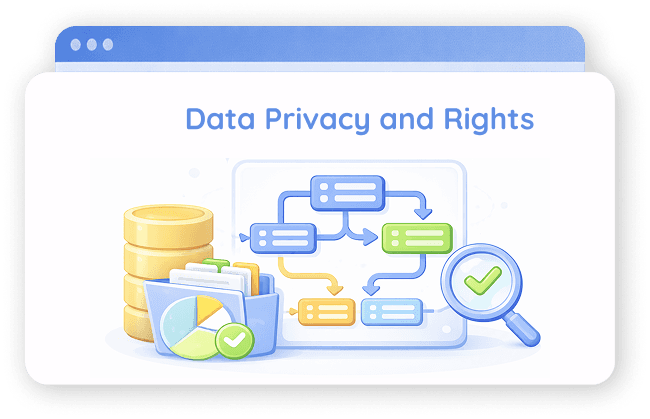

Personal data protection is the foundation of Vietnam PDPL compliance. Organizations must know what data they hold, where it flows, who consented to its processing, and how to respond when a data subject exercises their rights. Without structure, these obligations become disconnected tasks spread across spreadsheets, email chains, and siloed departmental processes.
The cost of fragmentation is operational: DSR deadlines are missed because no one tracks the 72-hour clock, RoPA records go stale because attestation cycles are not enforced, consent policies diverge from live CMP configurations without detection, and sensitive data sits unclassified in systems no one has inventoried. Each gap is a compliance finding waiting to surface during a regulator inspection.
ComplianceOne addresses this with six integrated modules that cover the full data lifecycle. Data Discovery finds where personal data lives. Data Classification applies sensitivity labels with approval gates. Data Mapping maintains your processing inventory with RACI ownership and cross-border transfer assessments. Consent Governance and Consent Properties manage consent policies across all digital properties with withdrawal propagation and CMP synchronization. Rights Requests handles DSR intake through multi-department fulfillment to auditable closure.
Together, they create a single operational record that connects discovery to classification, classification to mapping, mapping to consent, and consent to rights fulfillment.
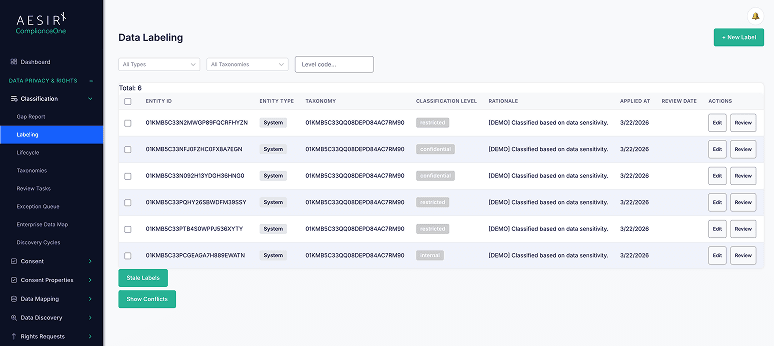
Sensitivity labeling with approval gates and enterprise data map
Classify data by sensitivity using custom taxonomies and apply labels consistently across the organization. New labels move through a proposed-to-approved lifecycle with owner review routing. Classification conflicts surface in a dedicated exception queue with escalation. The enterprise data map provides a consolidated organization-wide view with department-level drill-down for executive reporting.
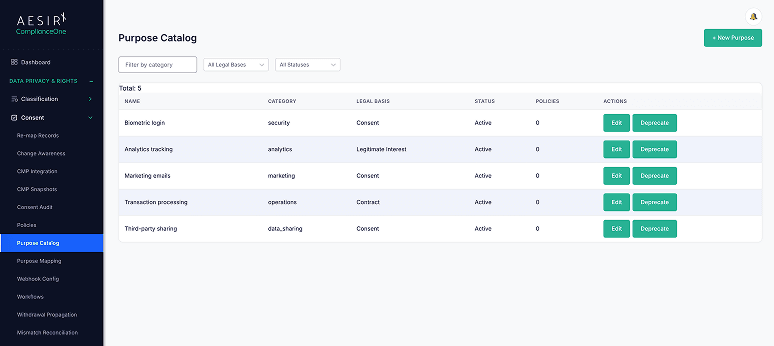
Consent policy management with CMP sync and withdrawal propagation
Centralize consent policy management and ensure your consent banners match your documented policies. Bidirectional synchronization with AesirX CMP Pro detects configuration drift automatically. Withdrawal propagation tracking confirms downstream systems have processed consent changes, and sensitive data policies route through additional approver sign-off.
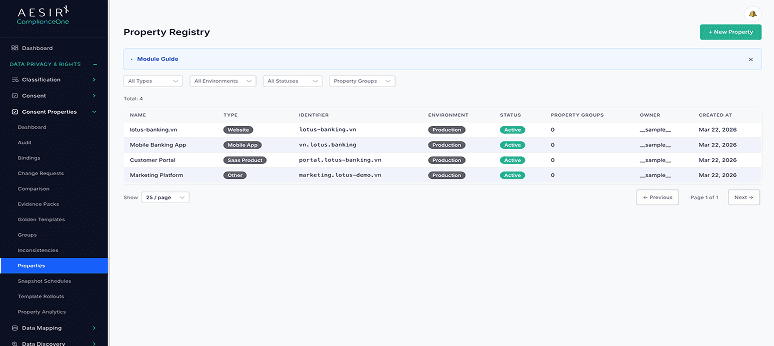
Multi-property consent management with golden templates and group rollouts
Manage consent across multiple digital properties - websites, apps, and services. Golden templates establish a master configuration that can be applied to individual properties or entire groups in a single operation. Group rollout confirmation workflows verify each property before changes go live, and per-property analytics track opt-in rates, withdrawal trends, and compliance scoring.
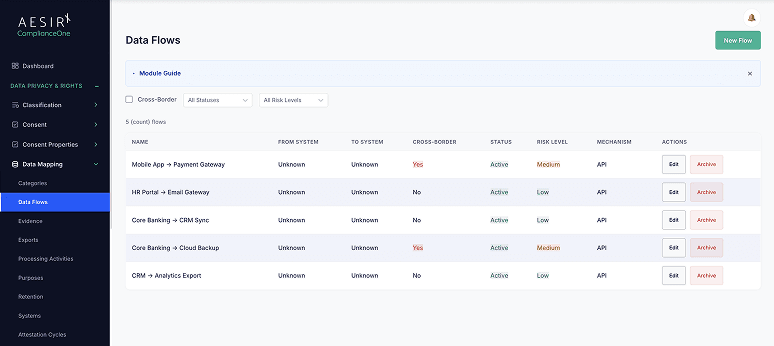
Data inventory, RoPA, attestation cycles, and cross-border transfer assessments
Maintain a complete inventory of your data landscape. Map systems, data flows, and processing activities to build Records of Processing Activities, keep them current with attestation cycles and RACI ownership assignment, and assess cross-border transfer risk with reviewer approval workflows and submission-ready export bundles.
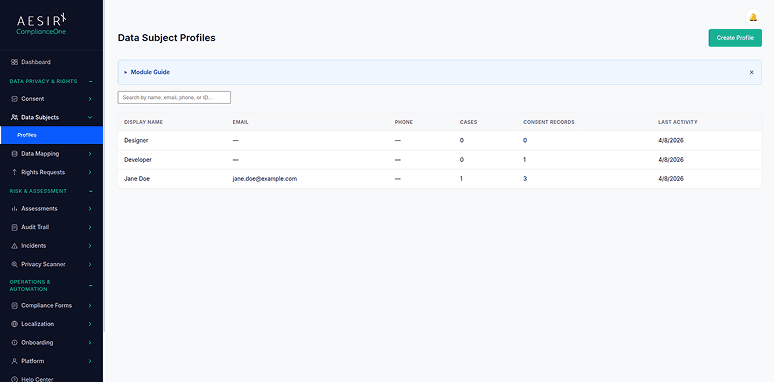
Unified view of every individual's privacy lifecycle across all modules
See the complete picture for any data subject – every rights request case, every consent workflow, and every privacy interaction in one profile. Auto-linking matches new cases and consent records to existing profiles by email or name, building a living timeline without manual maintenance. When a regulator asks about a specific individual, the answer is one click away.
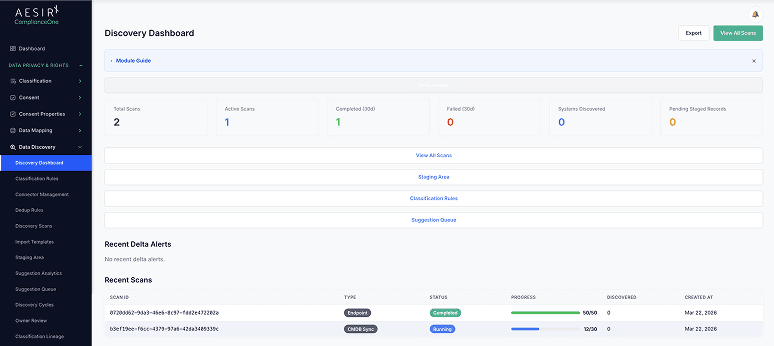
Discovery cycles with owner review, exception handling, and classification lineage
Automatically discover and classify data across your infrastructure. Orchestrated discovery cycles with delta detection highlight what has changed since the last scan. Discovered assets are routed to data owners for review, with exceptions surfaced for DPO resolution. Confirmed discoveries flow directly into the Data Classification workflow, maintaining auditable lineage from scan finding to approved label.
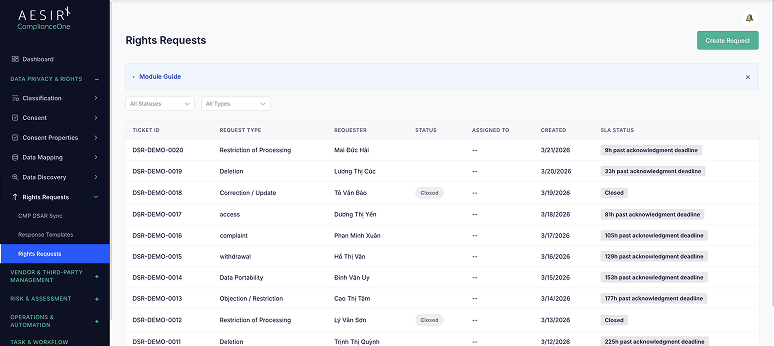
End-to-end DSR and DSAR fulfillment with multi-department coordination
Handle data subject rights requests from public intake to resolution. A complete workflow spanning multi-department coordination, template-driven response delivery, statutory deadline management with extension workflows, and data store linkage so each department knows exactly which records are in scope.
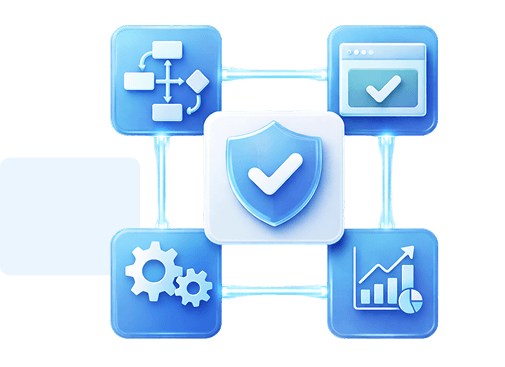
Use Privacy Workflows to compare a notice with documented processing, check transfers and prepare a rights response for review. Keep the action on the record the evidence supports.
Ready to see how ComplianceOne handles data subject rights fulfillment, consent governance, and data classification in practice? Request a personalized demo with your compliance scenarios.

Ronni K. Gothard Christiansen - Technical Privacy Engineer & CEO
Technical Compliance Expert, 32+ Years Open Source Advocate, X-BoD Open Source Matters Inc.
Explore the module architecture, then speak with us about the workflows your organization needs to operationalize first

Deploy the Data Privacy & Rights modules against your own data inventory and DSR workflows. See measurable results in 30 days.

Talk to our team about your PDPL obligations, data mapping requirements, and consent management challenges.
Data Discovery finds personal data across your systems. Data Classification applies sensitivity labels. Data Mapping records processing activities and cross-border flows. Consent Governance and Consent Properties manage consent policies and CMP synchronization. Rights Requests handles DSR intake and fulfillment. Data Subject Profiles ties it all together — aggregating every consent record and rights request case per individual into a unified timeline. Each module feeds data to the next, creating a connected operational record from discovery through rights response.
Yes. All modules are independently configurable. Many organizations start with Data Mapping and Rights Requests for core PDPL compliance, then add Consent Governance and Data Classification as their program matures. Each module delivers value on its own and integrates automatically when other modules are enabled.


The evolution of Aesir is Aesir +  (the Norse symbol for Necessity)"Needed in order to achieve a particular result"
♥Join the AesirX Privacy Newsletter. Stay Informed. Stay Compliant.