
DPO Radio
 OPERATIONS AND AUTOMATION
Automate the compliance operations that demand consistency – form filing, deletion orchestration, monitoring cycles, program governance, and cross-system integration.
Compliance operations span activities that are too consequential to manage manually. Official regulatory forms must use exact Vietnamese labels as prescribed by law – a single mislabeled field creates submission risk. A data subject's erasure request must be verified across every internal department and external vendor that holds their data, with documented proof and enforced deadlines. Monitoring programs must run on schedule regardless of team availability. Program maturity gaps must convert to tracked remediation tasks with full traceability.
Disconnected tools compound every one of these risks. When compliance forms live outside the case management system, fields must be re-entered manually – introducing errors and breaking the link between the form and the case that generated it. When deletion confirmations arrive by email, deadlines slip and proof gaps appear at the worst possible time, during an audit. When monitoring schedules depend on calendar reminders, cycles get missed. When obligation mapping exists in a spreadsheet, gaps go untracked from identification through remediation.
ComplianceOne's Operations & Automation category addresses these operational realities with structured workflows connected to their regulatory context. Compliance Forms link directly to filing cases with auto-populated fields and official label enforcement. Deletion Orchestration routes erasure requests to departments and vendors with completeness tracking. Incident Operations enforces regulatory SLA deadlines and automates notification workflows. Connectors bridge ComplianceOne to enterprise systems with security review and health monitoring. Monitoring schedules recurring compliance review cycles with auto-scheduling and KPI dashboards. Program Governance converts maturity gaps into tracked remediation tasks under RACI ownership. Localization deploys market-specific regulatory packs across jurisdictions.
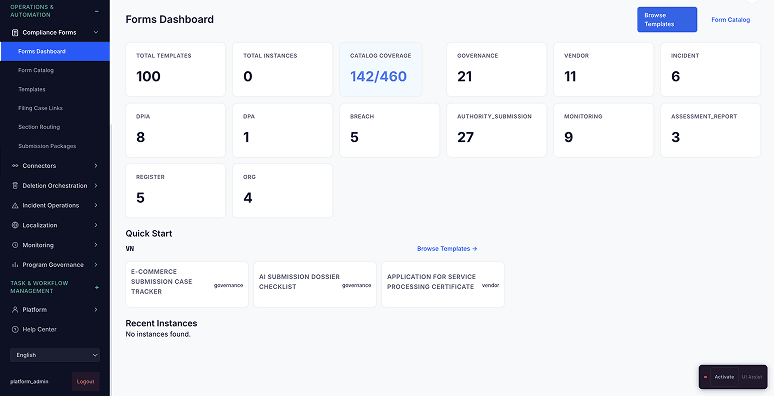
Official regulatory forms with filing case integration and submission package assembly
Interactive compliance forms linked directly to filing cases – DPIA dossiers, cross-border transfers, and breach notifications. Official Vietnamese labels are enforced as prescribed by law, fields auto-populate from linked case data, and submission packages validate completeness before filing.
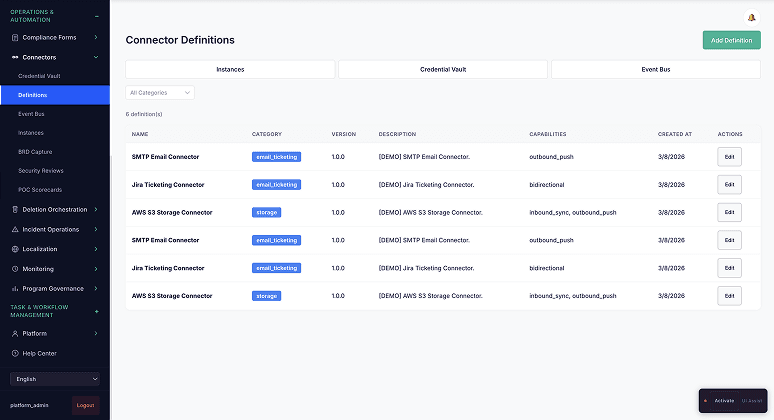
System integrations with BRD capture, security review, and health monitoring
Connect ComplianceOne to external systems with pre-built connectors and a framework for custom integrations. Every connector goes through Business Requirements Document capture, pre-deployment security review with approver sign-off, and vendor POC scoring. Post-deployment health monitoring alerts on connectivity failures and performance degradation.
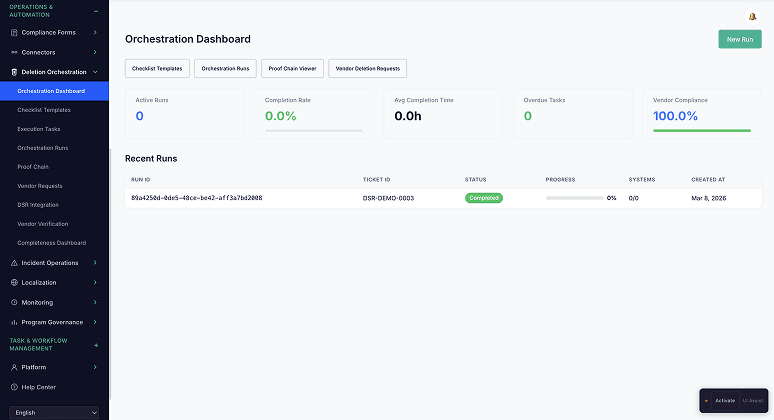
DSR-integrated deletion with vendor verification and completeness tracking
Coordinate data deletion across multiple systems and vendors when data subjects exercise their right to erasure. Deletion requests originating from DSR cases are automatically routed to relevant departments. Vendor acknowledgment and proof of deletion are tracked with deadline enforcement, and a per-data-subject completeness dashboard flags retention conflicts before closure.
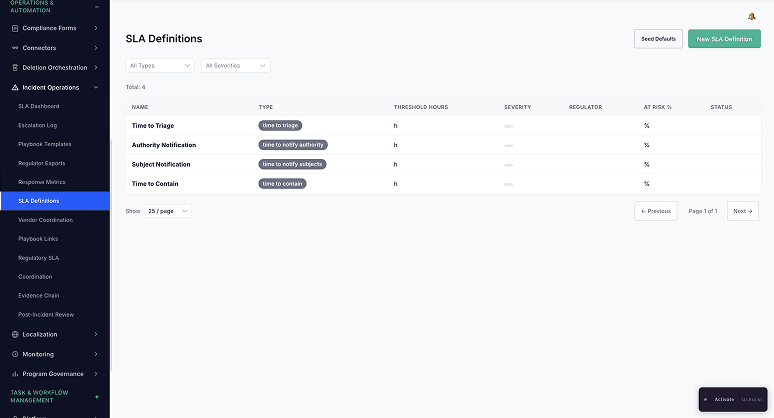
Playbook automation with regulatory SLA mapping and evidence chain of custody
Ensure consistent response to any incident scenario with playbook-to-notification linkage that automates breach notification triggers. Pre-configured PDPL SLA defaults enforce the 72-hour initial notification and 360-hour supplement deadlines. A coordination dashboard tracks team assignments and SLA clocks across all active incidents.
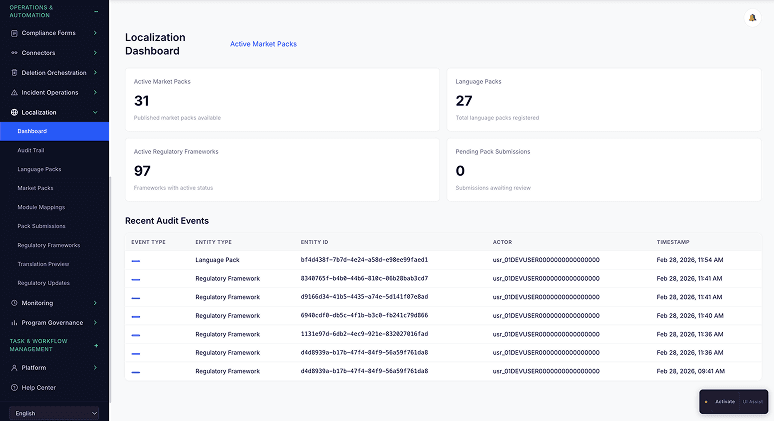
Framework-to-module linkage with submission channels and lifecycle coverage
Deploy market-specific compliance packs for different jurisdictions. Connect each regulatory framework to the platform modules and personas it applies to, configure official submission channels and statutory deadlines, and track framework lifecycle coverage at a glance. Regulatory update tracking routes affected modules for impact assessment review.
Framework-linked compliance monitoring with auto-cycle scheduling
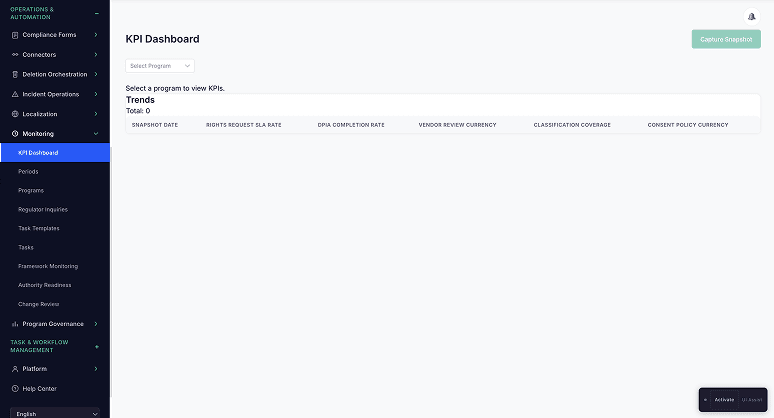
Establish ongoing monitoring programs with scheduled reviews, task tracking, and KPI dashboards. Link programs directly to regulatory frameworks with readiness scoring, respond to regulator inquiries with packaged evidence, and let auto-cycle scheduling keep your compliance calendar running without manual intervention.
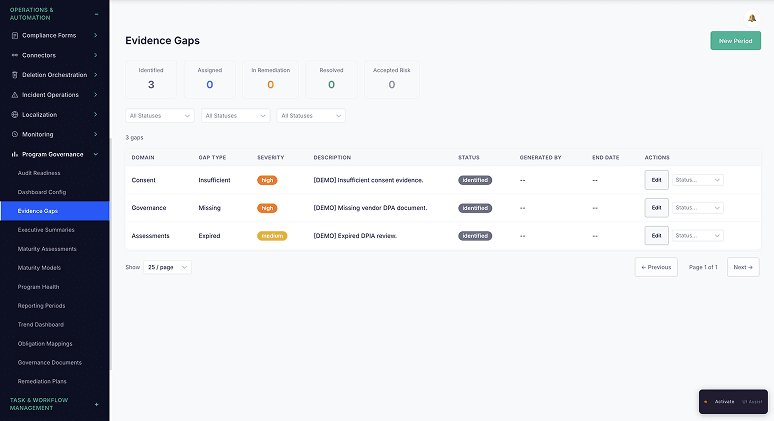
Obligation mapping, maturity assessment, and gap-to-remediation planning
Measure and improve your privacy program maturity with obligation mapping under RACI governance, a governance document register with acknowledgment tracking, cross-framework maturity assessment, and a structured pipeline that converts identified gaps into tracked remediation tasks through a defined lifecycle.
Ready to see how ComplianceOne handles compliance form filing, deletion orchestration, monitoring cycles, and program governance in practice? Request a personalized demo with your compliance scenarios.

Ronni K. Gothard Christiansen - Technical Privacy Engineer & CEO
Technical Compliance Expert, 32+ Years Open Source Advocate, X-BoD Open Source Matters Inc.
Explore the module architecture, then speak with us about the workflows your organization needs to operationalize first

Deploy incident response and deletion workflows against your own breach scenarios in a structured 30/60/90-day pilot.

Walk through your incident response readiness, deletion obligations, and integration requirements with a compliance specialist.
Compliance Forms are linked directly to the case that generated them — DPIA dossiers, cross-border transfer filings, and breach notifications. Fields auto-populate from case data, official Vietnamese labels are enforced to meet regulatory submission requirements, and submission packages validate completeness before filing so nothing is missing when the dossier reaches the Ministry of Public Security.
Yes. Deletion Orchestration sends deletion requests to external vendors and tracks acknowledgment, proof of deletion, and deadlines. If a vendor does not respond within the configured timeframe, the system escalates automatically. The completeness dashboard shows per-data-subject status across all internal systems and external vendors before a case can be closed.


The evolution of Aesir is Aesir +  (the Norse symbol for Necessity)"Needed in order to achieve a particular result"
♥Join the AesirX Privacy Newsletter. Stay Informed. Stay Compliant.