
DPO Radio

 DELETION ORCHESTRATION
Route deletion requests to departments and vendors, track execution, collect cryptographic proof, and verify completeness before closing any case.

When a data subject exercises their right to erasure under Vietnam's PDPL, the organization must delete their personal data across every system that holds it – internal databases, SaaS platforms, vendor systems, backups, and archives. This is not a single-step operation. It requires identifying every system that holds the data, routing deletion tasks to each responsible team, tracking execution, collecting confirmation from external vendors, and verifying that no retention conflicts prevent closure.
Enterprise DPOs (P-VN-01) coordinating DSR fulfillment (UC-VN-12) face the operational challenge of proving deletion happened completely and correctly. A data subject's personal data may exist in CRM systems managed by marketing, HR databases, vendor-hosted platforms, and cloud storage managed by IT. Each system requires a separate deletion action by a different team, and each vendor requires a formal request with deadline enforcement.
Without a structured orchestration system, deletion requests stall in email queues, vendor confirmations are never collected, and the DPO has no way to verify whether all systems have actually completed the deletion. Retention conflicts – where legal holds or regulatory requirements prevent deletion of certain records – are discovered late or not at all, leading to either premature closure of incomplete cases or indefinite delays.
AesirX ComplianceOne Deletion Orchestration integrates directly with DSR cases to automatically route deletion requests to relevant departments. It manages vendor deletion requests with deadline enforcement and escalation for non-response, maintains optional cryptographic proof chains for deletion events, and provides a per-data-subject completeness dashboard showing which systems have confirmed deletion, which are outstanding, and which have retention conflicts that must be resolved before closure.
The central view of deletion status across all systems. The dashboard shows active deletion runs, their progress across departments and vendors, and any cases that require attention – outstanding tasks, missed vendor deadlines, or retention conflicts blocking closure.
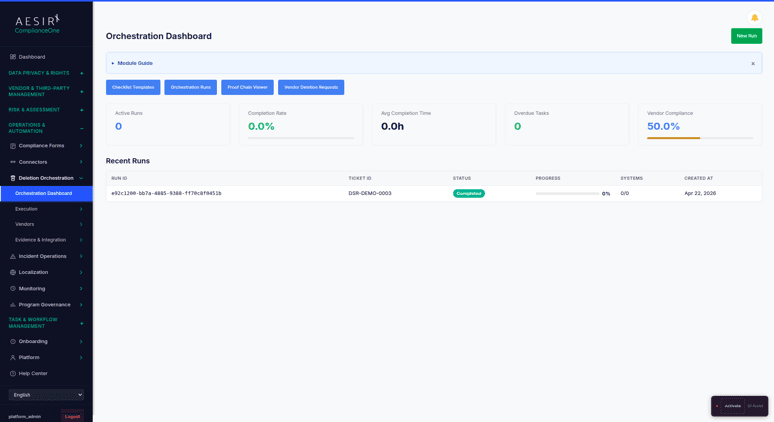
Deletion requests originating from data subject rights cases are automatically routed to the relevant departments with task generation. When a DSR case requires erasure, the orchestration module identifies which systems hold the data subject's records and creates deletion tasks for each responsible department, eliminating manual routing.
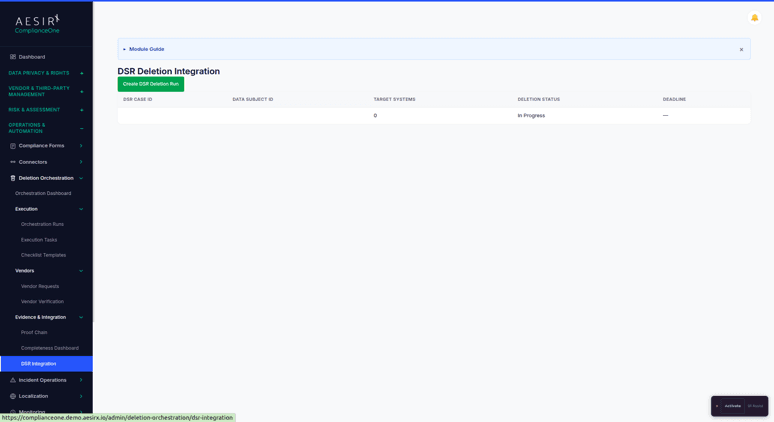
Each deletion request becomes an execution run that tracks deletion job progress across all targeted systems. The run shows which systems have completed deletion, which are in progress, and which have not started, providing a clear picture of where each case stands.
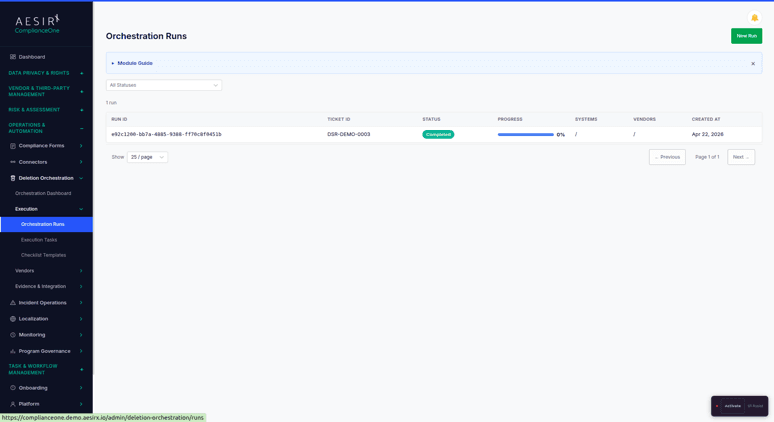
External vendor deletion requests are tracked with deadline enforcement and escalation for non-response. The system sends vendor requests, tracks acknowledgment, monitors completion deadlines, and escalates when vendors fail to respond or confirm deletion within the defined window.
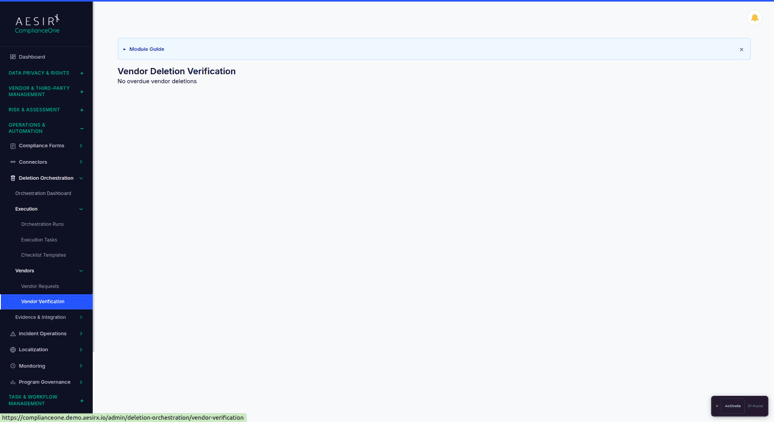
Optional cryptographic proof for deletion events provides a tamper-evident record that deletion actually occurred. Each deletion confirmation – whether from an internal system or external vendor – can be anchored to the proof chain, creating verifiable evidence for audit and regulatory purposes.
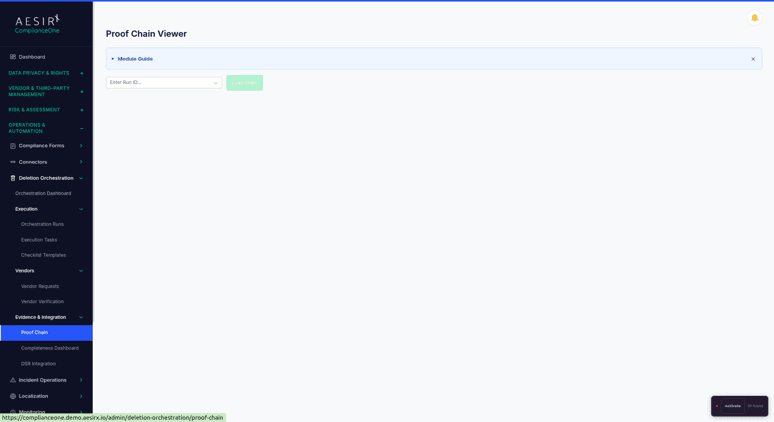
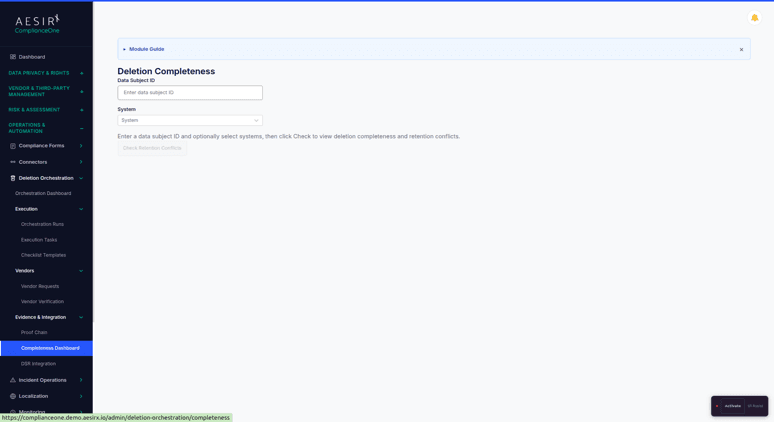
A per-data-subject view showing the full deletion picture: which systems have confirmed deletion, which are still outstanding, and any retention conflicts that must be resolved before the case can be closed. This prevents premature closure of incomplete deletion cases and gives DPOs the evidence they need to confirm full erasure.
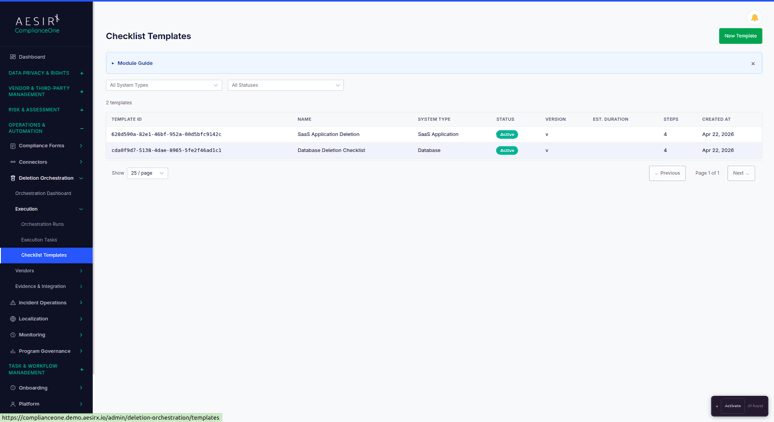
Reusable deletion workflows define the standard set of systems and steps for common deletion scenarios. Templates reduce setup time for recurring deletion patterns and ensure consistency across cases.


 Deletion requests are routed manually via email with no consolidated tracking.
 DSR-integrated routing automatically generates department-level deletion tasks for each affected system.Vendor deletion confirmations are not systematically collected or verified.Vendor deletion requests are tracked with deadlines and escalation for non-response.There is no single view showing whether all systems have completed deletion for a data subject.Per-data-subject completeness dashboard shows confirmed, outstanding, and conflict-blocked deletions.Retention conflicts are discovered late or missed entirely, leading to incomplete erasure.Retention conflict detection flags systems where legal holds or regulatory requirements prevent erasure.Proof of deletion relies on scattered screenshots and emails rather than a verifiable chain.Cryptographic proof chain provides verifiable evidence that deletion occurred across all targeted systems.
Direct DSR integration means deletion cases originating from data subject rights requests flow into orchestration automatically, no manual re-entry or routing decisions required.

Per-data-subject completeness tracking across all internal systems and external vendors provides the evidence chain that regulators expect when verifying erasure compliance.

Vendor deletion verification with deadline enforcement and escalation closes the most common gap in deletion fulfillment – vendor non-response that silently stalls case closure.
Supports data subject right to erasure with multi-system deletion tracking, vendor verification, and proof of completion for regulatory evidence.Provides structured deletion execution with completeness verification and retention conflict detection aligned with Decree 356 procedural requirements.Ready to see how Deletion Orchestration works with your compliance workflows? Request a personalized demo.

Ronni K. Gothard Christiansen - Technical Privacy Engineer & CEO
Technical Compliance Expert, 32+ Years Open Source Advocate, X-BoD Open Source Matters Inc.
When a DSR case requires data erasure, the orchestration module automatically identifies which systems hold the data subject's records and generates deletion tasks for each responsible department. This integration eliminates manual routing and ensures every system is included in the deletion scope.
The system tracks vendor acknowledgment deadlines and triggers escalation when vendors fail to respond or confirm deletion within the defined window. The escalation path and deadlines are configurable per vendor, ensuring non-response does not silently block case closure.
When a system or vendor reports that a legal hold, regulatory requirement, or other retention obligation prevents deletion, the completeness dashboard flags the conflict. The case cannot be closed until retention conflicts are either resolved (hold lifted, deletion completed) or formally documented as exceptions with justification.
The proof chain is optional. Organizations can enable cryptographic anchoring for deletion events when they need tamper-evident evidence, or they can rely on standard system-level deletion confirmations. The choice depends on the organization's evidence requirements and applicable regulatory expectations.
Yes. Deletion templates define reusable workflows for common deletion scenarios, and execution runs can be launched for individual or multiple data subjects. Each run tracks progress independently across all targeted systems, providing per-data-subject completeness tracking even in bulk operations.
Explore the module architecture, then speak with us about the workflows your organization needs to operationalize first.

Test multi-system deletion orchestration with DSR integration, vendor tracking, and completeness verification.

Walk through your data deletion requirements and see how orchestrated deletion fits your erasure obligations.


The evolution of Aesir is Aesir +  (the Norse symbol for Necessity)"Needed in order to achieve a particular result"
♥Join the AesirX Privacy Newsletter. Stay Informed. Stay Compliant.


 Vietnam PDPL (Law 2025)