

DPO Radio

 RIGHTS REQUESTS
One intake-to-resolution workflow covering multi-department coordination, statutory deadlines, and regulator-ready evidence packs.

Organizations subject to Vietnam's Personal Data Protection Law (PDPL) must respond to data subject access requests, correction requests, deletion requests, and portability requests within strict statutory timeframes. Missing a deadline is not just a process failure, it is a regulatory violation with documented consequences.
Enterprise DPOs coordinating multi-department responses face a specific challenge: a single rights request may require data from HR, finance, marketing, IT, and customer service. Without a structured system, the DPO sends emails, tracks responses in spreadsheets, and manually assembles evidence. Department Data Owners receiving these requests often lack clarity on what data is in scope or when their contribution is due.
When fulfillment depends on email threads and shared drives, deadlines slip without warning. Evidence is incomplete. Response letters are inconsistent. Extension requests lack formal documentation. Audit trails are fragmented across inboxes and chat logs, making it difficult to demonstrate compliance during a regulatory inspection..
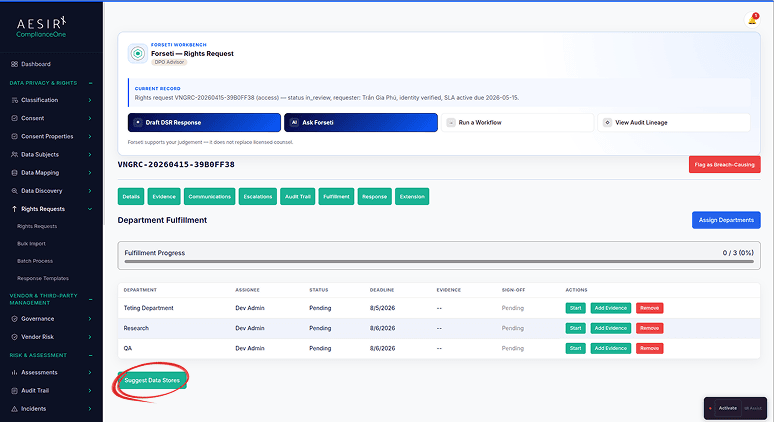
Rights Requests provides a single workflow from public intake through multi-department fulfillment to final response delivery. The Enterprise DPO manages the case lifecycle, assigns per-department tasks with individual sign-off gates, and tracks statutory deadlines with automatic countdowns. Department Data Owners receive clear assignments linked directly to the Data Mapping system, so they know exactly which data stores and records are in scope. The DSR Intake and Fulfillment workflow runs end-to-end within the module.
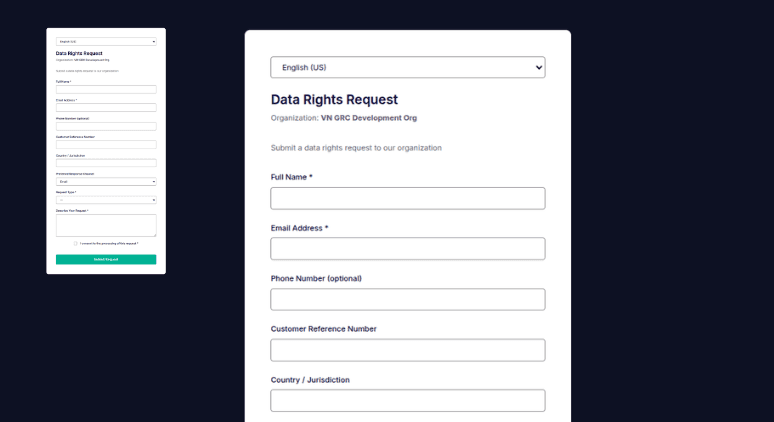
A multilingual web form allows data subjects to submit requests without authentication. Requests are captured with structured metadata – requester identity, request type, and supporting documentation – and automatically routed into the case management queue.
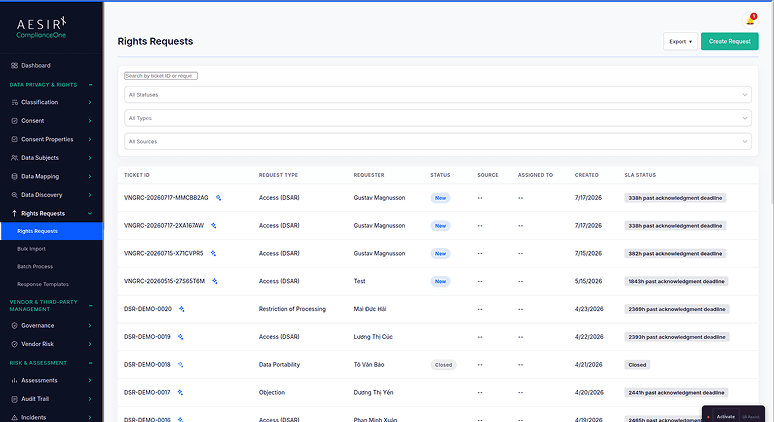
Every rights request becomes a tracked case with status, assignments, and SLA monitoring. Cases move through the full ticket lifecycle with visibility into who is responsible, what is pending, and which deadlines are approaching.
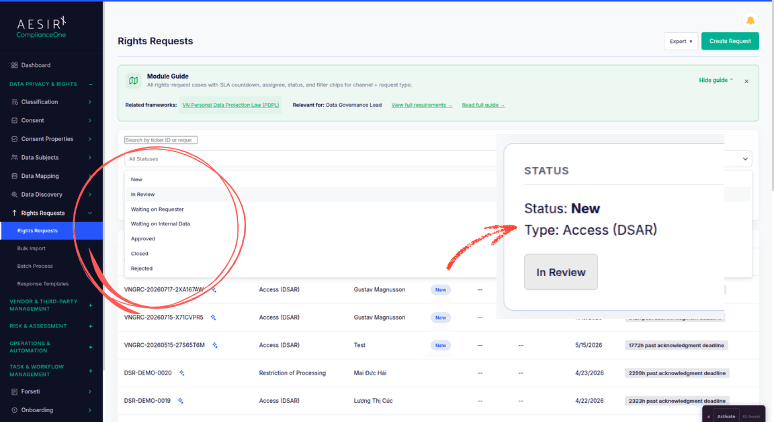
Requests progress through seven defined stages: New, In Review, Waiting on Requester, Waiting on Internal Data, Approved, Closed, and Rejected. Each transition is logged with timestamps and responsible parties, creating an immutable record of the fulfillment process.
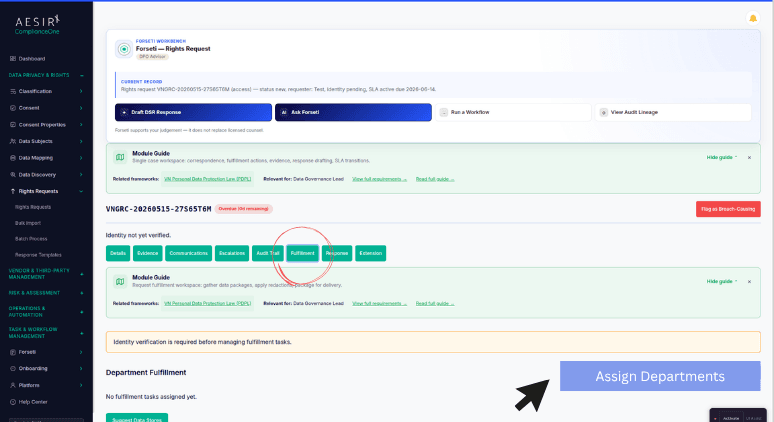
The DPO assigns per-department tasks with individual sign-off gates. Each department confirms its data contribution independently before the response can be finalized. This ensures no department is overlooked and every team's data is accounted for in the final response.
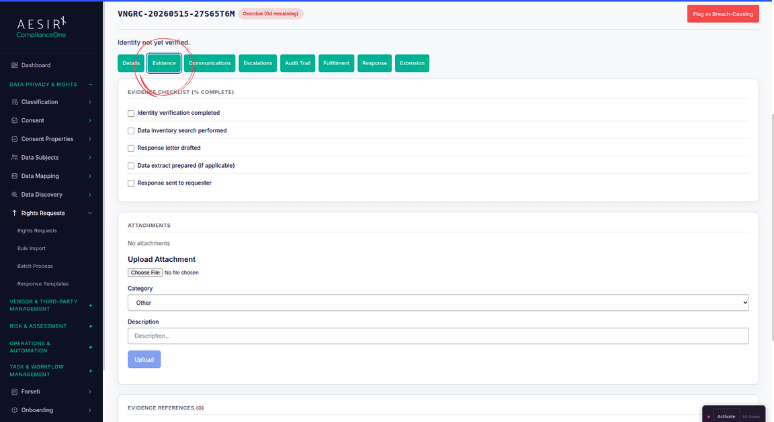
File-based evidence gathering with per-task document attachments enables every step of the fulfillment process to be documented. Evidence packs can be exported as ZIP archives for regulator submission.
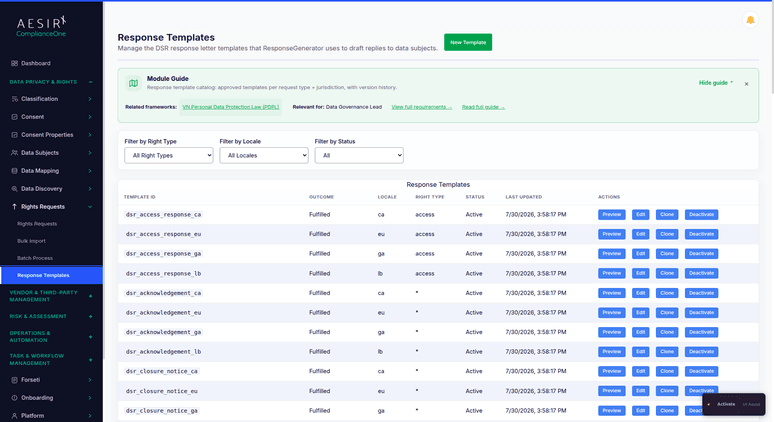
Pre-built templates for common response scenarios in Vietnamese and English use variable interpolation to auto-populate requester details, request type, and outcome. Multi-channel delivery tracking covers email, portal, and postal responses.
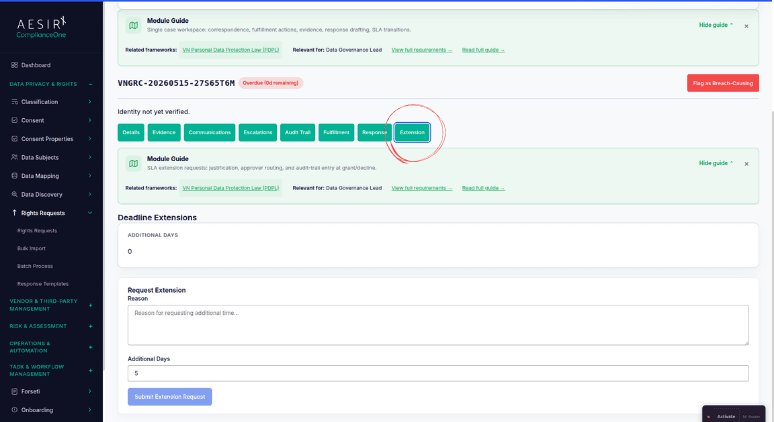
When a request cannot be fulfilled within the standard timeframe, a formal extension request process routes through DPO approval, recalculates the deadline, and notifies the requester, all documented in the audit trail.
Fulfillment tasks link directly to the Data Mapping system. Data store owners see which systems hold personal data in scope for a given request, eliminating guesswork about which teams and data sources need to be consulted for retrieval, correction, or deletion.


 DPOs track requests in spreadsheets with no automatic deadline alerts, risking statutory violations.
 Every request follows a 7-stage workflow with statutory countdown timers visible to all stakeholders.Department contributions arrive by email with no confirmation of completeness or sign-off.Per-department tasks have individual sign-off gates ensuring every team confirms its data before response.Response letters are drafted manually with inconsistent formatting and missing details.Template-driven response generation with variable interpolation produces consistent, complete letters.Extension requests are handled informally with no documented approval or deadline recalculation.Formal extension workflow routes through DPO approval with automatic deadline recalculation and requester notification.Audit evidence is scattered across email threads, shared drives, and chat logs.All evidence is collected in structured packs exportable as PDF reports and ZIP archives for regulators.
Every rights request case maintains a complete audit trail from intake through final response, with contributor lineage showing exactly which department provided which data and when they signed off.

Multi-department fulfillment tasks link directly to the Data Mapping module's system inventory, so data store owners work from the same source of truth rather than interpreting ad-hoc email instructions.

The statutory period extension workflow enforces a formal approval chain with automatic deadline recalculation – preventing informal extensions that lack documentation during regulatory inspections.
Manages the full DSR fulfillment lifecycle with statutory deadline tracking and evidence packs for PDPL compliance demonstration.Supports the procedural requirements of Decree 356 including response timeframes, extension documentation, and multi-department coordination for data subject rights.Ready to see how Rights Requests works with your compliance workflows? Request a personalized demo.

Ronni K. Gothard Christiansen - Technical Privacy Engineer & CEO
Technical Compliance Expert, 32+ Years Open Source Advocate, X-BoD Open Source Matters Inc.
The DPO assigns per-department fulfillment tasks, each with its own deadline and sign-off gate. A department must confirm its data contribution before the overall response can be finalized. The case dashboard shows which departments have completed their tasks and which are still pending.
Yes. The public intake form is a multilingual web form that does not require authentication. Data subjects submit their request with supporting documentation, and it enters the case management queue for identity verification and triage.
The module includes a formal statutory period extension workflow. The case handler initiates an extension request, which routes through DPO approval. Once approved, the deadline is automatically recalculated and the requester is notified, all logged in the audit trail.
Fulfillment tasks link directly to the Data Mapping module's system inventory. When a department receives a task, the linked data stores show exactly which systems and records are in scope, reducing the time spent identifying relevant data.
The module generates PDF reports for individual cases and ZIP evidence packs containing all case documentation, correspondence, department sign-offs, and attachments, ready for regulator submission or inspection response.
Explore the module architecture, then speak with us about the workflows your organization needs to operationalize first.

Test Rights Requests with real DSR cases and see multi-department fulfillment in your environment.

Talk through your DSR volume, department structure, and regulatory obligations with our team.


The evolution of Aesir is Aesir +  (the Norse symbol for Necessity)"Needed in order to achieve a particular result"
♥Join the AesirX Privacy Newsletter. Stay Informed. Stay Compliant.