


Why Vietnam's personal-data requirements are becoming an enterprise-wide operational challenge.
TL;DR: Customer information can move through a CRM, marketing platform, support system, analytics environment, regional reporting service and external provider while responsibility stays divided between departments. Vietnam's Personal Data Protection Law and Decree 356 make the applicable purpose, legal basis, safeguards and accountability relevant throughout that lifecycle. Decree 330 adds a sanctions framework covering personal-data protection and cybersecurity. The practical response is to connect each processing activity to its systems, vendors, responsible people, assessments and evidence. Start with one customer journey and test whether a request or change can be followed through every affected destination.
A customer asks why a promotional message arrived after they changed their preferences. Marketing checks its campaign platform and says the preference was updated. Customer support checks a different screen and sees an older setting. IT confirms that an integration ran successfully, but cannot say whether the update reached a regional reporting service or an external provider.
Consider this a hypothetical enterprise exercise. Nobody needs to have acted carelessly for it to become difficult. Each team can complete its own task while the company remains unable to explain what happened to the customer's information across the whole business.
I would begin a personal-data governance review with that question. Can the organization follow one customer's information from collection to its later use, sharing, retention and deletion? A privacy policy is part of the answer. The operating history behind it is where the answer becomes credible.
Follow the activity before counting the systems
In our example, a customer enters information through a website. The information then reaches six destinations: the CRM, marketing automation platform, customer-support system, analytics environment, regional reporting platform and third-party service provider. Those destinations may hold different fields, perform different activities and retain information for different reasons.
The CRM helps manage a commercial relationship. Marketing selects audiences. Support retains correspondence. Analytics produces reports. Regional management compares performance. The service provider performs an agreed task. Even where they share an email address, the processing purpose is not necessarily the same.
A list of software names will not explain those differences. The useful inventory connects an activity with the information it needs, the people whose information is involved, the purpose, the applicable legal basis, the recipients and the responsible owner. It also identifies where the operational facts supporting that description can be checked.
Responsibility disappears at the handoff
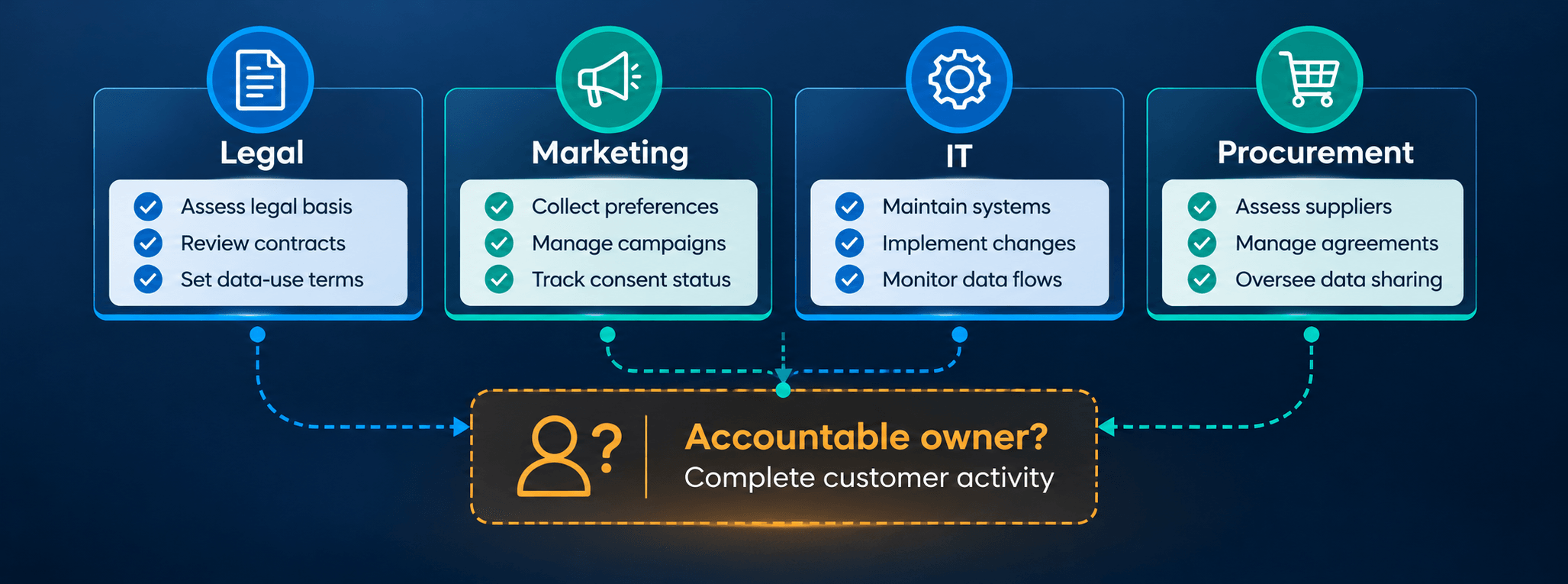
Legal may approve the privacy notice, marketing may configure the preference controls, procurement may sign the supplier agreement and IT may operate the integration. Those are separate contributions. None, on its own, establishes ownership of the complete processing activity.
A practical governance arrangement needs someone accountable for the customer journey and named people responsible for each destination. The accountable owner coordinates decisions across departments. System owners explain operational behavior. Legal and privacy specialists assess the applicable requirements. Procurement obtains information and commitments from suppliers.
The DPO should be able to challenge and coordinate that arrangement without becoming the substitute owner of every commercial system. Asking privacy leadership to chase six departments for every customer request creates a dependency that management should recognize. The people controlling the activity must provide its facts and execute the decisions that affect it.
The legal basis belongs to the activity
Vietnam's Personal Data Protection Law, Law 91/2025/QH15, and Decree 356/2025/NĐ-CP took effect on 1 January 2026. They provide the personal-data framework relevant to this exercise. The business needs to assess the rules applicable to its actual processing, rather than treating a signed policy as evidence that every later use is permitted.
Consent is not a universal answer for every activity. Teams should establish the applicable legal basis and conditions for the particular processing. Where consent is required and relied upon, they need evidence of what was communicated, what the person agreed to and how a later withdrawal is handled. Where another applicable legal basis supports processing, its conditions still need to be examined and recorded.
A customer relationship can contain several purposes. Providing a purchased service, sending a promotional campaign and using information for regional analysis should not be collapsed into one vague entry called customer management. That description makes it harder to assess whether a new use is within the established basis or requires another decision.
I would ask the owner to explain each purpose in language a customer could understand. Then ask the privacy and legal teams to review that explanation against the actual information, recipients and operations. The result should be specific enough that a system owner can recognize when the business changes the activity.
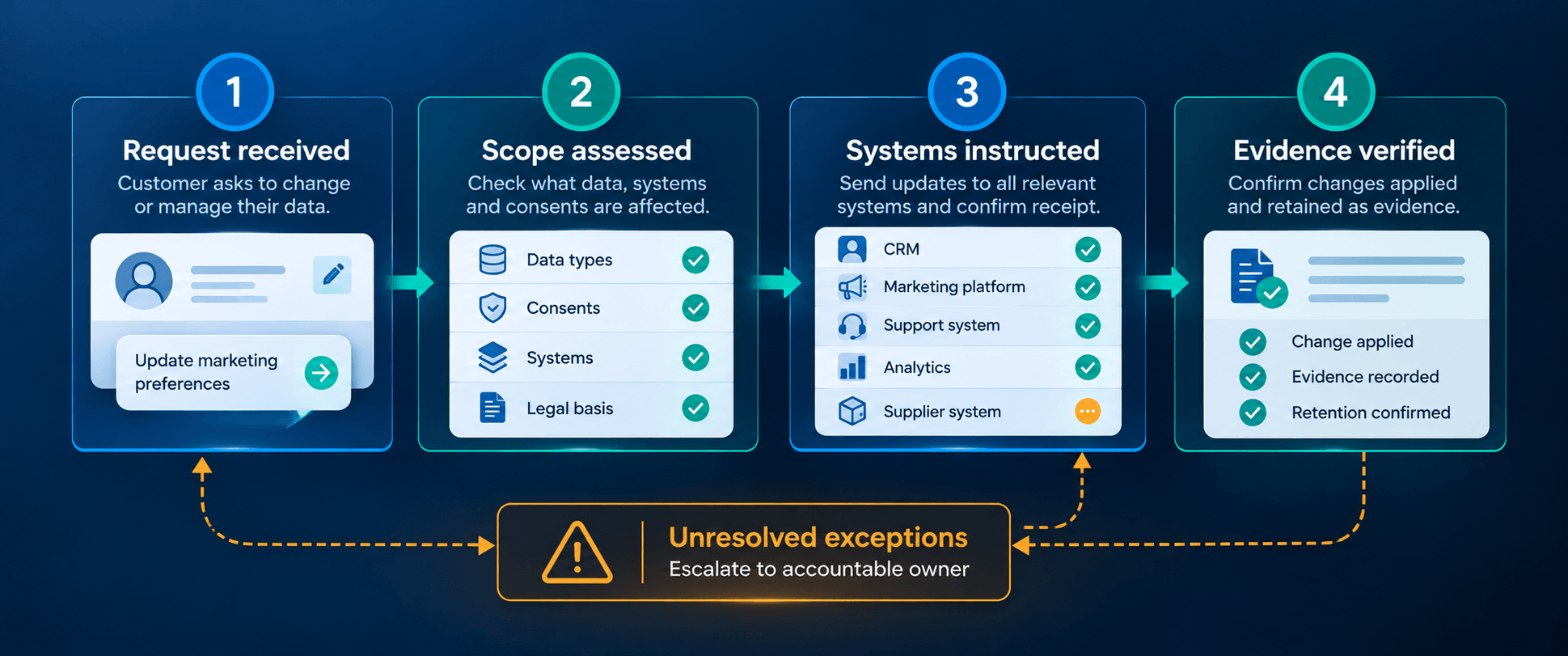
A preference change is an operational event
Return to the customer who changed their marketing preference. The visible website confirmation tells us that an interaction occurred. It does not establish which downstream systems changed, whether queued campaigns were affected or how the external provider handled a copy it already held.
The responsible teams need to determine the scope of the change first. Stopping promotional communication does not necessarily require deleting every record used for a separate lawful purpose. Equally, retaining information for one purpose does not authorize continued promotional use. The legal assessment and the operational instruction should reflect that distinction.
Next, map the instruction to each relevant destination. Marketing checks audience selection and queued messages. IT checks the integration and any failed events. Support verifies how staff see the customer's status. The provider confirms the action within its responsibility. Someone then checks whether the observed outcome matches the instruction.
Record exceptions with an owner and a follow-up action. An old export, a delayed synchronization or a supplier awaiting clarification should not disappear beneath a single completed status. Management needs to know which part of the request is complete, what remains unresolved and whether interim restrictions are necessary.
Sharing and offshore access require their own questions
A supplier agreement is a starting point for vendor governance. The organization still needs to know what the provider receives, why it receives it, who can access it, whether other providers are involved and what happens when the service changes. Procurement cannot reliably answer those questions from a contract title alone.
For regional reporting, distinguish where information is stored from who can access or otherwise process it. A Vietnam-hosted application may support offshore access. A regional report may contain identifiable records or appropriately aggregated information. Those facts affect the assessment; the name of the cloud region does not settle it.
Privacy and legal teams should assess whether the arrangement falls within applicable cross-border transfer rules and what assessment, documentation or filing duties follow. Do not assume every offshore access event has the same legal consequence or automatically creates a filing duty. Identify the facts, applicable conditions and any relevant exemption before determining the required action.
The resulting decision should be linked to the transfer arrangement and its supporting evidence. A new recipient, changed purpose, different access model or added service provider should prompt review of what changed. A prior assessment remains useful only insofar as its assumptions still describe the operation under review.
Retention needs a reason and an owner
Support may need a complaint history while marketing no longer needs a campaign audience. Finance may have another retention obligation. A regional report may preserve a copy whose operational purpose has ended. A single retention period applied to every destination can obscure those differences.
For each activity, establish the applicable retention rationale and how its end is determined. Identify the system or process that carries out the action, the person responsible for confirming it and any exception requiring review. Where a preservation obligation or another valid reason affects deletion, document its scope rather than treating it as a permanent excuse to retain everything.
Deletion also needs a destination list. Removing a CRM record may leave a support attachment, scheduled export or provider copy untouched. Operational teams should explain how backups, archives and restricted copies are handled within the applicable rules and technical arrangements. Avoid promising an immediate erasure outcome that those arrangements cannot support.
A credible completion record distinguishes the instruction from the result. It can show who requested an action, which systems and suppliers were affected, what confirmation was received and what remains subject to an approved exception. This gives the next reviewer a usable history without requiring them to reconstruct every conversation.
Enforcement makes the gaps consequential
Decree 330/2026/NĐ-CP, effective from 19 August 2026, establishes administrative sanctions covering cybersecurity and personal-data protection. That enforcement instrument is already in effect. It belongs in the personal-data discussion, alongside the substantive law and its implementing decree.
The management implication is practical. If the organization cannot explain a processing activity, it will also struggle to establish whether the required safeguards and actions were in place. A complete set of policy documents will not resolve a contradiction between a stated purpose and how a live campaign actually used customer information.
I would therefore treat evidence gaps as operational findings. Describe what is unknown, why it matters, who will resolve it and when the matter will next be reviewed. A finding that stays open with an accountable owner is more useful than a reassuring dashboard that hides uncertainty.
Run one customer journey as a management exercise
The exercise should be narrow enough to finish and broad enough to expose handoffs. Select a website journey that reaches several departments. Agree its boundaries, nominate the accountable owner and ask each system owner to supply current information. Legal and privacy specialists should review the applicable basis and safeguards as the operational facts emerge.
The first deliverable is a traceable description of the journey. It should identify the collection point, separate purposes, relevant information, six destinations, suppliers, recipients and access arrangements. If the teams disagree about whether a copy exists, preserve that disagreement as a finding and assign a check in the source system.
The second deliverable is a tested response to a change. Use an approved test or appropriately controlled sample to assess what happens when the customer changes a preference or makes a rights request. Record the instructions, responsibilities, confirmations and exceptions. Do not mark the journey complete merely because one team acknowledged its task.
The third deliverable is a decision about gaps. Perhaps marketing has a reliable preference history while regional reporting lacks an owner. Perhaps the provider contract is current but the team cannot establish the handling of an older export. Assign corrective actions and decide whether an interim restriction or escalation is needed.
This is a management exercise, not a promise that one sample establishes enterprise compliance. Its value is that it tests whether the governance arrangement works across a real business process. Repeat it for materially different journeys and use the findings to improve ownership and review practices.
Ask questions that require evidence
A COO or CIO can make the exercise useful without becoming the person who interprets every legal rule. Ask the teams to answer the following questions with a record, decision or observed result:
- Which customer activity are we reviewing, and which purposes does it serve?
- Who owns the complete activity, and who is responsible for each destination?
- What legal basis and safeguards apply to each purpose, and who reviewed them?
- Which recipients, providers and access arrangements are included in the current assessment?
- How does a preference change or rights request reach every relevant destination?
- What evidence supports retention and deletion decisions?
- Which exceptions remain open, and who will resolve them?
Keep the history when the business changes
Customer journeys change through ordinary work: a campaign launch, a reporting request, an integration update or a supplier change. The governance owner needs a route for those changes to reach privacy, legal and the affected operational teams. Otherwise the documented journey slowly becomes a description of an earlier business.
Review the difference between the old and proposed arrangements. Identify the added purpose, information, recipient or access. Determine which assessments and instructions need updating. Record the decision and the operational actions it requires, then retain the previous context so a later reviewer can understand why the change was accepted.
Avoid attaching all accountability to an annual review. Periodic checks matter, but an important change should reach the responsible people when it is proposed. Management can support this by requiring project and procurement teams to identify the customer activities their changes affect and the owner who must review them.
An operational view of the lifecycle
AesirX ComplianceOne supports the governance work around this journey through data inventories and processing records, ownership, assessments, vendor governance, rights-request coordination, deletion workflows and audit history. These records can help teams connect an activity to its responsibilities and supporting evidence.
The operational systems still perform their own work. The CRM holds customer records, the marketing service controls campaigns, and suppliers execute their contractual and technical responsibilities. ComplianceOne helps organize the governance and evidence around those acts. Teams must still check what happened in the relevant systems and review whether the outcome meets the applicable requirements.
I would start with one activity rather than a large software inventory exercise. If responsible people can explain its purposes, decisions, handoffs and outcomes, they have a pattern they can extend. If they cannot, the first improvement is clear: give the activity an accountable owner and make its unresolved questions visible.
A question to take back to your team
Ask someone to demonstrate the history of one customer activity without launching a new internal investigation. Where the answer breaks, assign the next action and its owner. For me, that is a practical way to move from approved privacy language to accountable operations.
Explore how AesirX ComplianceOne supports connected governance records, responsibilities and evidence around customer data.
Ronni K. Gothard Christiansen
Technical Privacy Engineer and CEO, AesirX.io
Download the Customer Data Governance Guide
22 slides showing how to connect customer data, accountable owners, processing purposes, and compliance evidence across six systems.
Laws and instruments referenced
- Personal Data Protection Law 91/2025/QH15, effective 1 January 2026: Official Gazette publication listing.
- Decree 356/2025/NĐ-CP, effective 1 January 2026: Official signed decree.
- Decree 330/2026/NĐ-CP, effective 19 August 2026: Official Gazette publication.
This article provides general operational guidance, not legal advice. The customer journey is hypothetical. Applicable duties depend on the organization's activities, roles, information and processing arrangements. Responsible teams should verify requirements and effective dates against authoritative sources before acting.









