

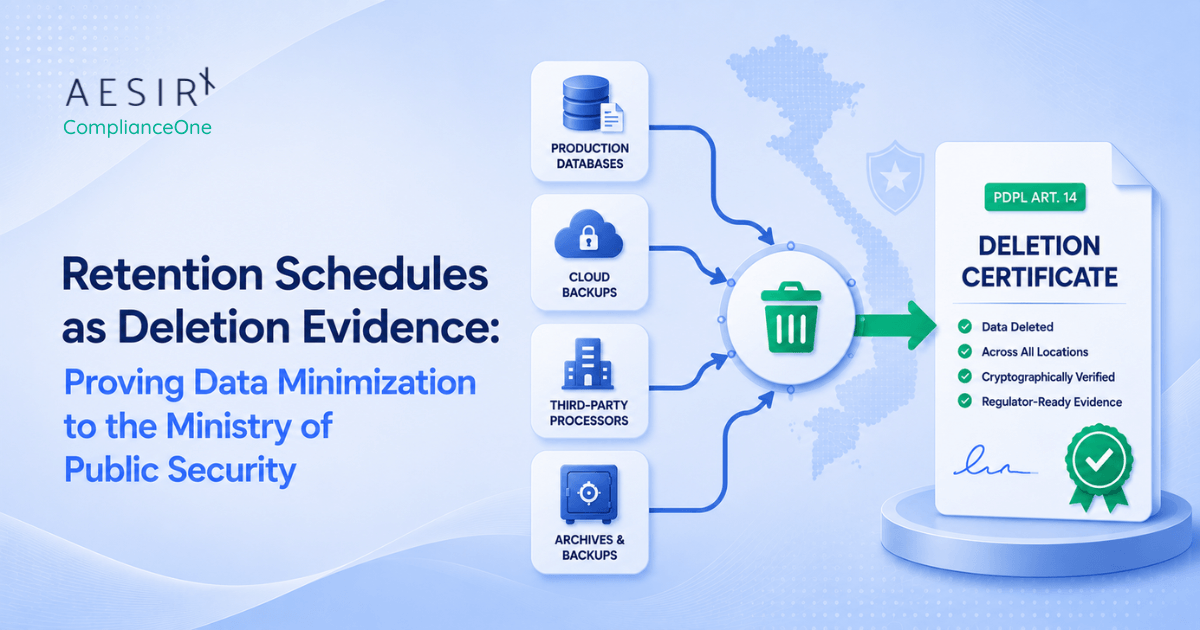
TL;DR: Data retention policies are often written as abstract corporate statements that sit inside legal handbooks while database backups and customer records accumulate indefinitely across cloud servers. Under Vietnam's Personal Data Protection Law (PDPL Article 14) and Decree 356/2025/NĐ-CP (Article 5), data controllers and processors are legally required to delete, destroy, or de-identify personal data once processing purposes expire or consent is withdrawn. When supervisory authorities perform regulatory inspections under PDPL Article 35 and Decree 356 Article 31, they do not ask to see your policy text; they demand cryptographic and operational evidence proving that data was actually purged from production databases, backup vaults, and third-party processor environments. This week’s article breaks down how enterprise organizations transform static retention policies into an automated deletion pipeline: binding retention schedules directly to system schemas, executing automated purging workflows, and generating verifiable deletion certificates backed by immutable audit logs
A Chief Risk Officer and Head of Data Governance receive a formal inspection notice from the Ministry of Public Security. The supervisory authority requests proof that customer personal data collected during a legacy marketing promotion three years ago has been destroyed in accordance with declared processing purposes under PDPL Article 3 and Article 14.
The compliance lead calls IT and database administrators. The engineers confirm that the promotional web application was decommissioned two years ago. However, when the database team checks active cloud storage repositories, they discover that raw database backups containing 450,000 customer records are still stored in unencrypted cold storage buckets. No automated deletion routine was ever configured, no disposal logs were recorded, and no officer ever signed off on destruction.
What was intended as routine data cleanup becomes an immediate statutory violation under PDPL Article 14, carrying severe administrative penalties and public enforcement actions.
This scenario is unfolding across large enterprises in Vietnam today.
Under the Personal Data Protection Law (Law No. 91/2025/QH15), data minimisation and storage limitation are not optional IT hygiene practices. PDPL Article 14 explicitly commands that data controllers and processors must delete, destroy, or de-identify personal data when:
- The declared processing purpose has been fulfilled.
- The statutory retention period has expired.
- The data subject withdraws consent or requests deletion under PDPL Article 10 and Decree 356 Article 5.
- Supervisory authorities issue a formal deletion mandate.
Organizations that manage data retention through manual reminders and policy documents fail during regulatory audits.
Enterprise privacy leaders do not rely on policy text to prove compliance. They build an automated deletion evidence engine that turns retention schedules into verifiable destruction proof.
“A retention policy without automated execution is not a compliance control. It is an admission of unmanaged data liability.”
The Reality of Data Hoarding and Silent Exposure
The core reason enterprise organizations fail data minimisation audits is the historical mindset of data hoarding. Storage was cheap, analytics required big data, and engineering teams saved everything indefinitely "just in case."
This legacy mindset creates three critical compliance traps under current privacy laws.
1. The Backup and Archive Blind Spot
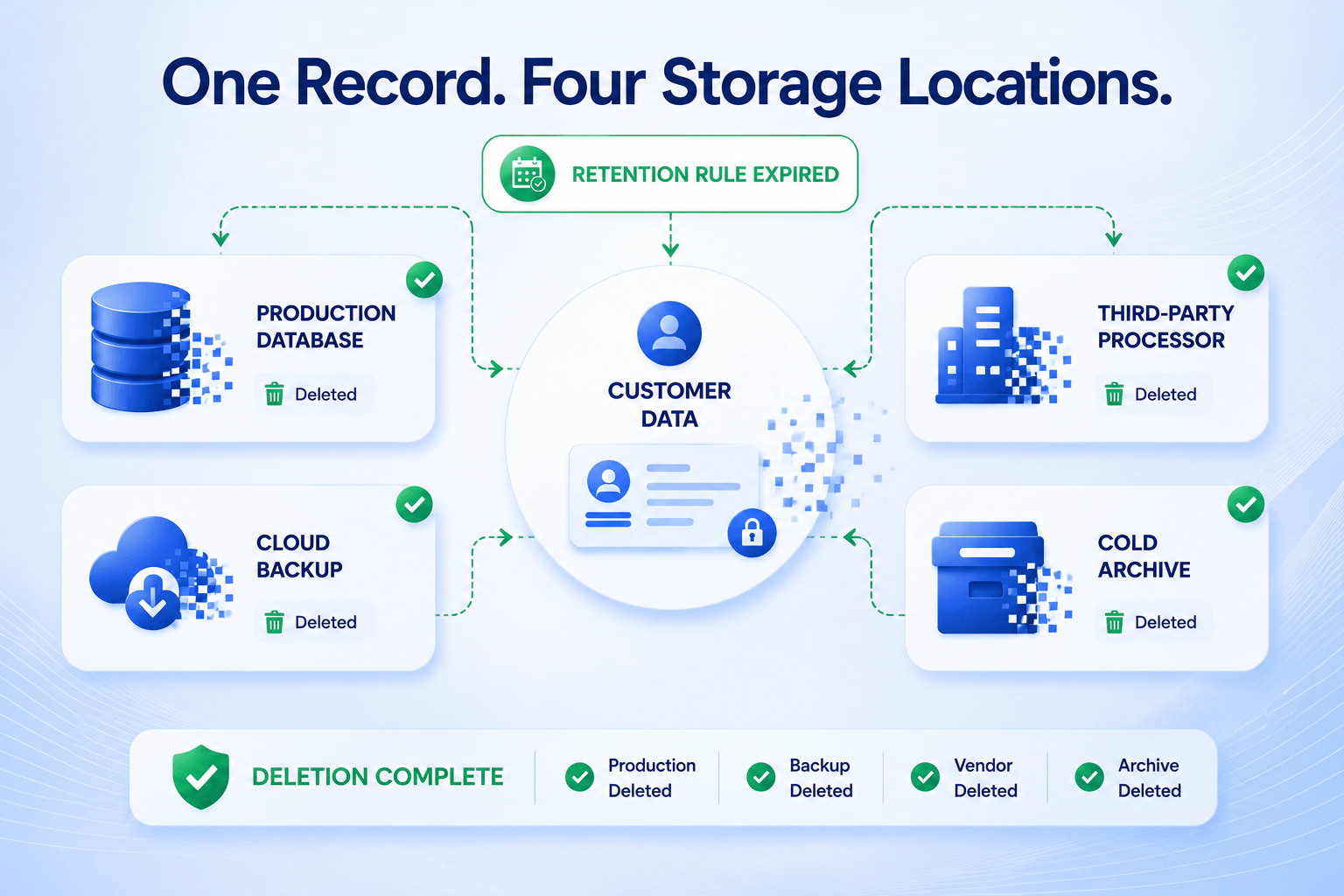
Deleting a customer record from a production application database is straightforward. Removing that same customer record from distributed microservices, read-replicas, data warehouses, and automated daily backup snapshots is immensely complex.
When compliance teams issue a deletion order, engineers often execute a simple DELETE query on the primary application table. They leave secondary data stores, log aggregators, and cold storage backups untouched. When an inspector audits your data estate under PDPL Article 35, un-purged backup files constitute direct proof of non-compliance.
2. The Vendor and Sub-Processor Gap
Modern enterprises share customer data with dozens of external processors: cloud hosting providers, CRM platforms, email delivery services, and analytics vendors.
When a customer withdraws consent under PDPL Article 10, or when a retention window expires, your organization remains legally responsible under PDPL Article 37 for ensuring that external processors also delete the data. Relying on informal emails to vendor managers produces zero audit evidence. If a sub-processor retains customer data past the statutory retention window, your organization bears primary regulatory liability.
3. The Legal Hold Conflict
Data minimisation rules do not operate in a vacuum. Organizations must retain specific records to satisfy statutory accounting laws, tax regulations, anti-money laundering (AML) mandates, or active litigation holds.
Without an automated retention engine, compliance teams struggle to manage conflicting legal requirements. They either delete records prematurely (violating financial reporting laws) or retain all records indefinitely (violating PDPL Article 14).
Building an Automated Deletion Evidence Framework
Solving the data minimisation challenge requires moving from paper retention policies to an automated deletion pipeline integrated directly into your data infrastructure.
Binding Retention Rules to Data Schemas
Retention rules should not live solely in legal PDFs. They must be encoded as metadata attributes on data classification registers.
- Data Category Metadata: Every personal data field (e.g. customer identity, transaction logs, biometric vectors) carries an explicit retention class attribute (e.g. RET-TAX-10Y, RET-MARKETING-30D, RET-AUTH-7Y).
- Trigger Event Binding: Retention clocks bind to specific operational events (e.g. account closure date, contract termination date, consent withdrawal timestamp).
- Statutory Overrides: Legal hold rules automatically override standard deletion timers when active litigation or regulatory inquiries occur.
This schema-level binding ensures that retention logic is evaluated automatically for every record in your database.
Automated Purging and De-Identification Workflows
When a retention timer expires, the GRC engine initiates structured disposal workflows based on data sensitivity and statutory requirements:
- Permanent Hard Deletion: Executing cryptographic erasure or physical record destruction for temporary or high-risk data categories.
- Irreversible De-Identification / Anonymization: Transforming personal data into non-identifiable statistical aggregates under PDPL Article 14, preserving analytical utility while removing privacy risk.
- Cascade Dispatches to Sub-Processors: Transmitting automated API deletion signals to external processors and cloud vendors, requiring signed cryptographic receipts upon completion.
“When retention rules are encoded on database schemas, data deletion happens as a routine system operation, not an emergency project.”
Five Capabilities of Audit-Ready Deletion Evidence
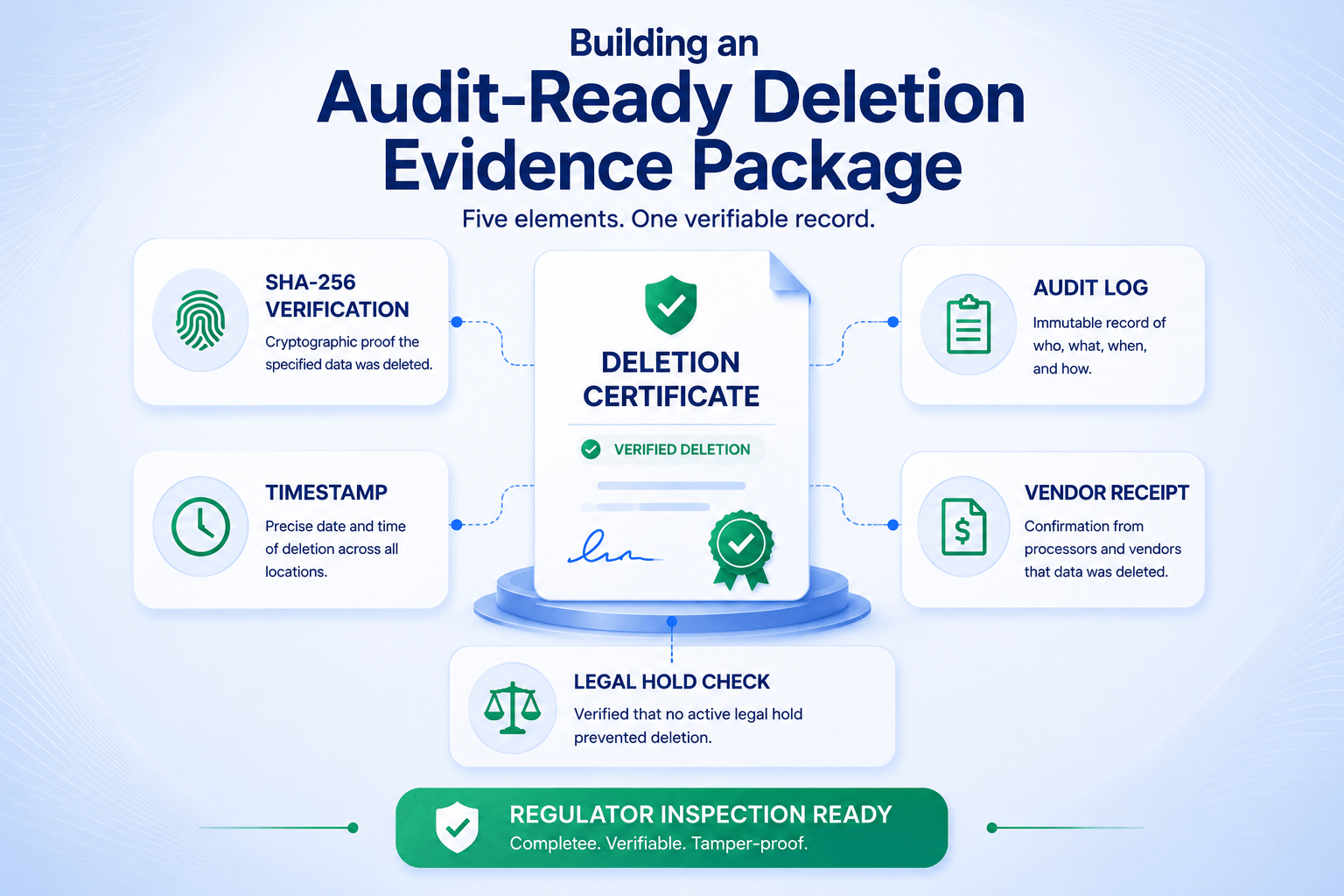
Proving compliance to the Ministry of Public Security under PDPL Article 14 requires establishing five verifiable capabilities across your retention infrastructure.
1. Cryptographic Deletion Verification Logs
A simple database status update (status = 'deleted') is insufficient evidence during a regulatory inspection. Regulators require proof of actual data destruction or irreversible anonymization.
An enterprise deletion engine generates immutable verification logs for every disposal action:
- Recording original record identifiers, retention rule codes, and execution timestamps.
- Capturing SHA-256 cryptographic hashes of pre-deletion state and post-deletion verification states.
- Stamping disposal entries into an immutable audit trail that cannot be altered retroactively.
This cryptographic logging provides irrefutable evidence that data was purged on the specified date.
2. Sub-Processor Deletion Cascade and Receipt Tracking
When your organization processes customer data through third-party vendors, a local deletion is only half the job.
The retention engine orchestrates sub-processor deletion cascades:
- Automatically dispatching webhooks or API deletion dispatches to external vendor endpoints upon retention expiry.
- Monitoring vendor processing queues and tracking completion SLA windows.
- Requiring sub-processors to return signed digital deletion certificates.
If a vendor fails to respond within the required window, the system flags a third-party compliance alert for immediate procurement escalation.
3. Automated Legal Hold Management
Legal holds must override automated deletion timers seamlessly without breaking system automation.
The GRC platform provides centralized legal hold controls:
- Legal teams apply holds to specific data subjects, processing activities, or date ranges during active investigations.
- The retention engine flags affected database records, freezing automated deletion workflows for those specific records.
- All non-held records continue along standard retention schedules automatically.
- When the legal hold is released by authorized counsel, standard retention timers resume, and pending deletions execute smoothly.
4. De-Identification Validation and Re-Identification Testing
Where organizations retain personal data for research or statistical analysis under PDPL Article 14, statutory rules mandate true anonymization.
The system performs automated de-identification validation:
- Verifying that direct identifiers (names, national ID numbers, phone numbers) are permanently removed.
- Running mathematical re-identification risk tests on indirect identifiers (quasi-identifiers like birth dates, postal codes, and transaction timestamps).
- Flagging data sets where combination risks exceed acceptable statistical thresholds.
This automated testing guarantees that retained datasets cannot be re-identified by unauthorized parties.
5. Automated Deletion Certificate Generation
During supervisory inspections under PDPL Article 35 and Decree 356 Article 31, DPOs must present clear, official documentation detailing data disposal activities.
The platform automatically compiles statutory Deletion Certificates:
- Summarizing disposal volumes by data category, processing activity, and retention rule
- Including cryptographic verification digests and sub-processor completion attestations
- Providing executive sign-off blocks for DPO and CISO authorization
- These certificates give supervisory authorities instant, verifiable proof of continuous data minimisation.
Deletion Evidence in Practice
Let us examine how an automated deletion engine functions in two enterprise scenarios.
Scenario A: Executing a Customer Consent Withdrawal (Right to be Forgotten)
A retail banking customer submits a formal request to withdraw marketing consent and close their digital wallet account under PDPL Article 10 and Decree 356 Article 5.
- Intake & Verification: The customer service portal validates the request and flags the customer ID for processing termination.
- Selective Legal Hold Mapping: The retention engine checks applicable banking laws. It determines that core transaction logs must be retained for 10 years under financial accounting rules, but marketing preferences, behavioral tracking, and credit scoring profiles must be deleted immediately.
- Cascade Execution: The engine executes hard deletion of marketing profiles in internal databases, dispatches API deletion requests to external email marketing vendors, and applies a 10-year legal hold tag to financial transaction logs.
- Certificate Generation: Upon receiving vendor deletion receipts, the platform generates a signed Deletion & Retention Certificate, archiving it in the audit trail and notifying the customer within statutory timelines.
Scenario B: Automated Annual Purge of Inactive E-Commerce Accounts
An e-commerce platform enforces a statutory 2-year retention schedule for inactive user accounts where no transactions have occurred.
- Automated Expiry Detection: The retention engine identifies 85,000 user accounts whose last activity timestamp exceeds the 2-year statutory window.
- Batch Processing: The system initiates a scheduled off-peak disposal job: permanently purging personal profile data, anonymizing purchase history for inventory reporting, and clearing cold storage backups.
- Sub-Processor Audit: The platform dispatches deletion dispatches to cloud analytics and customer support vendors, ingesting signed completion receipts.
- Inspection Readiness: The DPO receives an automated summary report and SHA-256 verified certificate confirming the successful destruction of 85,000 expired records, maintaining 100% compliance prior to the annual regulatory review.
Demonstrating Continuous Data Minimisation
When enterprise organizations transition from static retention documents to an automated deletion evidence engine, data minimisation transforms from a complex risk into a operational strength.
DPOs approach regulatory inspections with total confidence, presenting cryptographic proof of data destruction. IT teams reduce storage costs and cloud infrastructure complexity by systematically purging obsolete data. Executive leadership protects the brand from massive data breach exposure, knowing that unneeded customer data is eliminated on schedule.
Data you no longer store is data that can never be breached.
Building Lasting Compliance
- Static retention policies in legal handbooks provide zero defense during regulatory audits. Regulators demand verifiable proof of data destruction.
- Un-purged database backups and cold storage archives represent severe statutory liabilities under PDPL Article 14 and Article 35.
- Encoding retention rules as metadata on data schemas enables automated disposal and anonymization workflows as routine system operations.
- Automated legal hold management freezes specific records during investigations while allowing standard retention schedules to execute normally across all other data.
- Sub-processor deletion dispatches and cryptographic verification logs generate regulator-ready Deletion Certificates backed by immutable audit trails.
Explore how your organization can automate data retention schedules and generate verifiable deletion evidence: https://aesirx.io/compliance-one
Ronni K. Gothard Christiansen
Technical Privacy Engineer and CEO, AesirX.io
Laws and standards referenced
- Vietnam: Law on Personal Data Protection (PDPL), Articles 3, 4, 10, 14, 35, and 37.
- Vietnam: Decree 356/2025 (Decree 356), Articles 5, 19, 20, and 31 (Forms Mẫu số 02a/02b, 03a, 10).
- International: GDPR Article 5(1)(e) (storage limitation), Article 17 (right to erasure), and ISO/IEC 27001 A.8.10 (information deletion).
Disclaimer
This article is operational guidance from a platform vendor, not legal advice. Specific data retention periods, statutory exception rules, and deletion procedure requirements under Vietnam's PDPL and Decree 356 should be confirmed with qualified Vietnamese legal counsel for your specific industry sector and supervisory authority.