

TL;DR: Product traceability is usually treated as a quality problem, while personal data is managed as a privacy problem. In a modern factory, they meet in the same records. Batch histories can identify operators, shipment events can identify drivers and recipients, supplier files can identify individual contacts, and remote-access logs can identify technicians. A defensible operating model connects those facts without turning every production system into a compliance system. ComplianceOne provides governed records for products, batches, trace events, conformity evidence, corrective actions, substances, operational technology, and vendor access. It preserves human decisions and evidence while respecting clear boundaries: it does not run production, determine conformity, calculate producer liability, certify substance safety, discover plant assets, or transmit filings to authorities.
A customer reports a defect in a specific carton. Quality asks which batch produced it. Operations asks which line was running. Procurement asks which supplier lot was used. Security asks whether an external technician had access to the line controller. Privacy asks which employees, drivers, supplier contacts, and recipients appear in the evidence that will now be shared across teams.
Each question is reasonable. The risk begins when every team answers from a different spreadsheet.
One file holds the product code. Another holds the batch. A warehouse export holds the shipment. A quality folder holds the test report. A service desk ticket names the technician. An access gateway records a login. An email thread contains the decision to widen a recall. The records may all be accurate, yet the organization cannot show how they relate or which version was relied on when a decision was made.
That is the operational gap between traceability and proof.
Manufacturing privacy is not about removing names from every industrial record. Product quality, workplace safety, maintenance, logistics, and supplier management often require accountable people. The challenge is to keep personal data connected to a legitimate operational purpose, limit access to it, preserve the decisions that depend on it, and avoid copying it into uncontrolled evidence packages.
Product traceability has a parallel challenge. A trace event is useful only when it points to the right product, batch, place, party, and supporting material. A correction is credible only when the original remains readable and the reason for the correction is recorded. A recall decision is defensible only when its scope, owner, evidence, and closure can be reconstructed later.
The right architecture connects these disciplines. It does not collapse them.
“The factory system runs production. The compliance record proves which decision was made, by whom, on what evidence, and under which rule.”
Why Industrial Traceability Contains Personal Data
Traceability programs begin with products, materials, and movement. Personal data enters through the people who perform, approve, receive, investigate, and repair those movements.
A batch record may identify the supervisor who released it. A test report may identify the laboratory analyst. A conformity declaration identifies the person who signed. A corrective action names the person who raised it and the person who approved closure. A shipment event may carry an individual recipient, driver, or broker contact. A remote-access grant identifies the requester, vendor, approver, and time window. An incident link may contain employee or contractor evidence.
The problem is uncontrolled replication. When a team copies a complete batch export into an email, attaches access logs to a shared drive, and adds supplier contact lists to an inspection folder, the same personal data spreads across systems with different retention rules and access controls. The organization gains more copies without gaining a better explanation.
A stronger approach keeps a governed reference to the person, role, event, and evidence. Exports should contain only what the review needs. Historical records should remain intelligible if an account is later removed. Access should follow the register being reviewed, not a blanket assumption that anyone involved in quality may see every personnel or vendor-access detail.
This is why privacy and traceability should share an evidence design even when they retain separate responsibilities.
Start With One Product Record
The first control is deceptively simple: maintain one product record that every related register references.
If conformity, traceability, producer responsibility, and substance records each repeat the product name, category, or identifier, those copies will drift. A renamed product may appear under its new name in one register and its old name in another. A regulator or customer then has to decide whether two apparently different products are actually the same.
ComplianceOne uses one product record as the common anchor. Product codes are unique within the organization. Batch codes are unique within their product. Conformity evidence, trace events, producer-responsibility records, and substance compositions point back to that anchor rather than maintaining competing product descriptions.
This does not replace product lifecycle management, enterprise resource planning, warehouse management, or manufacturing execution. Those systems remain responsible for engineering, orders, inventory, and production. The compliance record preserves the evidence references needed for review.
Build a Trace Ledger That Preserves Corrections
Industrial facts change. Operators enter the wrong location. A shipment timestamp arrives late. A batch relationship is clarified after an investigation. A credible traceability system must allow correction without pretending the earlier record never existed.
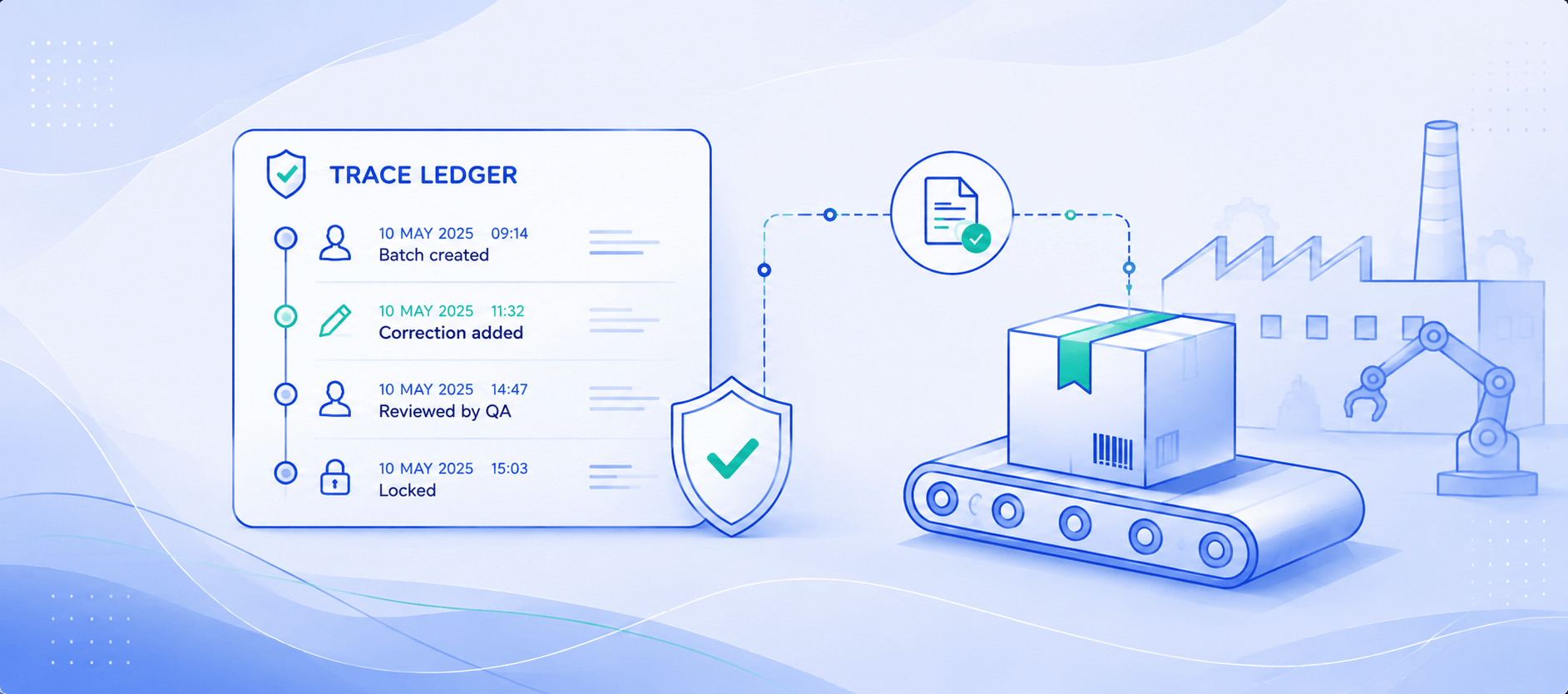
The trace ledger in ComplianceOne is append-only. A recorded event is not edited or deleted. A correction is a new event linked to the previous one, with a mandatory reason. If an event has already been corrected, the next correction must continue from the latest event in the chain.
This design answers three inspection questions:
- What did the organization originally record?
- What changed, when, and why?
- Which event represents the current understanding?
Append-only does not mean cryptographically immutable. It means the operating surface provides no edit or delete path for trace events and represents corrections as new records. Cryptographic anchoring is a separate audit control.
The ledger also keeps the time an event occurred separate from the time it was recorded. A warehouse event entered the next morning should not appear to have happened the next morning. That separation exposes delayed recording while preserving the operational fact.
Connect Conformity Evidence Without Automating the Legal Decision
A declaration of conformity is an act by the organization placing goods on the market. Software can structure the evidence and prevent incomplete records. It should not claim to make the declaration on the organization’s behalf.
ComplianceOne holds a conformity evidence file against a product and one technical regulation at a time. The record identifies the legal regime and its version, tracks supporting material, and keeps findings visible. Only one live conformity position stands for a product and technical regulation. A reassessment supersedes the earlier position, which remains readable.
The platform refuses to record a declaration when the evidence file is empty, a finding remains unresolved, the record already states nonconformity, the underlying regulatory content is retained for reference rather than accepted as directly applicable, or the record has been superseded. The person submitting the declaration is recorded as the signatory. The permission to declare can be separated from the permission to assemble evidence.
These refusals do not determine that the product conforms. They prevent an obviously incomplete or contradictory record from being represented as a signed declaration.
That is the appropriate role for compliance technology. It can require a complete evidence state, preserve the signatory and date, and show which version of the technical regulation governed the review. The accountable organization still makes the legal and technical determination.
For privacy teams, the signatory model also reduces unnecessary personal-data entry. A user does not type another person’s name into a declaration field. The platform records the authenticated person who took the action. Historical exports can display a readable name and retain an identifier for audit linkage, including where an account is later deleted.
Turn Corrective Action and Recall Into Governed Decisions
Corrective actions often begin with uncertainty. A finding may affect one unit, one batch, several lots, stock held by distributors, or products already held by consumers. The evidence should allow the response to widen as facts emerge without rewriting the earlier decision.
ComplianceOne links corrective actions and recalls to the product record and supporting evidence. A recall’s reach may widen but cannot be narrowed in place. A consumer recall cannot later be rewritten as a smaller market withdrawal. If the organization needs to document a new decision, it creates a new record rather than editing history.
Closure is also a distinct decision. The person who raised the action cannot approve its closure, and closure is unavailable until the work is awaiting approval. Once an action is closed or cancelled, it takes no further writes.
This is a practical separation of responsibility, but it should not be overstated. Organizations can assign permissions in ways that combine other responsibilities. They should review role assignments and confirm that their intended separation exists. The platform blocks specific self-approvals; governance teams remain responsible for the wider operating model.
The privacy benefit is clarity. Instead of distributing investigation notes and employee names through email, teams can keep the accountable roles, evidence references, scope decisions, and approval history together. Reviewers see who acted without receiving every unrelated personnel detail.
Reconcile Producer Records Without Calculating Liability
Producer-responsibility evidence creates a particular automation risk. The organization may need to determine whether a material category applies, record quantities placed on the market, choose how an obligation was discharged, and document what it filed. Those records contain numbers, so a system can easily appear to calculate an amount that it is not qualified or configured to determine.
ComplianceOne draws a firm boundary. It records a required yes-or-no applicability decision with a rationale. A volume cannot be added until that decision exists. Quantities require units, and the platform does not convert one unit into another. Declared contribution figures require a currency, an author, and the basis used by that author.
The reconciliation performs one limited operation: it restates the organization’s recorded volumes and compares that restatement with the quantity the organization declared. It can show that records are missing, a filing has no supporting volumes, quantities differ, or units do not match. It does not contain a field for the correct value and does not produce a payable amount.
This protects legal accountability and data quality. A difference requires review; it does not establish which statement is right. When units differ, the comparison stops rather than introducing an unapproved conversion.
Record Substance Evidence Without Issuing a False Pass
Substance governance also invites false certainty. A product composition may record a concentration and compare it with a limit, but the comparison is meaningful only when the value, unit, and basis align.
ComplianceOne treats a substance limit as a value, unit, and basis together. If a value is missing, units differ, or the basis differs, the result says the comparison could not be made and records the reason. It does not silently return “within limit.”
The platform does not screen products for restricted substances, certify safety, or approve chemical compliance. It holds the organization’s composition record, the limit it chose to compare against, the evidence, and the outcome of a valid comparison. Specialist teams remain responsible for the underlying substance determination.
Supplier documents may identify individual authors, representatives, laboratory contacts, or reviewers. Those details should be retained only where they support provenance, communication, or accountability. A substance register should not become an unrestricted directory of supplier personnel.
Join Plant Systems to the Data Inventory
Operational technology is where manufacturing privacy becomes most visible. Plant systems can process operator identifiers, access records, shift information, maintenance notes, images, device events, or safety observations. They can also connect to artificial-intelligence systems and incident records.
ComplianceOne’s OT asset profile extends a live system already held in the data inventory. It is not a separate plant asset discovery tool. A profile records plant, line, zone, described integrations, whether worker data is processed, and links to relevant AI systems and incidents. If worker data is involved, the related processing activity must be named.
Requiring the system record first creates one extra step, but it prevents the privacy inventory and plant view from describing different machines. The factory gains a common point where the technical context and data-governance context meet.
This capability does not discover devices, connect to controllers, ingest telemetry, read RFID events, or integrate with ERP, MES, WMS, SCADA, historians, or PLCs. Describing an integration on a profile records what the system talks to. It does not create that connection.
That boundary should shape implementation. Start with the systems most material to safety, product quality, worker data, external access, or incident response. Confirm ownership and existing system records. Then add the OT profile and its evidence links. Do not promise a complete factory inventory if the underlying inventory is incomplete.
Put Vendor Remote Access on a Clock
Remote access is one of the clearest points where privacy, security, third-party governance, and production risk converge. A vendor technician may need access to a line system to diagnose a fault. The organization needs to know who requested the access, which vendor is involved, who approved it, when it expires, and whether it was revoked.
ComplianceOne requires a vendor record and a future expiry for every remote-access grant. The requester cannot approve their own request. The state is derived when the register is read: pending approval, active, expired, or revoked. An unapproved grant never appears active. Revocation takes precedence because a closed access path should not be presented as available merely because its original expiry has not arrived.
This model prevents stale status from surviving after time or revocation changes the reality. It also lets reviewers answer a useful question: which proposed vendor access routes are still awaiting a decision?
Remote Access Assurance depends on the vendor-governance capability and is available with the Standard package. OT Asset Profiles are available with the essential package because they extend the existing system inventory. Customers should confirm that vendor records exist before attempting the first grant.
The system does not open, broker, or monitor the technical tunnel. It governs the evidence and approval record around access. Network enforcement remains with the organization’s security and plant infrastructure.
Design Exports for the Review, Not for Convenience
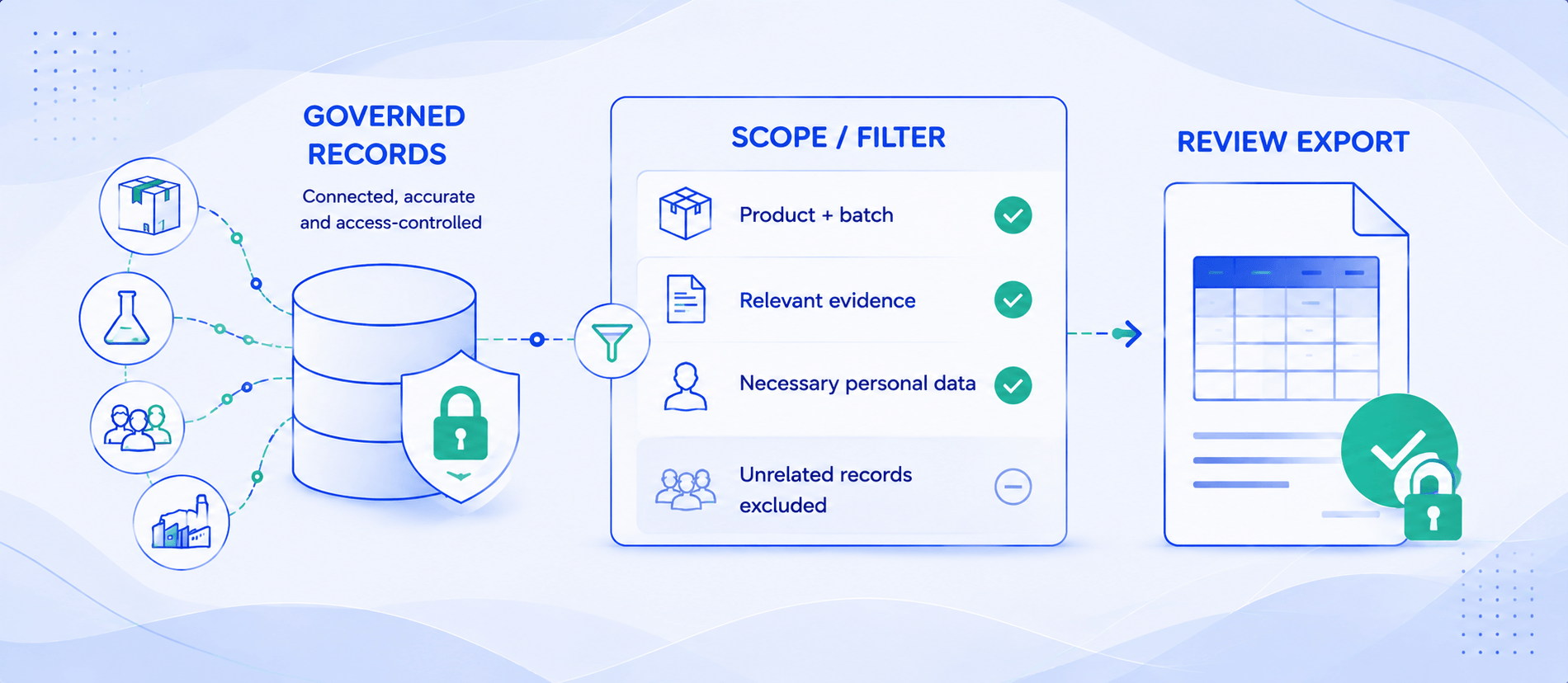
An inspection package can become a privacy incident if every register is exported wholesale. Evidence delivery should follow the question being asked.
Manufacturing registers can be exported in common business formats from the page that owns them. Access follows the right to read each register rather than a universal export entitlement. Relevant filters are carried into the file where supported. Exports identify the row count and refuse populations that would otherwise be silently truncated.
The file also carries the context needed to interpret records: the applicable evidence caveat and whether the organization treats the regulatory content as directly applicable or as reference material. That prevents a reviewer from mistaking research records for a legal position the organization accepted.
Before sharing an export, teams should ask:
- Which decision or period is the reviewer examining?
- Does the file need personal names, or would roles and accountable identifiers suffice?
- Are vendor-access details relevant to this quality review?
- Does the recipient need the complete trace history or only the affected product and batch?
- What secure channel and retention period apply to the exported copy?
A Practical Implementation Sequence
A factory can adopt this operating model without replacing production systems.
1. Establish ownership. Name accountable owners for product data, traceability, conformity evidence, corrective actions, substances, OT profiles, vendor access, privacy, and audit review.
2. Confirm the regulatory context. Install and review the relevant manufacturing content. Decide which obligations apply directly and which are retained for reference. Keep technical and legal interpretation with qualified personnel.
3. Clean the product anchors. Resolve duplicate product codes and agree how source-system references will be recorded. Create batches beneath the correct product rather than maintaining parallel descriptions.
4. Define evidence-minimization rules. Decide when names are required, which roles may see personnel and vendor-access details, how long exported copies remain available, and which secure channels reviewers use.
5. Begin with one traceable product family. Record representative batches and trace events. Test correction lineage with a controlled example. Confirm that occurred and recorded times remain distinct.
6. Add conformity and corrective-action evidence. Verify that declarations cannot bypass missing evidence or unresolved findings. Test closure approval with separate people.
7. Extend priority plant systems. Add OT profiles only after the underlying systems are inventoried. Record the worker-data answer, linked processing activity where relevant, and incident relationships.
8. Govern one vendor-access scenario. Confirm the vendor record, require an expiry, test requester and approver separation, and verify that status changes correctly after expiry and revocation.
9. Rehearse an inspection. Choose a carton, unit, or batch and reconstruct the product, trace chain, conformity evidence, corrective action, relevant access history, and export package. Record gaps as remediation work.
10. Review access and evidence regularly. Check role assignments, unresolved findings, actions awaiting closure, expiring vendor grants, incomplete OT profiles, and evidence shared outside the governed records.
This sequence produces something more valuable than a perfect diagram. It produces a repeatable answer to an operational question.
The Manufacturing Evidence Standard
Manufacturers do not need another system claiming to run the plant. They need an accountable layer that connects legal context, product identity, evidence, decisions, and review history to the systems already running it.
The standard is straightforward:
- One product anchor, not competing descriptions.
- Append-only trace events with visible correction lineage.
- Human conformity decisions supported by complete evidence.
- Recall history that cannot be narrowed after the fact.
- Reconciliations that identify differences without inventing liability.
- Substance comparisons that refuse false certainty.
- OT profiles connected to the data inventory.
- Vendor access that expires and cannot be self-approved.
- Exports limited to the review and readable in their original context.
This is how privacy becomes part of industrial evidence without obstructing production. The organization keeps making the decisions. The platform makes those decisions easier to prove and harder to record in a state that will collapse under inspection.
Ronni K. Gothard Christiansen
Technical Privacy Engineer and CEO, AesirX.io
Laws and standards referenced
- Vietnam: Personal Data Protection Law (PDPL), Law 91/2025/QH15: personal data processing, purpose limitation, data minimisation, security and accountability.
- Vietnam: Decree 356/2025/NĐ-CP: implementation of the PDPL, including processing records, impact assessments and protection measures.
- Vietnam: Law on Product and Goods Quality: product quality responsibilities, conformity, traceability and handling of defective goods.
- Vietnam: Law on Standards and Technical Regulations: technical regulations, conformity assessment and supporting conformity evidence.
- Vietnam: Law on Cybersecurity 116/2025/QH15: cybersecurity governance relevant to industrial systems, access and security records.
- ISO 9001:2015: quality management, traceability, documented information, nonconformity and corrective action.
- ISO/IEC 27001:2022: information security controls relevant to access control, supplier relationships, logging and protection of operational records.
- IEC 62443 series: cybersecurity for industrial automation and control systems, including OT security and controlled remote access.
Disclaimer
This article provides operational guidance from a platform vendor, not legal advice. Applicable privacy, product quality, conformity, cybersecurity, traceability and sector-specific requirements should be confirmed with qualified legal and technical specialists for the relevant products, systems and markets.