

DPO Radio

DECENTRALIZED CONSENT MODE
AesirX Decentralized Consent Mode keeps consent tied to the user, blocks scripts until they choose, and lets them update or revoke decisions later.

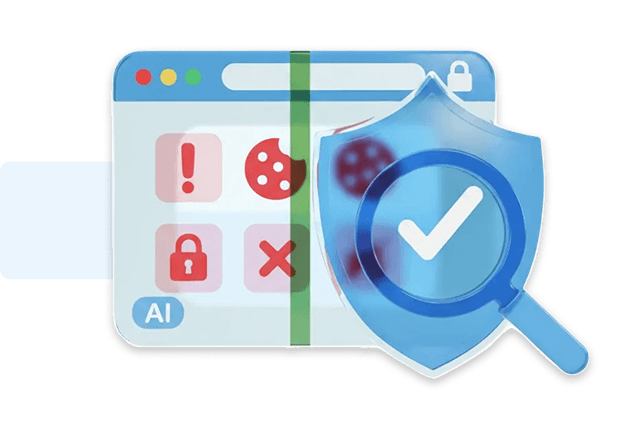
Decentralized Consent shifts consent from anonymous browser-based signals to authenticated user actions. Instead of relying solely on cookies or local storage, consent is expressed through a wallet-based signing request and protected by the Shield of Privacy. This allows users to provide explicit, verifiable consent while keeping personal identifiers hidden.
The Shield of Privacy adds a pseudonymization layer between the user and the website. Identifiers such as email addresses, social accounts, or wallet addresses are never exposed directly. Businesses only receive privacy-preserving, first-party data for the specific sites where consent has been granted, supporting GDPR and ePrivacy principles such as data minimization and purpose limitation.
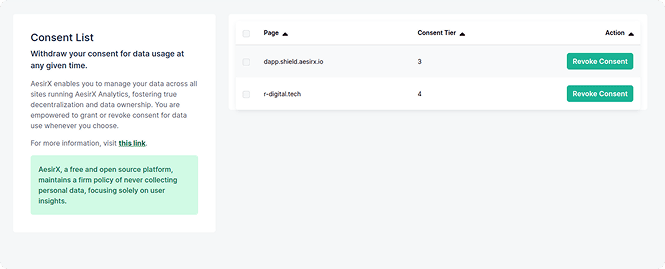
Consent is fully controlled by the user. It can be reviewed, re-confirmed, or revoked through the same wallet used to grant it, either on the originating site or via a unified consent dashboard. This creates a predictable, transparent consent model that aligns legal compliance with real user intent.
Built for organizations where data protection meets performance

One consent journey that follows users between sites.

Returning shoppers keep choices across sessions.

User-controlled consent for regulated flows.

Persistent choices across ad-supported pages.

Consent states that survive portal changes.

User-maintained choices for sensitive environments.

Consent records that outlive cookie expiration.

Consent portability across booking paths.
Blocks scripts until users choose, stores consent as a decentralized record, and makes revocation a user-driven action.




The Decentralized Consent modal presents clear accept, reject, and category options while blocking scripts until a decision is made. Consent is stored as a decentralized record, so users can reuse or revoke it later without seeing the same banner again.
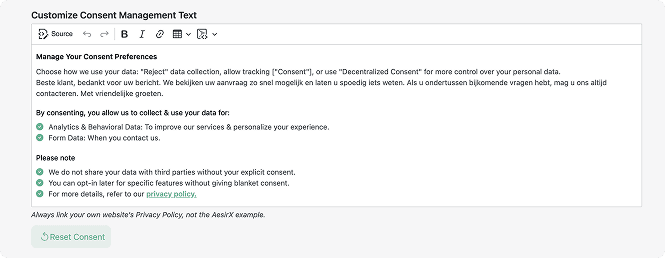
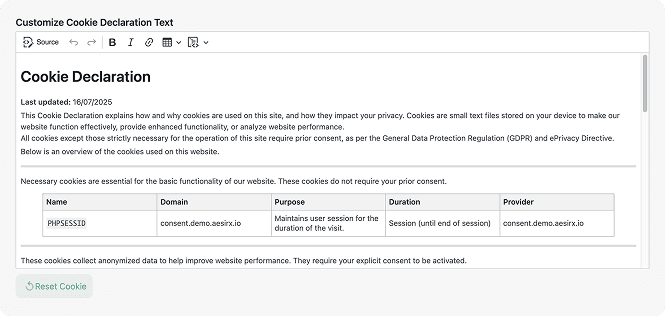
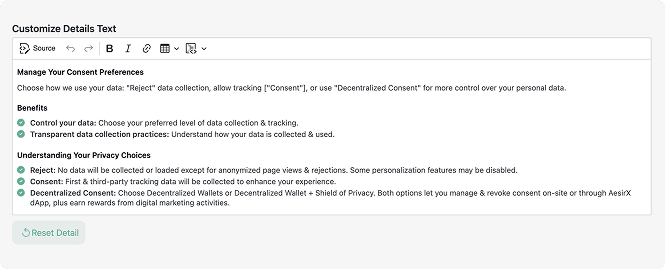
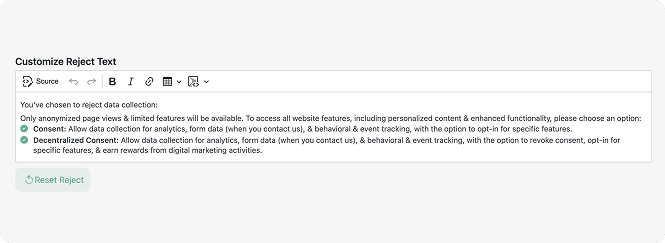
 Remember, decentralized consent is optional.
Note that AI Auto-Blocking works for plugins and scripts loaded through WordPress’ standard architecture. Scripts hardcoded in theme files are not detected and must be added to blocking rules manually


 Consent stored per device
 Consent stored as a recordResets after cookie changesPersists beyond browser resetsChoices repeated on each siteOne consent decision reusedLimited cross-property reusePortable across propertiesConsent tied to browser stateUser-controlled revocation
 Portable consent states
 Consistent user choices
 Reversible decisions
AesirX Consent Management Platform (CMP) for WordPress v1.3.0 release, introducing category-based and granular consent controls.
READ MORE




It extends browser-based consent signals by adding a wallet-based signing action. This shifts consent from anonymous, browser-based storage to an explicit user action.
Consent is given through a wallet-based signing request rather than relying solely on cookies or local storage. The signing action represents an explicit user decision and is recorded as part of the consent flow, with the Shield of Privacy applied to protect identifiers.
Not significantly. The banner layout stays almost the same as Default Mode, but AesirX Decentralized Consent Mode adds an extra button that lets users choose decentralized consent instead of a local browser decision. The interface remains familiar, yet it offers a new option that determines where the consent is stored and how long it remains valid.
The website does not receive direct personal identifiers such as email addresses, social accounts, or wallet addresses. Instead, it receives privacy-preserving, first-party consent data limited to the specific site where consent has been granted, with a pseudonymization layer provided by the Shield of Privacy.
Users can review, re-confirm, or revoke their consent using the same wallet that was used to grant it. This can be done on the originating site or through the unified consent dashboard, with changes reflected in the consent state.


The evolution of Aesir is Aesir +  (the Norse symbol for Necessity)"Needed in order to achieve a particular result"
♥Join the AesirX Privacy Newsletter. Stay Informed. Stay Compliant.