

DPO Radio

COOKIE DECLARATION
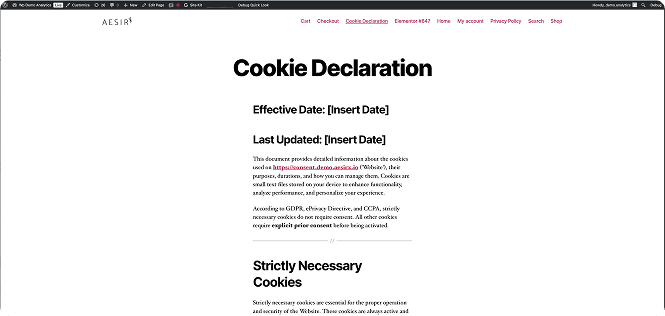
AesirX’s Cookie Declaration feature generates a structured, editable list based on real scan data, giving you accurate categories and clear descriptions for every detected cookie.

Manually building a cookie declaration is one of the most tedious parts of implementing transparent consent. Sites use different cookies and unknowingly load cookies that teams were never informed about. Keeping the documentation accurate becomes a constant, manual rewriting task that rarely stays aligned with what the site actually does.
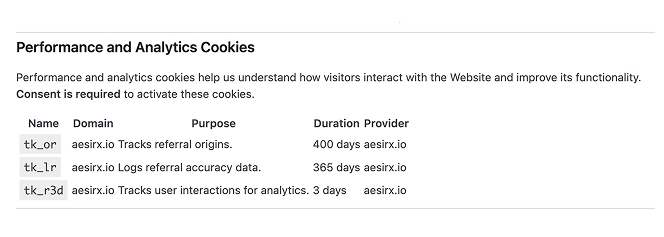
The Cookie Declaration feature removes this burden by generating a complete draft based on real scan data from the AI Privacy Advisor. The system analyses what loads before and after consent under GDPR and the ePrivacy Directive 5(3), then categorizes each cookie by purpose and consent requirements. Essential versus non-essential items are separated, durations are listed, providers are identified, and embedded tools or analytics services are included if detected. This creates a clear, structured, ready-to-edit Cookie Declaration that reflects your site’s real behavior.
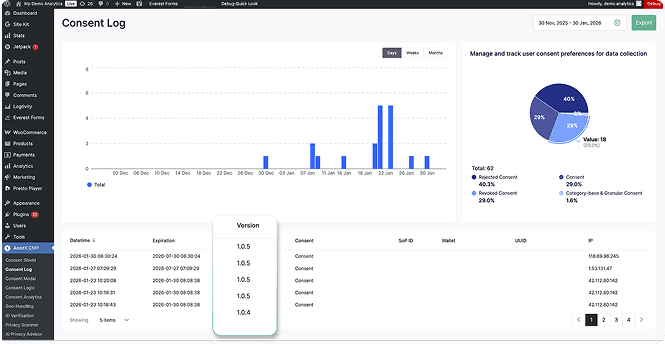
In CMP Pro, Cookie Declarations are versioned, and any change automatically revokes previous consents, prompting users to provide fresh consent aligned with the latest content. AI Privacy Advisor can also automatically create and update Cookie Declaration pages in WordPress, removing manual setup and ongoing copy updates. This reduces manual work, improves auditability, and supports transparency obligations across global frameworks like GDPR, ePrivacy Directive 5(3), and CCPA/CPRA.
Built for organizations where data protection meets performance

Behavior-based cookie lists for faster documentation .

Clear categorization of pixels and analytics tools.

Transparent listing for sensitive site workflows.

Structured categories for complex tagging stacks.

Visibility over essential and optional tools.

Behavior-based clarity on non-essential tracking.

Accurate lists generated from real scan behavior.

Updated cookie sets for evolving marketing tools.
The Cookie Declaration feature turns real scan insights into structured, editable cookie content.




The Cookie Declaration is generated from Privacy Scanner results, with AI Privacy Advisor analyzing detected cookies, domains, and data flows before and after consent.
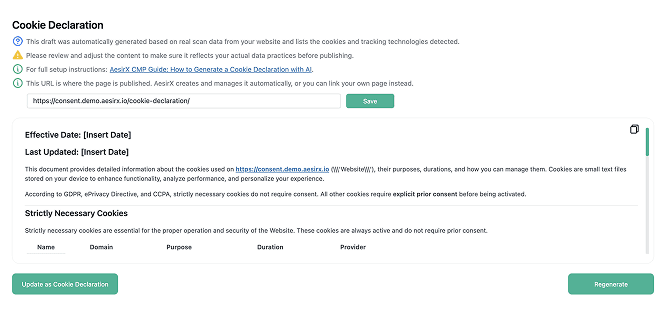
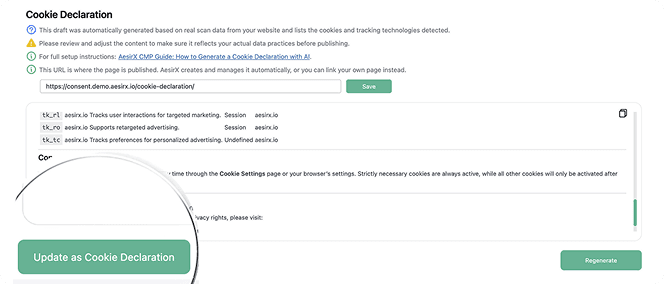
 Use the Copy button to export the text if you prefer to manually update your own Cookie Declaration page or use a custom setup.
Note that AI Auto-Blocking works for plugins and scripts loaded through WordPress’ standard architecture. Scripts hardcoded in theme files are not detected and must be added to blocking rules manually


 Manual cookie lists become outdated
 Scan-based lists stay alignedHard to track new cookiesUpdates follow new behaviorInconsistent structure across sitesConsistent format across sitesTime-consuming to rewriteFast drafts with real dataHigh effort for every updateLess time spent documenting
 Real-data alignment
 Clear categorization
 Behavior-based structure
AesirX CMP for WordPress v1.9.0 introduces automated scanning and blocking of cookies and beacons using the new AI Privacy Advisor feature.
READ MORE
AesirX CMP JS 1.0.0 brings first-party consent control to any platform, delivering faster, compliant, and privacy-first data management for all websites.
READ MORE
Explore the AesirX Consent Management Platform Features Guide to configure tracking, block scripts, and stay compliant with global privacy laws.
READ MORE




The Cookie Declaration is automatically built from Privacy Scanner results, with AI Privacy Advisor analyzing real website behavior before and after consent. Detected cookies and services are categorized into essential and non-essential groups, keeping the declaration aligned with actual tracking activity and audit data.
Yes. The Cookie Declaration is built from real scan data processed by AI Privacy Advisor and structures cookies by their actual purpose, which is required under GDPR and the ePrivacy Directive 5(3) (or UK GDPR/PECR).
Each detected item includes its specific function, provider, duration, and whether consent is required, supporting informed and explicit user consent rather than broad category assumptions.
In addition to clear purpose-based documentation, AesirX CMP supports granular consent controls, allowing users to approve or reject individual purposes and technologies, not just high-level categories. This gives teams accurate compliance alignment and clearer explanations of essential versus non-essential tracking.
Yes. The Cookie Declaration includes items detected from plugins, embedded media, analytics tools, and chained script requests. This aligns with the AI privacy advisor workflow and functions as an AI tool for website privacy compliance, helping teams understand how to audit cookies on a website based on actual behavior.
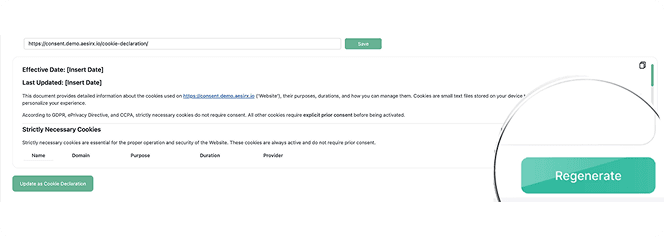
On first use, clicking Regenerate automatically creates a Cookie Declaration page in WordPress and fills it with scan-based content. The generated page URL is added to the CMP fields so it can be updated automatically.
On future updates, Regenerate refreshes the content on that page to reflect new cookies, trackers, and technologies detected during scans. Agencies can also replace the generated URL with their own existing Cookie Declaration page if preferred.
For agencies managing many sites, this removes manual page setup, keeps documentation aligned with real site behavior, and allows consistent, repeatable updates across client environments.
Update it whenever tracking changes. Regenerating scans lets Cookie Declaration refresh the list to reflect new cookies or retired trackers, and provides a new version number in the Consent Log. This process fits the model of automated privacy documentation and uses software to audit trackers & privacy risks to maintain accuracy without manual rechecking.
Yes. The Cookie Declaration feature provides a strong, behavior-based draft, but you review and refine it to reflect your actual data practices. This makes it compatible with AI consent & privacy documentation and helps you consider how real scan data improves cookie documentation, without implying legal assurance.

The evolution of Aesir is Aesir +  (the Norse symbol for Necessity)"Needed in order to achieve a particular result"
♥Join the AesirX Privacy Newsletter. Stay Informed. Stay Compliant.