

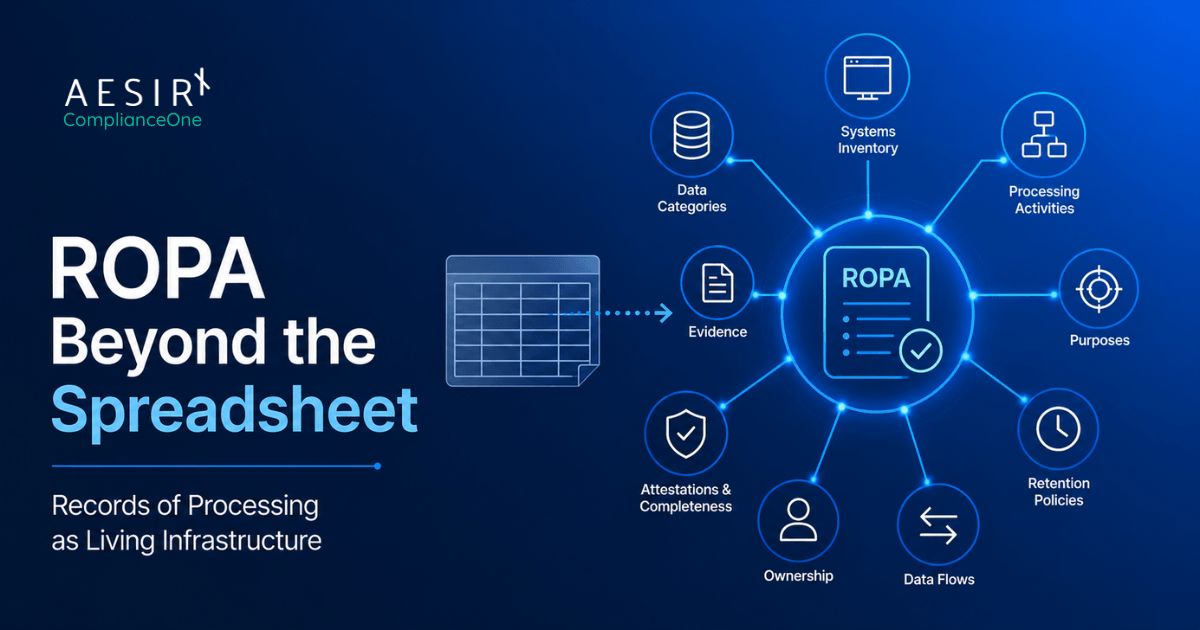
TL;DR: A Record of Processing Activities is often treated as a spreadsheet that legal updates once a year. That’s exactly why it goes stale. The operational system behind the export is the real record of processing. It brings together systems inventory, processing activities, data categories, purposes, retention policies, data flows, ownership, attestations, completeness checks, evidence, and change review.
When those pieces live in separate spreadsheets and inboxes, the DPO inherits a document that looks complete until someone asks whether it is current.
This article explains how to turn ROPA from a static compliance artifact into living infrastructure, where every department contribution, owner sign-off, field correction, and export leaves proof behind.
This article is written for DPOs, privacy operations leads, data governance teams, legal counsel, audit leads, and department owners who supply the facts behind the company's processing records.
The spreadsheet that was current until the business changed
The DPO asks for the latest Record of Processing Activities before an internal audit. The answer comes back quickly: "Yes, we have one."
It’s a spreadsheet. It has tabs for systems, processing activities, purposes, recipients, retention, transfers, and owners. It looks serious. It has colour coding. It has a version date. It has enough rows to feel complete.
Then the questions start.
Did marketing add a new customer analytics tool after the last review? Did customer support start exporting call transcripts to a quality vendor? Did the payments team change retention after the fraud model update? Did HR decommission an old onboarding system, or is it still holding employee records? Did anyone confirm that the listed owner still owns the activity?
Nobody can answer from the spreadsheet itself. The DPO starts asking departments, the departments start forwarding old files, and the audit lead starts building a second spreadsheet to reconcile the first one.
The problem was never that the organisation lacked a record. The problem was that the record was not connected to the work that keeps it true.
"A ROPA export is only as reliable as the operating system behind it."
Records of processing are often described as documentation. That framing is too small. Documentation is the output. The real discipline is operational: knowing which data exists, where it moves, why it is processed, who owns it, how long it is retained, which controls apply, which departments have attested to it, and what changed since the last time anyone looked.
If that discipline runs in a spreadsheet, the spreadsheet becomes a snapshot of memory. If it runs as living infrastructure, the record becomes evidence.
Why the spreadsheet model fails
A spreadsheet is attractive because it is familiar. Everyone can open it. Everyone can add a row. Everyone can send a copy.
That is also the failure mode.
The moment a ROPA spreadsheet leaves the DPO's desk, the organisation starts producing competing versions of the truth. One department updates a local copy. Another replies in email instead of editing the file. A third changes a system but forgets that it feeds three processing activities. Legal reviews the export, while data governance is still cleaning the inventory behind it.
The result is not obvious chaos. It is something more dangerous: plausible completeness.
- The activity exists, but the owner is no longer correct.
- The system is listed, but its status changed from active to decommissioning.
- The data category is named, but the specific data elements are missing.
- The retention period is present, but nobody can show who approved it.
- The transfer is documented, but the review evidence lives in a separate folder.
- The export was generated, but the source changed two weeks later.
A static spreadsheet can show what someone believed at a point in time. It cannot, by itself, prove that the belief was current, complete, reviewed, owned, and defensible.
The record has more owners than the DPO
The DPO is accountable for the privacy programme, but the DPO does not own every system, every customer journey, every vendor integration, or every data store.
That is the structural tension at the heart of ROPA work. The central privacy team needs a single record. The facts live in departments.
Customer support knows what case data it stores. Marketing knows which segments and campaigns exist. HR knows its onboarding and payroll systems. IT knows infrastructure and access paths. Product teams know telemetry, event data, and workflow changes. Procurement knows the vendor relationship. Legal knows the basis, restriction, and escalation logic.
When ROPA is a spreadsheet, those owners are asked to "fill in their part." That sounds simple, but in practice it creates recurring friction:
- Department owners receive broad requests that do not match their real scope.
- Required and optional fields are unclear, so teams either over-answer or under-answer.
- The same department receives duplicate inventory requests from privacy, audit, security, and governance.
- Draft answers get mistaken for final answers.
- Review comments disappear into email threads.
- Nobody can see which department is blocking the record.
The DPO then becomes the project manager of a document, not the operator of a compliance system.
Staleness is the real enemy
Most ROPA failures are not caused by bad faith. They are caused by normal business change.
A new system goes live. A vendor adds a sub-service. A department changes a retention rule. A product team starts collecting a new field. A cross-border flow appears because a support tool moved regions. A data category that was once harmless becomes sensitive in context.
None of these changes waits for the annual ROPA refresh.
That is why the most important question is not "do we have a ROPA?" The better question is: "what tells us when the ROPA is no longer true?"
Living infrastructure gives the organisation a way to detect staleness. It ties the record to owners, review cycles, completeness checks, classification review, data flows, and export history. When the underlying facts change, the record has a reason to move.
"A stale ROPA is not a weak document. It is a weak control."
ROPA as an operating layer
The shift starts by changing what counts as the record.
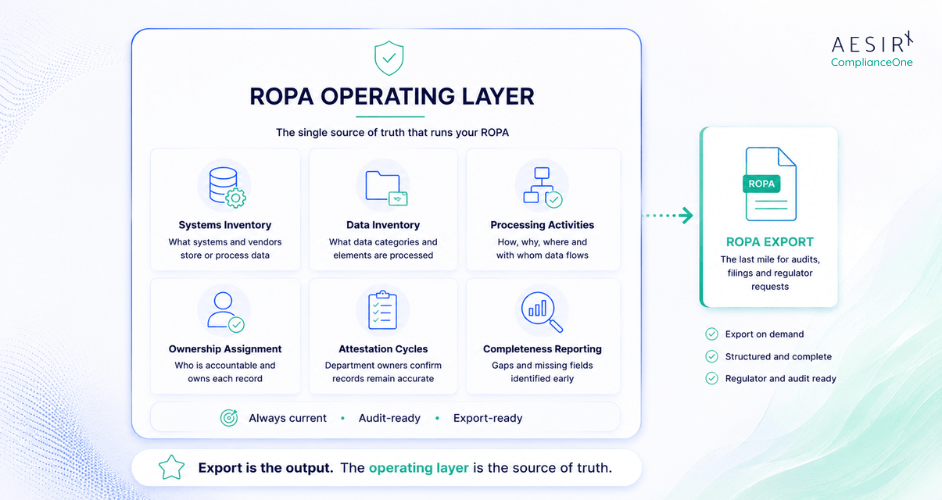
The record is not only the final export. The record is the structured operating layer that produces the export. In ComplianceOne, that layer connects systems, data categories, purposes, retention policies, data flows, processing activities, evidence, review status, ownership, and exportable records.
This matters because the export should be the last mile, not the source of truth.
A living ROPA operating layer needs six ingredients:
- A systems inventory that says which applications, databases, services, and vendors hold or move regulated data.
- A data inventory that names the categories and specific data elements the organisation processes.
- Processing activity records that connect systems, data, purposes, retention, recipients, and transfer context.
- Ownership assignment so every record has a responsible business owner and review path.
- Attestation cycles so department owners periodically confirm whether the record is still true.
- Completeness reporting so missing fields are visible before an audit or filing review.
The point is not to create more administration. The point is to stop pretending that one spreadsheet can hold an entire organisation's data reality without operational support.
Systems are the foundation
You cannot maintain processing records if you do not know the systems that hold and move data.
Systems inventory is the practical foundation because business processes usually depend on applications, databases, platforms, and vendor tools. A processing activity such as customer onboarding may touch a website, identity verification tool, CRM, customer support system, payment provider, email platform, analytics stack, archive, and reporting warehouse. If the systems are not mapped, the activity record becomes a guess.
The systems layer also gives the DPO something a spreadsheet rarely provides: operational status.
An active system should be reviewed differently from a planned system. A decommissioning system raises migration and retention questions. A vendor system with unresolved governance questions may block a clean record. A high-criticality system may deserve a tighter review cadence.
The record becomes stronger when each system has an owner, status, criticality, and relationship to processing activities. That lets the DPO ask better questions:
- Which active systems contribute to this activity?
- Which systems have unreviewed ownership or evidence gaps?
- Which system changes should trigger a ROPA review?
This is where ROPA stops being a table and starts becoming infrastructure.
Data categories need more than labels
Many organisations classify data at a broad level: contact data, financial data, employee data, health data, behavioral data, device data, and so on.
That is necessary, but it is not enough.
A processing record needs to know which categories are used, where they appear, which data elements sit inside them, how sensitivity is determined, what retention applies, and which activities depend on them. A category without ownership or linkage becomes vocabulary. A category connected to systems, activities, retention, and evidence becomes governance.
This distinction matters when the business changes. If marketing adds a new profile field, the DPO should not wait until the next annual spreadsheet refresh to discover it. The data governance lead should be able to route that item for owner review, attach it to the right category, and see which processing activities are affected.
The strongest records are not built by naming categories once. They are maintained by keeping the relationship between data elements, categories, activities, and evidence alive.
Processing activities are where the truth comes together
The processing activity is where ROPA becomes more than inventory.
It is the place where the organisation answers the operational questions a regulator, auditor, or board will eventually ask:
- What regulated data is processed?
- Who is it about?
- Why is it processed?
- Which systems and departments touch it?
- Which recipients or vendors receive it?
- Which cross-border flows apply?
- What retention policy governs it?
- Which controls and evidence support it?
- Who reviewed it, and when?
The spreadsheet model treats these fields as columns. Living infrastructure treats them as relationships.
That difference changes the work. A department owner does not need to write a long narrative from memory. They respond to scoped tasks tied to their systems and responsibilities. The data governance lead does not manually reconcile every answer. The platform consolidates structured inputs, flags missing or conflicting sections, and preserves who supplied what. The DPO does not approve a document in the abstract. The DPO reviews a record with lineage.
“The processing activity is not a row. It is the meeting point between business process, data reality, and accountability.”
Ownership has to be explicit
ROPA breaks down when ownership is implied.
Everyone assumes someone else owns the field. Marketing owns the purpose. IT owns the system. Legal owns the basis. Procurement owns the vendor. Data governance owns the category. The DPO owns the final record. Then a field goes stale and nobody knows who had the duty to update it.
Living infrastructure makes ownership explicit across the record. Responsibility can be assigned at multiple levels: systems, flows, activities, categories, purposes, and retention policies. The important point is that ownership is attached to the object being governed, not buried in an email.
This gives the organisation three advantages: the DPO can see who owes input before approval, department owners receive scoped work, and the audit trail can show who confirmed the record.
Ownership is not bureaucracy. It is how the record stays alive after the export is produced.
Attestation turns memory into evidence
Attestation is the discipline that turns department memory into evidence. Instead of asking every team to refresh a spreadsheet, the central owner runs review cycles against the records and fields that need confirmation. Department owners receive scoped tasks. They confirm what is still true, correct what changed, attach evidence where required, and send uncertain items back for review.
This creates a different kind of record.
The DPO can see which teams have responded, which items are stale, which answers conflict, and which activities still have missing fields. The audit lead can later see contributor and reviewer history instead of relying on a final spreadsheet with no lineage.
Completeness has to be tested before the audit
Many teams discover ROPA gaps at the worst possible time: during an audit, during a regulatory inquiry, during a transaction diligence review, or when a privacy incident reveals that the data map was incomplete.
Completeness reporting moves that discovery earlier.
A useful completeness report does not simply say "record missing." It shows the field-level hygiene of every active processing activity, the priority of each miss, and the exact activity that needs correction.
That field-level view matters because ROPA gaps rarely arrive as one dramatic absence. They arrive as small holes:
- A missing retention period.
- A data category without a linked inventory item.
- A processing purpose without a clear basis.
- A cross-border flow without enough review context.
- A system owner who has not confirmed the current status.
- A draft activity that never became active.
Small holes become large risk when they are scattered across many activities. Completeness reporting lets the privacy team see the pattern before someone else does.
Evidence belongs inside the record
The record should not only say that something is true. It should carry the proof that supports the statement.
Evidence may include system exports, diagrams, screenshots, policy references, owner attestations, review notes, approval history, vendor documents, retention confirmations, and change records. If those artifacts live in a shared drive, the DPO still has a reconstruction problem. If they live with the processing activity, the record becomes easier to defend.
This is where audit readiness becomes practical.
When an auditor asks why a data flow was included, the evidence is linked. When a regulator asks who approved a change, the review history is preserved. When the board asks whether the programme is improving, completeness trends and attestation status show where work remains.
The export is important. The evidence behind it is what makes the export credible.
ROPA Operating Layer in Practice
Walkthrough: the DPO preparing for a regulatory review
Consider a group DPO preparing for a regulatory review of customer onboarding, marketing, and support operations.
In the spreadsheet model, the DPO sends requests to every department and waits. Marketing returns a campaign inventory. Support returns ticket fields. IT sends a systems list. Procurement sends vendor documents. Legal comments on basis and retention. The DPO then reconciles everything manually.
In a living ROPA model, the DPO starts from the current processing activity records.
The customer onboarding activity already links to its systems, data categories, purposes, retention policies, flows, and owners. The DPO runs a review cycle. Marketing confirms campaign fields. Support confirms call and ticket data. IT confirms systems status. Procurement attaches current vendor evidence. Legal reviews basis and restriction context. Data governance resolves category or retention gaps.
The DPO is not chasing a document. The DPO is watching a controlled review of the record itself.
When the export is generated, it carries the current record and the review history behind it. If the regulator asks who supplied the information and what evidence supports it, the answer is the record's own lineage.
Walkthrough: the data governance lead finding stale records before they become risk
Now consider a data governance lead responsible for keeping the enterprise data inventory current.
A new analytics field appears during a discovery cycle. It is attached to customer behavior, used by marketing, and stored in a platform that feeds reporting. In a spreadsheet model, this change may sit unnoticed until the next refresh.
In a living model, the new item enters review before it becomes part of the published record. The data governance lead assigns ownership, confirms the category, checks retention, and links the item to the processing activities that use it. If the field changes sensitivity or evidence requirements, the affected activities become visible for review.
This is the practical value of living infrastructure. It does not wait for the annual refresh to discover that the business changed. It catches the change near the work that created it.
Walkthrough: the department owner who finally gets a scoped request
Department owners often experience privacy governance as a stream of vague requests.
"Please update the data inventory."
"Please confirm your systems."
"Please review the ROPA."
Those requests sound reasonable to the central team, but they are too broad for the person receiving them. A support operations lead does not want to interpret a legal template. They need to know which support processes, systems, fields, and vendors are in scope, what answer is required, and what evidence to attach.
Living infrastructure changes the request from "fill this spreadsheet" to "confirm these records."
The department owner sees the systems and activities assigned to them. They review the fields that relate to their operation, attach evidence where required, and return uncertain items for clarification. Their contribution is recorded against the record.
The department owner is no longer a reluctant spreadsheet contributor. They become a named steward of the part of the record they actually understand.
Managing the record, not the document
The mindset shift is simple, but it changes the entire programme.
Do not ask whether the organisation can produce a ROPA export. Ask whether the organisation can operate the facts that make the export true: ownership, review cycles, completeness checks, evidence, data inventory, change triggers, and export history.
This is why ROPA belongs in operational infrastructure, not in a static compliance file.
A spreadsheet can document yesterday's understanding. Living infrastructure can show how the organisation keeps that understanding current.
Making the record credible
Records of processing become powerful when they stop being treated as records only.
They are the operating map of the organisation's data reality: systems, people, purposes, data, flows, retention, evidence, and accountability. When that map is alive, the organisation maintains proof as part of daily work.
If you want to see how AesirX ComplianceOne turns data mapping, ownership, attestation, completeness reporting, and ROPA exports into one operational evidence layer, explore the platform here: https://aesirx.io/compliance-one
Ronni K. Gothard Christiansen
Technical Privacy Engineer and CEO, AesirX.io
Disclaimer: This article is educational and does not provide legal advice. Regulatory duties vary by jurisdiction, sector, role, and processing context. Always validate your organisation's obligations with qualified counsel.