

TL;DR: Most organizations still treat compliance as a document problem. They collect policies, keep spreadsheets, run annual reviews, and hope the evidence can be assembled when a regulator, auditor, board committee, customer, investor, or bank asks for proof. That model no longer works. Under Vietnam’s expanding regulatory stack - PDPL, Decree 356, the Law on Data, the Cybersecurity Law, sector overlays such as Banking Circular 83, and international frameworks such as ISO 27001, SOC 2, GDPR, NIS2, DORA, and ePrivacy - the question is no longer whether an organization says it is compliant. The question is whether it can prove, quickly and coherently, what happened, who decided, which requirement applied, which evidence supports the claim, and whether the same control is reusable across overlapping frameworks. Audit readiness is not a legal statement. It is an operating condition. This article sets out five maturity markers that distinguish organizations that merely own compliance documents from organizations that can survive inspection.
This article is written for DPOs, compliance managers, CISOs, internal audit leads, legal counsel, risk officers, vendor-risk leaders, board members, and executives who are trying to move compliance out of the policy folder and into daily operations.
It is especially relevant for organizations in Vietnam that now have to operate across personal data protection, cybersecurity, data governance, cross-border transfer controls, sector-specific regulation, website compliance, vendor management, internal controls, and AI-assisted governance.
The company that looked compliant until someone asked for proof
A company has a privacy policy. It has a cookie banner. It has a vendor list. It has an information security policy. It has a data processing agreement template. It has a spreadsheet for risks, another spreadsheet for vendors, a shared drive folder for evidence, and a compliance manager who knows where most things are stored.
From the outside, it looks mature.
Then the questions arrive.
A customer asks for evidence that third-party trackers are blocked before consent.
The DPO asks whether the organization can prove the lawful basis for each processing purpose.
The internal audit team asks who approved the last vendor risk acceptance.
The board asks whether the organization has unresolved high-risk findings.
A regulator asks when a data subject request was received, who handled it, whether the deadline was met, and which response was sent.
A bank, insurer, or enterprise buyer asks for control evidence mapped to a framework.
An AI advisor suggests a remediation plan, and the legal team asks whether the suggestion was grounded, reviewed, accepted, and logged.
Suddenly the question is not:
“Do we have compliance documents?”
It is:
“Can we reconstruct the truth?”
That is the difference between having compliance material and being audit-ready.
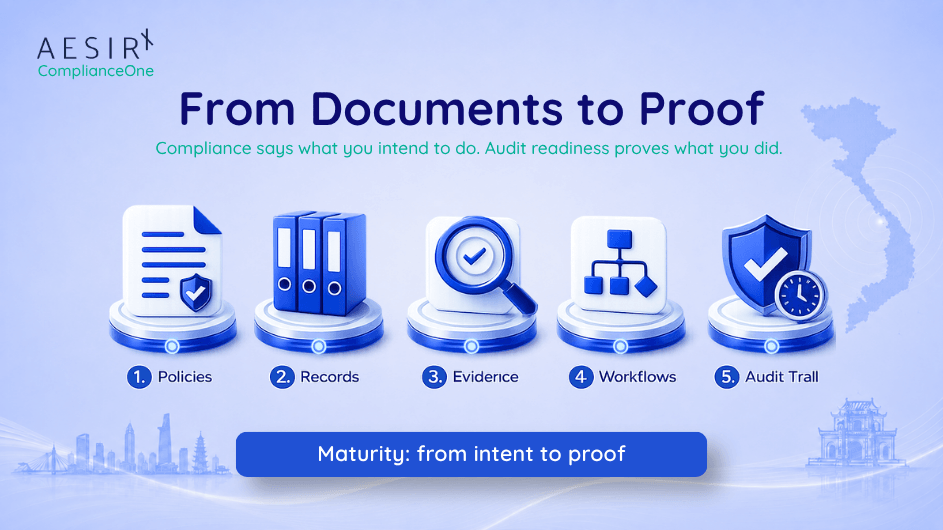
“Compliance says what the organization intends to do. Audit readiness proves what the organization actually did.”
The distinction matters because modern regulation is no longer satisfied by static documentation. Regulators, auditors, customers, investors, and boards increasingly ask for operational proof: timestamps, owners, versions, approvals, risk decisions, evidence links, deadline history, and change lineage.
The organizations that can produce that proof are not necessarily larger. They are more operationally mature.
Audit readiness is not the same as compliance
Compliance is the organization’s legal and regulatory posture.
Audit readiness is the organization’s ability to prove that posture under pressure.
A company can have a good legal interpretation and still fail operationally because the evidence is fragmented. A company can have a strong policy and still fail because nobody can prove whether the policy was followed. A company can run a vendor review and still fail because the risk acceptance was recorded in an email thread that nobody can find six months later.
This is why audit readiness has to be treated as a separate maturity layer.
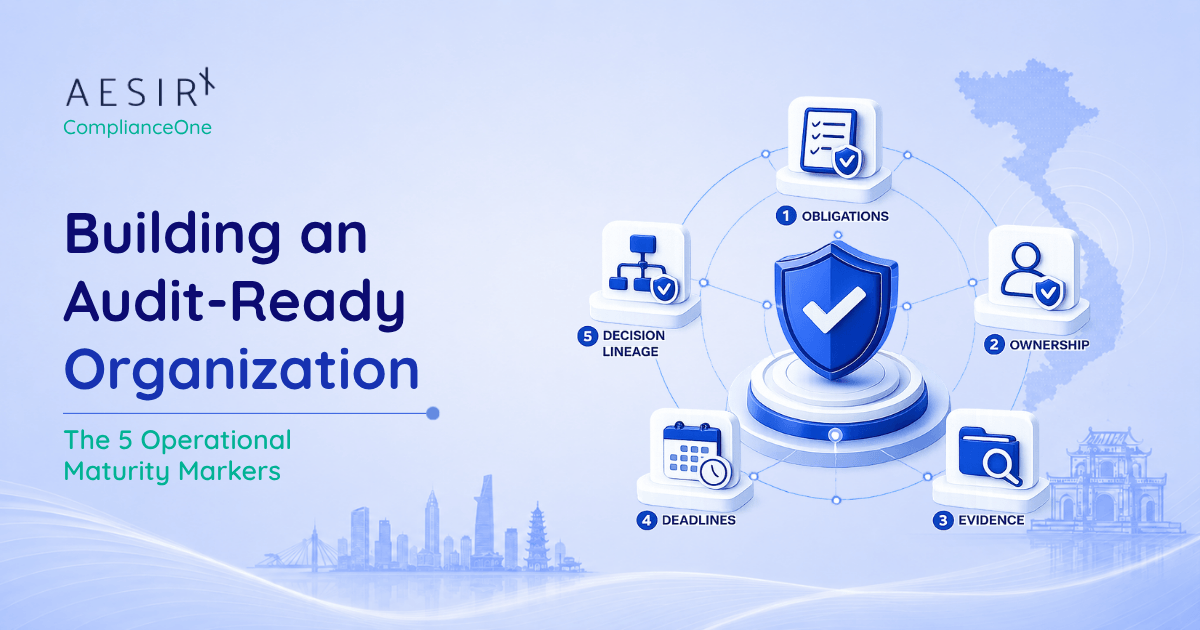
It asks five operational questions:
- Can we identify the obligation?
- Can we assign the owner?
- Can we show the evidence?
- Can we prove the timeline?
- Can we reconstruct the decision?
If the answer to any of those questions depends on one person remembering where something is stored, the organization is not audit-ready. It is dependent on institutional memory.
That dependency is fragile.
People leave. Spreadsheets fork. Shared drives become archives. Policies age. Deadlines move. Regulatory packs change. Vendors update sub-processors. Consent banners get modified by marketing scripts. AI-generated suggestions enter the workflow. Sector-specific obligations land on top of horizontal frameworks.
The operating model has to survive all of that.
Marker 1: obligations are mapped to operational records, not buried in policies
The first maturity marker is that the organization knows which obligations apply and where each obligation lives operationally.
Immature organizations store regulation as PDFs, policy text, and legal summaries.
Mature organizations translate obligations into working records.
A personal data protection obligation is not only a paragraph in a law. It becomes a DPIA requirement, a transfer assessment field, a consent workflow, a rights-request deadline, a breach-notification trigger, a vendor-control checklist, or an evidence requirement.
A banking internal-control obligation is not only a circular. It becomes an annual report, a control self-assessment, an internal audit record, a risk appetite statement, a remediation workflow, or a board-reporting obligation.
An ePrivacy requirement is not only a cookie rule. It becomes a pre-consent blocking test, a vendor-by-vendor purpose record, a scanner finding, a banner configuration, and a repeatable monitoring check.
The maturity shift is from legal text as reference to legal text as workflow input.
That does not mean legal interpretation disappears. It means legal interpretation becomes operationally connected.
The organization should be able to open a requirement and see:
- the framework it belongs to;
- the module where it is implemented;
- the records that satisfy it;
- the evidence attached to those records;
- the person or function responsible;
- the deadline or trigger, if any;
- the current status;
- the audit trail behind the last change.
This is where many organizations fail. They can show the regulation. They can show the policy. But they cannot show the operational record that proves the requirement is being executed.
That gap becomes visible the moment an inspector or enterprise buyer asks for a control walk-through.
“A requirement that is not connected to a record is not operational compliance. It is reading material.”
For an audit-ready organization, the regulatory library, the forms, the controls, the workflows, the deadlines, and the evidence model are not separate worlds. They are connected parts of the same governance system.
Marker 2: ownership is explicit before the deadline arrives
The second maturity marker is named ownership.
Not abstract ownership. Not “legal handles it.” Not “IT probably has that.” Not “the DPO will coordinate.” Not “the country manager knows.”
Named operational ownership.
Every obligation that requires action should have a responsible function and, where appropriate, a named owner. Every workflow should know who prepares, who reviews, who approves, and who is informed. Every control should know who performs it, who tests it, and who accepts the residual risk.
This is particularly important in layered compliance environments.
A DPO may own the privacy dossier.
A CISO may own cybersecurity controls.
Legal may own contract clauses and regulatory interpretation.
Procurement may own vendor onboarding.
Internal audit may own control testing.
Risk may own risk appetite and acceptance.
The board may own final oversight.
In a sector-regulated organization, the same evidence can serve multiple functions, but the ownership does not collapse into one person. A vendor record may support PDPL, ISO 27001, SOC 2, cybersecurity, outsourcing, and banking-sector requirements at the same time. But the review paths may differ.
That is why ownership has to be explicit at the record and workflow level.
The audit-ready organization can answer:
Who owned this record?
Who approved this decision?
Who accepted this risk?
Who was notified?
Who changed the status?
Who missed the deadline?
The immature organization answers with a story.
The mature organization answers with an audit trail.
This is not bureaucracy for its own sake. It is how organizations avoid failure by ambiguity.
When ownership is unclear, deadlines slip. Evidence gets duplicated. Teams assume other teams are handling the same obligation. Risk acceptances happen informally. Vendors go live before review is complete. Consent implementations are changed without legal review. AI suggestions are copied into documents without traceability.
The result is not only compliance risk. It is operational noise.
An audit-ready organization reduces that noise by making responsibility visible.
Marker 3: evidence is captured during the work, not reconstructed after it
The third maturity marker is continuous evidence capture.
This is the marker that separates serious compliance operations from theatre.
Many organizations still run compliance as an annual evidence-gathering exercise. For most of the year, teams do the work in emails, meetings, spreadsheets, ticketing systems, shared folders, and chat. Then, when an audit or customer review arrives, the compliance team spends days or weeks reconstructing what happened.
That model is expensive, slow, stressful, and unreliable.
It also creates a dangerous incentive: people start writing evidence after the fact.
An audit-ready organization captures evidence as a by-product of the work itself.
When a DPIA is created, the evidence attaches to the DPIA.
When a vendor is reviewed, the due diligence artifacts attach to the vendor record.
When a risk is accepted, the reasoning, approver, expiry date, and compensating controls are recorded at acceptance time.
When a rights request is handled, intake, identity verification, correspondence, deadlines, decisions, and response artifacts remain connected.
When a breach assessment is performed, the timeline, severity analysis, legal review, notification decision, and authority communication are preserved.
When a consent banner is configured, the scanner results, vendor classifications, purpose records, and blocking behavior are documented.
When an AI advisor produces a draft, the prompt context, tool calls, citations, accepted fields, rejected fields, and final human decision remain traceable.
The principle is simple:
“Evidence created after the fact explains the story. Evidence captured during the work proves the story.”
This matters even more in Vietnam’s current compliance environment because organizations are no longer dealing with a single regulatory lens. Personal data protection, cybersecurity, data governance, sector overlays, e-commerce, telecommunications, banking, outsourcing, AI governance, and international customer requirements all create evidence demands.
If each team captures evidence separately, the organization drowns in duplication.
If evidence is captured once and mapped properly, the same artifact can support multiple requirements without losing its original context.
That is the operational advantage.
Not fewer obligations. Better evidence reuse.
Marker 4: deadlines are managed as regulatory workflows, not calendar reminders
The fourth maturity marker is deadline intelligence.
A calendar reminder is not a compliance workflow.
A calendar reminder can tell someone that a deadline exists. It cannot prove when the trigger occurred, which rule applied, who owned the response, whether an extension was allowed, whether third parties were involved, what evidence was collected, who approved the response, and whether the final action was completed within the required window.
Modern compliance deadlines are not simple dates. They are conditional rules.
A data subject request deadline may depend on when the request was received, whether identity verification was required, whether third parties were involved, whether the request was access, deletion, withdrawal, restriction, objection, or rectification, and whether an extension is permitted.
A breach notification timeline may depend on when the organization became aware, how severity was assessed, which jurisdiction applies, and whether regulator or data-subject notification is required.
A cross-border transfer assessment may depend on the transfer purpose, recipient, destination country, legal basis, safeguards, risk level, and approval status.
A banking annual report may depend on fiscal year-end, sector applicability, responsible function, official template, board approval, and reporting window.
A phased obligation may become active only on a future date or earlier if the organization elects early implementation.
A calendar cannot model that.
A workflow can.
The audit-ready organization treats time as part of the control system. It can show not only that something was done, but whether it was done on time under the correct rule.
That requires:
- trigger capture;
- deadline calculation;
- owner assignment;
- escalation;
- extension logic;
- status history;
- evidence linkage;
- final closure;
- audit trail.
The difference becomes obvious under inspection.
The immature organization says, “We believe we responded within the deadline.”
The audit-ready organization shows the intake timestamp, the calculated deadline, the responsible owner, the correspondence history, the decision log, the final response, and the closure event.
That is not a cosmetic difference.
It is the difference between assertion and proof.
Marker 5: decisions have lineage, especially when AI is involved
The fifth maturity marker is decision lineage.
This is the marker that will define the next generation of compliance operations.
Organizations are already using AI to summarize regulation, draft DPIAs, review contracts, classify vendors, explain scanner findings, create remediation plans, and answer compliance questions. That is not the future. It is already happening.
The risk is not that AI helps.
The risk is that AI output enters the compliance record without inspection, citation, approval, or traceability.
In regulated work, an AI-generated answer is not useful because it sounds confident. It is useful only if the organization can inspect it.
Who asked the question?
What data did the AI use?
Which regulatory pack was searched?
Which records were retrieved?
Which citations supported the answer?
Which draft fields were accepted?
Which were rejected?
Who approved the final change?
Was the answer written into a record?
Did it create a task?
Did it attach evidence?
Was any external tool involved?
Can the entire chain be reconstructed later?
That is decision lineage.
Without it, AI becomes an invisible contributor to regulated work. That is unacceptable. An inspector cannot audit a black box. A legal team cannot defend a conclusion it cannot trace. A board cannot rely on a risk summary that has no source trail.
This is why auditable AI must be treated as part of the compliance operating model, not as a chat widget bolted onto the side.
The audit-ready organization does not ask only whether AI can accelerate work. It asks whether AI-assisted work can survive scrutiny.
“The value of AI in compliance is not the answer. It is the inspectable path to the answer.”
That path has to include grounding, human review, approval gates, audit events, and record-level back-references.
The same principle applies beyond AI. Every meaningful compliance decision should have lineage: legal interpretations, risk acceptances, vendor approvals, breach decisions, transfer approvals, control exceptions, policy deviations, and remediation closures.
If the organization cannot reconstruct why a decision was made, it does not truly own the decision.
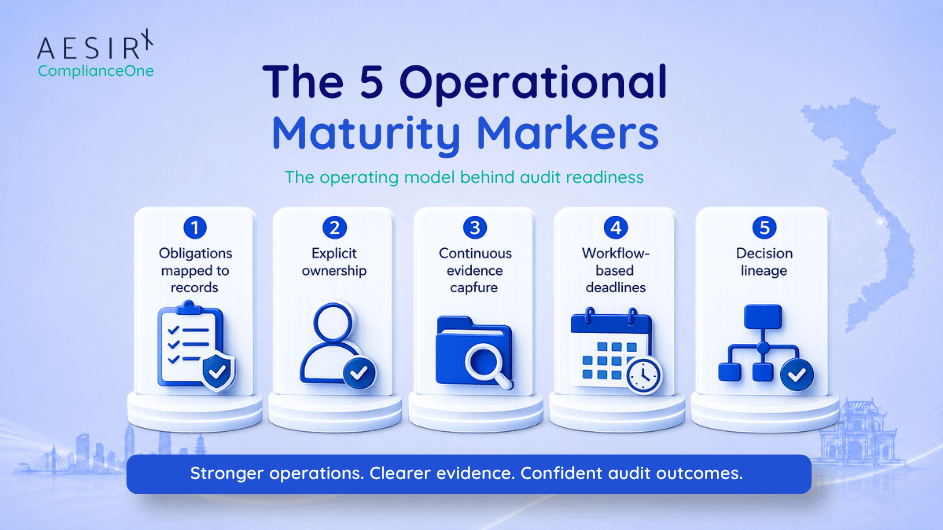
The five markers as a practical maturity test
An organization can test its audit readiness with five simple questions.
- Obligations mapped to records: Can we open a requirement and see the operational records that satisfy it?
- Explicit ownership: Can we see who prepared, reviewed, approved, and changed each record?
- Continuous evidence capture: Is evidence attached during the work, or reconstructed later?
- Workflow-based deadlines: Are regulatory deadlines calculated from triggers, or managed as calendar reminders?
- Decision lineage: Can we reconstruct the path from question to evidence to decision to approved record?
Most organizations can answer “partly” to some of these.
That is not failure. It is the starting point.
The mistake is pretending that document maturity equals operational maturity.
A company can have beautiful policies and poor evidence. It can have a serious DPO and weak workflow. It can have strong legal counsel and fragmented records. It can have ISO documentation and still fail on website consent. It can have AI assistance and no AI audit trail.
Audit readiness requires the pieces to connect.
Why this matters now in Vietnam
Vietnam is moving quickly from policy-level compliance into operational compliance.
The legal environment is no longer one-dimensional. Organizations have to consider personal data protection, cross-border transfers, cybersecurity, data governance, sector-specific regulation, vendor risk, website tracking, internal controls, and increasingly AI governance.
Last week’s consent-gap study made one point visible: many corporate websites still show a gap between what compliance pages say and what the browser actually does. That same pattern exists across broader governance.
The document says one thing.
The system does another.
The evidence is missing.
That is the real compliance gap.
For Vietnamese companies preparing for PDPL enforcement, Data Law obligations, cybersecurity requirements, sector overlays, enterprise customer reviews, bank due diligence, ISO certification, SOC 2 preparation, or international expansion, audit readiness is no longer optional.
It becomes a commercial requirement.
Customers ask for proof before procurement.
Investors ask for proof before funding.
Banks ask for proof before onboarding.
Regulators ask for proof after complaints.
Boards ask for proof after incidents.
Legal teams ask for proof when exposure becomes visible.
The organization that can answer quickly earns trust. The organization that needs three weeks to assemble screenshots, emails, spreadsheets, and policy extracts sends a different signal.
What audit-ready looks like in practice
An audit-ready organization does not need to be perfect.
It needs to be coherent.
It can show its framework map.
It can show which obligations apply.
It can show which obligations are not yet fully implemented.
It can show the risk owner for each gap.
It can show the evidence already collected.
It can show the missing evidence.
It can show deadlines and status.
It can show who approved what.
It can show why a risk was accepted.
It can show how a vendor was reviewed.
It can show how a data subject request was handled.
It can show how a breach decision was reached.
It can show how AI-assisted outputs were grounded, reviewed, accepted, or rejected.
It can show improvement over time.
That last point matters.
Audit readiness does not mean the organization has no gaps. It means the organization can see its gaps, own them, prioritize them, and prove what it is doing about them.
A regulator, auditor, enterprise customer, or board does not expect every organization to be flawless. But they will expect the organization to know its own state.
The worst answer is not “we have a gap.”
The worst answer is “we do not know.”
Where ComplianceOne fits
AesirX ComplianceOne is being built around this operating model.
Not as a policy repository.
Not as a generic checklist.
Not as a thin compliance UI.
The platform connects regulatory packs, forms, workflows, evidence, deadlines, audit trails, sector overlays, AI assistance, and exportable records into one governance layer.
That is the product thesis:
Compliance should be operational before it is inspected.
The five maturity markers are therefore not abstract theory. They are the architecture:
- regulatory obligations map into working records;
- records have owners, workflows, statuses, and approvals;
- evidence is attached where the work happens;
- deadlines are triggered by regulatory logic;
- AI assistance is grounded and human-gated;
- audit trails preserve the chain of custody;
- sector overlays sit on top of horizontal frameworks without flattening them;
- the organization can export what it needs when inspection arrives.
The purpose is not to make compliance look mature.
The purpose is to make the organization provably mature.
Closing
The next phase of compliance will not be won by the organization with the longest policy library.
It will be won by the organization that can prove its operating reality.
When the regulator asks what happened, the answer cannot depend on memory.
When the auditor asks for evidence, the answer cannot be a shared-drive search.
When the customer asks for control proof, the answer cannot be a generic policy.
When the board asks whether risk is under control, the answer cannot be a dashboard with no lineage behind it.
When AI contributes to regulated work, the answer cannot be “the assistant said so.”
Audit readiness is the discipline of making the organization inspectable.
The five markers are simple:
- map obligations to operational records;
- assign ownership before deadlines arrive;
- capture evidence during the work;
- manage deadlines as workflows, not reminders;
- preserve decision lineage, especially when AI is involved.
That is how an organization moves from compliance theatre to compliance operations.
And that is the standard regulated companies in Vietnam and beyond will increasingly be expected to meet.
If you want to see how audit readiness works as an operating model - across regulatory packs, workflows, evidence, deadlines, AI assistance, sector overlays, and audit trails - you can explore AesirX ComplianceOne at:
https://aesirx.io/compliance-one
Ronni K. Gothard Christiansen
Technical Privacy Engineer & CEO, AesirX.io
Laws, regulations, and frameworks referenced
- Luật Bảo vệ dữ liệu cá nhân (PDPL): Vietnam Personal Data Protection Law, Law No. 91/2025/QH15, issued 26 June 2025, effective 1 January 2026.
- Nghị định 356/2025/NĐ-CP: Decree detailing and guiding implementation of the Personal Data Protection Law, issued 31 December 2025, effective 1 January 2026.
- Luật Dữ liệu: Vietnam Data Law, Law No. 60/2024/QH15, issued 30 November 2024, effective 1 July 2025.
- Luật An ninh mạng: Vietnam Cybersecurity Law, referenced as part of the wider legal context for cybersecurity, cross-border digital services, system security, and data governance.
- Thông tư số 83/2025/TT-NHNN: State Bank of Vietnam circular on internal control systems for commercial banks and foreign bank branches, referenced as an example of a sector overlay that creates audit, reporting, internal-control, risk-management, and supervisory-evidence obligations on top of horizontal compliance frameworks.
- Sector-specific rules and supervisory expectations: Relevant sector overlays may apply depending on the organization, including banking, insurance, telecom, aviation, healthcare, logistics, e-commerce, infrastructure, payments, energy, education, and other regulated or high-data-volume sectors.
- International and assurance frameworks: GDPR, ePrivacy, ISO/IEC 27001, SOC 2, NIS2, DORA, and related international assurance frameworks are referenced as part of the wider audit-readiness and evidence-mapping context for organizations operating across jurisdictions or serving international customers.
Disclaimer
This article is for informational purposes only and does not constitute legal advice.
It discusses audit readiness, operational compliance maturity, evidence management, regulatory mapping, workflow design, and AI-assisted governance from a technical and compliance-operations perspective. It should not be treated as a final legal interpretation of any individual organization’s obligations, compliance status, filing duties, cross-border transfer position, cybersecurity posture, sector-specific obligations, or enforcement exposure.
Organizations should obtain qualified legal advice before making regulatory filings, data protection impact assessments, cross-border transfer assessments, data-classification decisions, risk-acceptance decisions, sector-regulatory submissions, breach-notification decisions, or enforcement-risk conclusions.
AesirX ComplianceOne and Forseti can support compliance work, evidence management, regulatory mapping, workflow execution, audit preparation, AI-assisted drafting, and chain-of-custody documentation. They do not replace qualified legal counsel, the responsible DPO, the compliance function, internal audit, risk management, board oversight, or human review and approval of compliance evidence, assessments, filings, and decisions.
FAQ
It is not the same as simply having policies or legal documents. An audit-ready organization can show what happened, who did it, which requirement applied, what evidence supports the claim, when the action occurred, and how the decision was approved.
Audit readiness also matters for enterprise customers, investors, banks, insurers, internal audit teams, board committees, ISO/SOC 2 assessors, vendor due diligence, procurement reviews, cyber insurance reviews, and legal disputes.
In practice, many organizations are asked to prove their controls long before a regulator appears.
They do not prove that the work was actually performed.
A privacy policy, information security policy, vendor policy, or AI governance policy may be useful, but it does not by itself prove that a DPIA was completed, a vendor was reviewed, a data subject request was handled on time, a breach decision was approved, a risk was accepted by the right person, or a non-essential tracker was blocked before consent.
Audit readiness requires operational records and evidence, not only policy text.
If AI helps draft a DPIA, summarize a regulation, classify a vendor risk, produce a remediation plan, or answer a legal/compliance question, the organization must be able to inspect how that output was produced.
That means preserving the prompt context, retrieved records, citations, tool calls, draft output, human review, accepted fields, rejected suggestions, final approval, and resulting record changes.
In regulated work, AI is only useful if the path to the answer can be audited.
The practical first step is to identify the key regulatory obligations that apply to the organization and connectthem to the records, workflows, owners, deadlines, and evidence that prove execution.
For most organizations, the first priority should be:
1. inventory applicable frameworks and sector rules;
2. map obligations to operational workflows;
3. assign named owners;
4. attach evidence during the work;
5. replace calendar reminders with regulatory deadlines;
6. preserve decision lineage for risk, legal, privacy, vendor, breach, and AI-assisted decisions.
The goal is not to become perfect overnight. The goal is to stop relying on memory, scattered files, and after-the-fact reconstruction.