
Most GRC platforms entering the Vietnamese market start with a GDPR-based architecture and adapt it. They translate the interface, map a few Vietnamese legal references into European-shaped fields, and call it localization. The result is a tool that looks Vietnamese but thinks European, and breaks down the moment an enterprise DPO needs to assemble a filing dossier for the Ministry of Public Security or coordinate cross-department attestations under Decree 356.
Vietnam's regulatory environment is structurally different from the EU's. Building compliance operations here requires starting from Vietnamese regulatory logic, not adapting someone else's.
Why Adapting Western GRC Tools Fails in Vietnam
Western GRC platforms are designed around a specific compliance model: a single supervisory authority, a unified data protection regulation, and standardized filing procedures. GDPR compliance tools assume one primary framework, one regulator, and one set of submission templates.
Vietnam does not work this way. Vietnamese enterprises operate under six distinct regulatory frameworks, each governed by a different ministry with its own authority relationships, filing requirements, and enforcement patterns. The Ministry of Public Security (Bo Cong an) oversees personal data protection under the PDPL. The Ministry of Industry and Trade handles e-commerce obligations. The Ministry of Information and Communications governs telecommunications data requirements. These are not variations on a theme, they are separate regulatory regimes with distinct operational demands.
When a DPO at a Vietnamese enterprise uses a GDPR-adapted tool, they encounter friction at every step. The filing forms do not match the official templates prescribed by Vietnamese decrees. The workflow logic assumes a single supervisory authority rather than three separate ministries. The dossier assembly process – critical for Vietnamese regulatory submissions – does not exist because European frameworks do not require it. The tool forces compliance teams to work around the platform rather than through it.
The data-governance problem compounds quickly. Department-level compliance inputs arrive in inconsistent formats because the platform has no Vietnamese-specific governance structure. There is no staleness detection for regulatory records, no structured attestation assembly, and no clear responsibility mapping for the multi-ministry obligations that define Vietnamese compliance work.

Why This Matters Now
Vietnam's regulatory environment has matured rapidly. Six frameworks are now active or entering enforcement, covering personal data protection, e-commerce, telecommunications, cybersecurity, data governance, and AI systems. The Cybersecurity Law amendments (116/2025/QH15) take effect on July 1, 2026. The AI Law is establishing governance requirements for AI systems operating in Vietnamese markets. This is not a single-regulation environment anymore, it is a multi-framework compliance landscape that requires coordinated operations across every framework simultaneously.
In practice, the operational pressure is immediate. Decree 356 alone prescribes the official Mẫu số filing instruments and the supporting dossier components required for personal data protection compliance.
Manual dossier assembly across these forms, while also tracking obligations under the Data Law, Telecom Law, and E-Commerce Law, creates the kind of fragmented, deadline-sensitive work that breaks spreadsheet-based compliance programs. The question is no longer whether Vietnamese enterprises need structured compliance operations, but whether they can afford to run those operations on tools that were not designed for this regulatory environment.
What Vietnam-First Regulatory Operations Look Like
Vietnam-first means the platform's regulatory logic, filing workflows, form templates, and authority interaction patterns originate from Vietnamese law, not from a European model with Vietnamese labels applied.
In a Vietnam-first compliance operation, the DPO opens a filing workflow and sees the official filing templates and dossier structures required by Decree 356, not a generic form builder adapted to approximate Vietnamese requirements.
When they prepare a submission to the Ministry of Public Security, the workflow routes through the correct authority channel with the correct dossier structure. When cross-department attestations need to be coordinated, the platform enforces clear Vietnamese-specific responsibility structures and tracks contributor lineage across every department that touches a compliance record.
Filing deadlines are tracked per framework, per authority, per obligation, because a single business operation in Vietnam may trigger requirements under the PDPL, the E-Commerce Law, and the Data Law simultaneously. Evidence is captured as a byproduct of the compliance workflow itself, not assembled manually after the fact. Dossier packages are generated from existing records rather than reconstructed from emails and shared drives under deadline pressure.
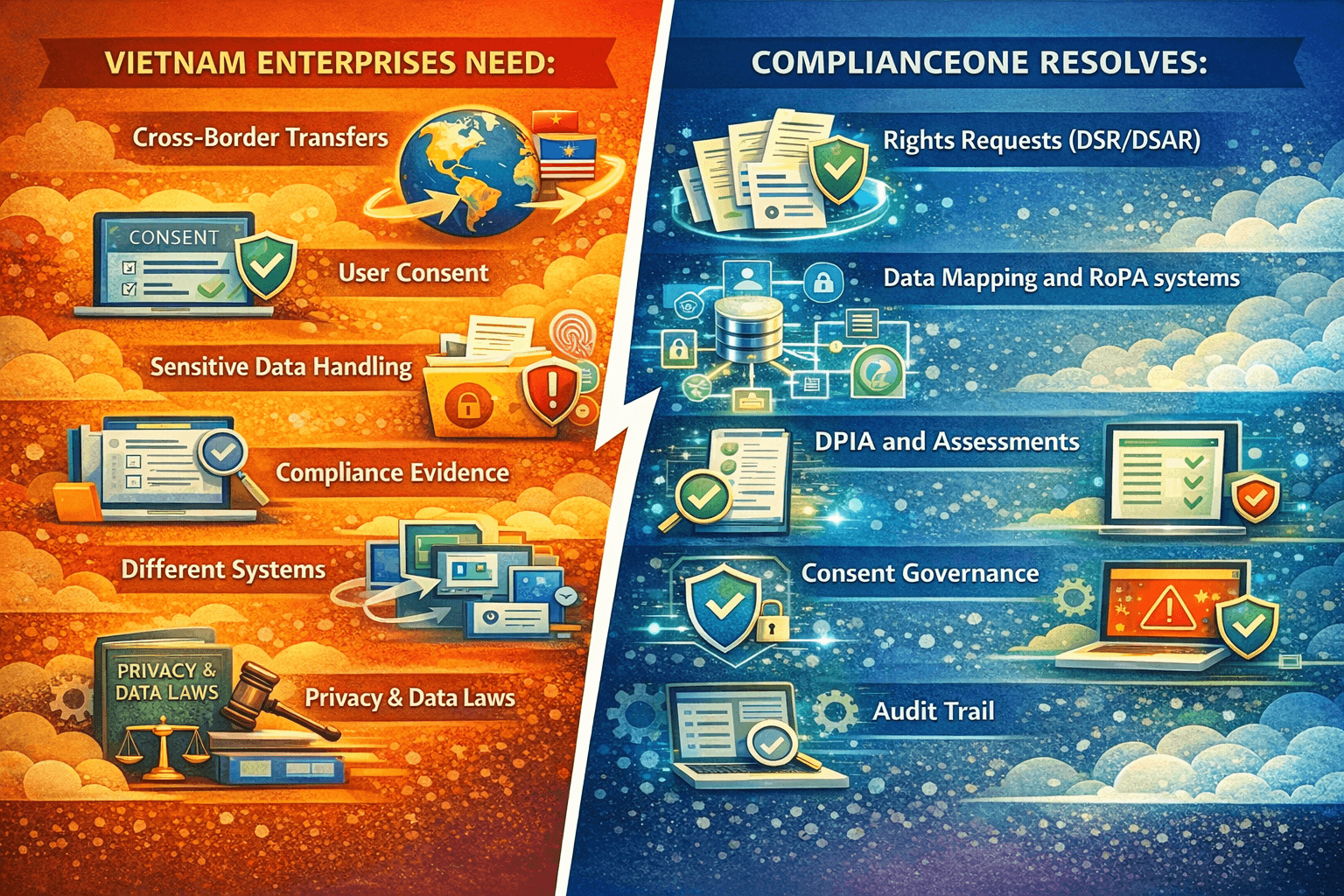
Vietnamese-language forms, Vietnamese authority submission channels, Vietnamese dossier structures, and Vietnamese regulatory logic are not features added in a localization sprint. They are the foundation the platform is built on.
How ComplianceOne Supports This
ComplianceOne was built with Vietnamese regulatory operations as a primary design target, not an afterthought. The platform supports all six Vietnamese frameworks with dedicated compliance structures for each.
The PDPL (91/2025/QH15) framework provides the personal data protection foundation, with Decree 356 implementation guidance that maps directly to the official Mẫu số filing instruments and the supporting dossier components those workflows require.
The platform supports the main Vietnamese compliance workflows across PDPL, e-commerce, telecommunications, data governance, cybersecurity, and AI-related obligations, with structures tailored to the authority relationships and filing demands of each regime.
In practice, that means support for workflows such as MPS filing submissions, multi-ministry dossier assembly, cross-department data governance coordination, authority interaction tracking, privacy assessment triggers for new products or projects, and multi-channel rights-request intake from phone, postal, and in-person channels.
The platform is built to give Vietnamese enterprises operational granularity, role-based control, Vietnamese-language regulatory content, and the ability to manage both local and EU/EEA obligations from one system without forcing teams to switch between adapted tools.
Explore Vietnam Regulatory Frameworks →
Frequently Asked Questions About Vietnam-First Compliance Operations
Key Takeaways
- Vietnam's compliance landscape is structurally different from Europe's. Six frameworks, three primary ministries, and distinct filing patterns mean GDPR-adapted tools create more operational friction than they resolve.
- Dossier assembly is a core Vietnamese compliance workflow. Decree 356 requires multiple official Mẫu số filing instruments across submission, update, notification, and assessment workflows, together with the supporting dossier components those filings require. A platform that cannot generate these filing packages from existing records forces manual reconstruction under deadline pressure.
- Multi-ministry coordination requires purpose-built authority tracking. A single business operation may trigger obligations under MPS, MOIT, and MIC simultaneously. Your compliance platform must model these distinct authority relationships, not flatten them into a single regulator abstraction.
- Vietnam-first means Vietnamese regulatory logic is the foundation, not a localization layer. Vietnamese-language forms, Vietnamese filing workflows, and Vietnamese authority submission channels should be built in from the start, not patched onto a European architecture.
- Global extensibility matters for Vietnamese enterprises expanding internationally. A Vietnam regulatory compliance platform should handle local obligations natively while also supporting EU/EEA frameworks for organizations with cross-border operations.
Next Steps
Request a pilot
See how ComplianceOne handles Vietnamese regulatory operations in your environment. Start with a focused pilot covering your highest-priority frameworks — no long-term commitment required.
Book a consultation
Discuss your multi-framework compliance challenges with our team. We will map your Vietnamese regulatory obligations to specific platform capabilities and identify where purpose-built workflows replace manual processes.