

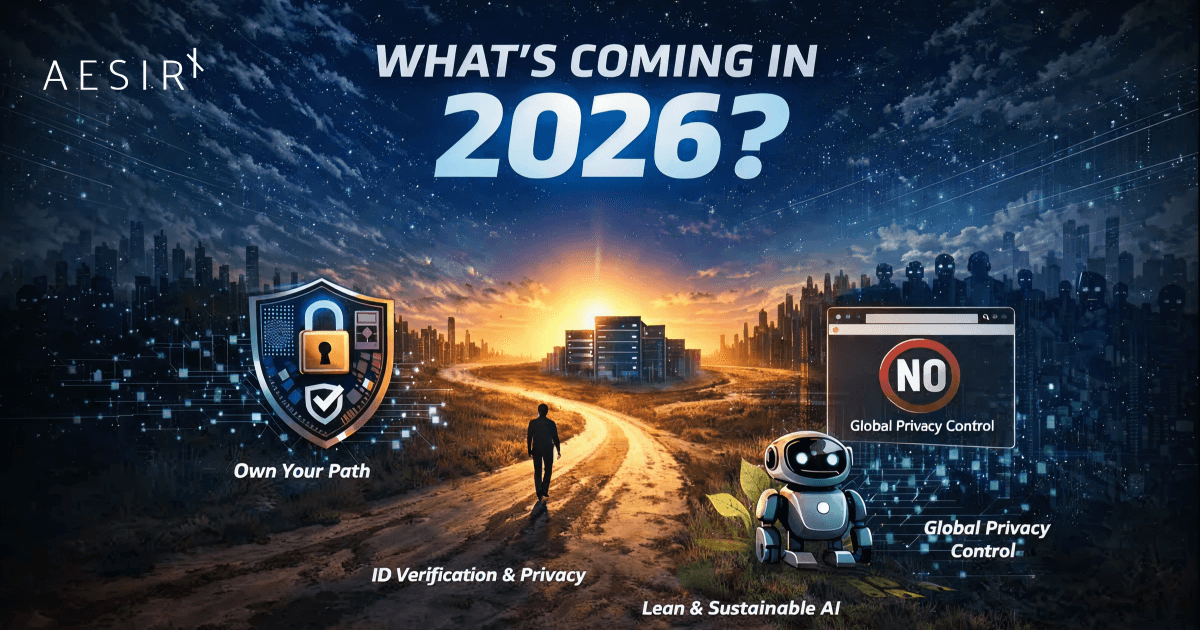
For digital agencies, web and marketing agencies, privacy professionals, and anyone translating regulation into real-world implementation across CMPs, analytics, tag stacks, UX, attribution, and governance.
TL;DR
2025 didn't "solve consent". It exposed the truth: banners are a symptom of an architecture problem.
So 2026 will reward teams that stop treating privacy as a UI layer and start treating it as infrastructure. The practical route is clear: Own Path (true first-party collection and processing) reduces the need for consent moments because you remove the third-party data export by design. Browser signals then become the scalable way for people to say "no" without having to negotiate with every site, every week, forever. And as ID verification spreads from age checks into communities and marketplaces, the only acceptable standard is verification that does not turn into tracking.
This is not a "privacy vs growth" year. It's a "privacy as the foundation for sustainable growth" year.
What 2025 made impossible to ignore
The big shift in 2025 wasn’t a new CMP feature. It was the slow, unavoidable alignment of three pressures: enforcement risk, signal loss, and trust collapse.
On one side, regulators and courts are not moving toward “consent-lite tracking by default”. They are moving toward narrower lanes where you can operate without consent only when it is genuinely necessary, proportionate, and not repurposed. On the other side, marketing teams are realizing that third-party dependency is a business risk: measurement breaks, attribution becomes guesswork, and your most valuable behavioral data becomes someone else’s asset.
That is why the Digital Omnibus debate matters even if you don’t agree with every clause. It signals a direction: simplification for consumers is only possible if the ecosystem stops relying on opaque third-party chains.
And it also revealed a political tension that will define 2026: if “simplification” excludes the biggest tracking hotspots, then it becomes theatre, not consumer protection.

2026 Prediction #1: Own Path becomes the agency advantage that actually sticks
In 2026, “Own Path” stops being a niche privacy argument and becomes the most pragmatic agency proposition.
Because it answers three client needs at the same time:
- Compliance becomes simpler when your measurement layer is controller-only, purpose-bound, and not a hidden export to third parties.
- Performance becomes more stable because you are not at the mercy of vendor-side changes, script bloat, and shifting rules.
- Trust becomes easier to earn because you can truthfully say: “your data stays here”.
Own Path, in plain terms, is a decision to stop renting your analytics integrity. Your consent layer is first-party. Your analytics collection is first-party. Your storage is first-party. Your reporting is first-party. Your improvement loop is built on data you legitimately control, instead of side-channel data that flows out through the tag stack.
This is where the narrative shifts from defensive to strategic: the agency that can implement Own Path is not “the privacy agency”. It is the agency that can give a client durable measurement in a world where third-party assumptions are decaying.
Own Path solves the biggest part of the problem by removing the third-party export. But it does not solve the rest. As long as a meaningful part of the web still relies on third parties, people will still be asked. That is where 2026 shifts from architecture to enforcement at scale: browser signals become the universal way to say no once, and have it respected everywhere.
2026 Prediction #2: Browser signals go mainstream, but the real win is the universal “NO”
Browser signals are finally being treated as the only scalable way to reduce consent fatigue. California is already pushing hard on opt-out preference signals, and that pressure will shape what browsers and operating systems implement globally.
Europe should learn from this. Not by pretending a browser setting can replace informed, contextual consent for complex vendor chains. It can’t.
But as a universal refusal mechanism, browser signals are a gift because they operate at the only layer that can scale.:
- They respect user agency at the right layer (device/browser).
- They reduce repetitive interactions.
- They reduce banner manipulation games.
- They create a clear default that sites must honor.
This is also where the strategy becomes real instead of theoretical:
If we combine Own Path with browser-level refusal, we reduce consent fatigue in a way that survives contact with reality.
- Own Path removes the need for consent on a huge share of sites because the third-party export disappears.
- Browser signals remove the need for endless banner interactions for the remainder because users can say “no” once and have it respected.
- Consent becomes a smaller, more meaningful moment, reserved for truly optional third-party activity.
That is the only path I see that reduces consent fatigue without weakening consumer rights.
Once ‘NO’ becomes enforceable at scale through browser signals, the next battleground is trust: proving eligibility and humanity without creating a new tracking rail.
2026 Prediction #3: Age verification expands into proof-of-human, and the privacy bar gets higher
A lot of people still frame age verification as a narrow regulatory checkbox. That framing won’t survive 2026.
Age verification is merging into a broader category: human verification and community integrity.
We’re entering a year where AI agents don’t just generate content. They participate. They negotiate. They post. They review. They message. They influence. And if you manage a human community, a marketplace, a support channel, or even a B2B onboarding funnel, you will increasingly face a simple operational question:
“How do we keep human spaces human?”
But this is also where the most dangerous implementation mistake will happen: identity used as a blunt instrument.
If the default becomes “centralized ID checks with linkable trails”, we won’t get safer communities. We’ll get a new surveillance rail that follows people across contexts.
So the standard we should demand is not “verification”. It is arms-length verification:
- The issuer must not learn where you verify.
- The relying party must not learn who you are when they only need eligibility.
- Unlinkability must be the default.
- Accountability should exist, but only under due process, not continuous monitoring.
That is what privacy-preserving technology is for: enabling trust without building a tracking layer.
Once you accept that we need proof-of-human and eligibility checks, the next question is what happens after verification. In 2026, AI agents will sit inside the same funnels and communities we are trying to protect. If we respond by centralizing everything in massive cloud models, we trade one risk for another. That is why the next wave is lean AI running inside the first-party boundary.
2026 Prediction #4: AI agents accelerate, and “lean AI” becomes the sustainable path
2026 will be full of louder AI. More capable models. More autonomous agents. More “AI inside the funnel.”
But it will also be full of an uncomfortable question: is the cost of running these systems becoming sustainable, economically and environmentally, at the scale everyone is promising?
That pressure will create space for a different approach: lean, self-hosted, single-purpose AI.
Not “general intelligence”. Just highly optimized models that do one job extremely well, cheaply, and privately.
And this connects back to Own Path again: when your measurement is first-party and your infrastructure is under your control, you can run narrowly scoped prediction and optimization without exporting raw behavioral data to third parties. That is how you get intelligence without surveillance.
This is where I think agencies will start differentiating in 2026: not “we integrated an AI vendor”, but “we implemented a capability you can own, audit, and run without leaking your customers.”
In practice this looks like lean models running inside a first-party server for forecasting, anomaly detection, or content classification - without exporting behavioral exhaust.
The privacy stance that will define 2026
2026 is the year we either harden consumer protection into the infrastructure, or we rebrand surveillance as “simplification” and call it progress.
Own Path is not a marketing slogan. It is the clearest privacy-by-design answer to the real problem: third-party ecosystems turn your website into a data export machine. When you remove that export, you protect consumers and you protect the business. You reduce risk, improve integrity, and regain control of measurement by moving to first-party digital marketing solutions.
Browser refusal signals are not about making tracking easier. They are about making user agency real at scale. A universal “NO” that is honored consistently is one of the most practical consumer protections we can implement on the modern web, because it stops the “banner negotiation” game and forces stacks to respect the user’s decision.
And privacy-preserving verification is the only acceptable foundation for the coming proof-of-human era. If we want safer communities without a permanent monitoring layer, we must design verification that proves eligibility without revealing identity, and enables accountability without continuous traceability.
So my prediction for 2026 is not just “more regulation” or “more AI”.
My prediction is that the winning strategy becomes obvious:
- Own your path.
- Respect signals.
- Verify without tracking.
- Build intelligence without surveillance.
Because that combination is not only more compliant. It is a better internet for humans.
Own Path is consumer protection you can ship. Browser signals are agency you can enforce. Privacy-preserving ID verification is trust you can defend.
If you’re a digital agency, a privacy professional, or a team rebuilding stacks for 2026, I’d love to hear what you’re seeing right now:
- Are clients ready to reduce third-party dependency, or are they still stuck in “we need it because everyone uses it”?
- Are you being asked about age verification or proof-of-human already?
- Do you think Europe will embrace a universal refusal signal in practice, and close the exemptions that would otherwise swallow the rule?
Ronni K. Gothard Christiansen
Technical Privacy Engineer & CEO @ AesirX.io