

DPO Radio

CONSENT BEHAVIOR METRICS
Understand consent decisions over time to refine UX, messaging, and regional consent strategies.


Most consent tools reduce user behavior to a single opt-in rate, which hides how consent is actually applied and changed. This makes it difficult to understand whether users are actively accepting consent, selectively allowing categories, relying on default settings, or withdrawing consent later. Without this clarity, changes in data availability are often misattributed to technical issues or campaign performance rather than consent behavior.
Consent Behavior Metrics addresses this by showing a structured breakdown of consent states, including opt-in, opt-out, partial consent, rejection, and revocation. These states are recorded as they occur, reflecting both explicit user actions and default consent models applied through configuration or regional rules. From a technical perspective, the data is derived directly from consent state changes within the CMP, rather than inferred signals or secondary analytics.
This visibility allows organizations to review how consent choices evolve over time, identify patterns that may indicate friction or disengagement, and better contextualize shifts in analytics data. It also supports clearer internal and external reporting by grounding explanations in observable consent behavior. Over time, these insights help teams refine consent design and decision-making based on measured patterns, without relying on assumptions about user intent.
Built for organizations where data protection meets performance

Clear consent patterns across multiple client configurations.

Detects drop-offs caused by consent fatigue.

Tracks withdrawal trends without user profiling.

Understands selective consent at scale.

Supports transparent reporting requirements.

Observes consent changes without storing identifiers.

Provides structured evidence for advisory reviews.

Compares consent behavior across markets.
See how consent states change across sessions and over time.




Consent Behavior Metrics records consent state changes and groups them into opt-in, opt-out, partial, rejected, and revoked states for analysis over time.
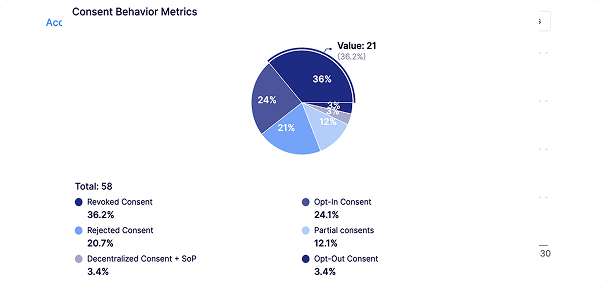
 Behavior trends can be reviewed across defined time periods, helping teams observe how consent states shift in response to changes in UX, messaging, or overall site context.
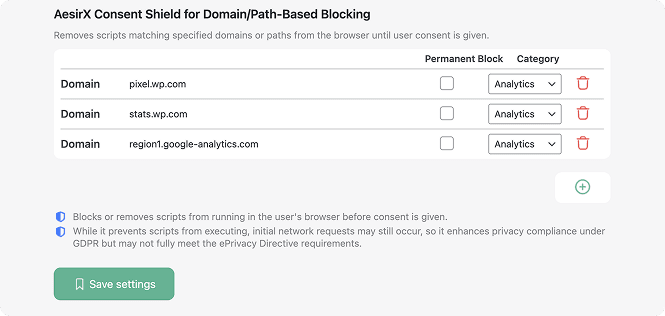
Note that AI Auto-Blocking works for plugins and scripts loaded through WordPress’ standard architecture. Scripts hardcoded in theme files are not detected and must be added to blocking rules manually


 Consent outcomes collapse into a single opt-in rate.
 Each consent action is visible and clearly categorized.Category-level behavior is hidden from reports.Partial consent shows where users draw boundaries.Partial consent lacks clear explanation.Revocations reveal trust or expectation issues early.Data loss is blamed on tools or tracking issues.UX changes are guided by observable behavior.Category changes rely on assumptions.Consent trends support informed iteration over time.
 Observable consent trends
 Consistent behavioral patterns
 Audit-ready reporting
AesirX CMP for WordPress v1.8.0 adds advanced consent analytics, exportable insights, and 8 new languages – giving WordPress users deeper control and legal readiness.
READ MORE




Consent Behavior Metrics in AesirX goes beyond a single opt-in percentage by separating full consent, partial consent, rejection, and revocation. This reveals how users actually interact with consent choices over time, rather than compressing different behaviors into one number that hides meaningful patterns.
In Consent Behavior Metrics, each consent action represents a distinct type of user decision, not just a variation of opt-in. Opt-In Consent reflects users who actively accepted all available consent categories at the time of interaction, showing a clear and complete agreement. Partial Consent captures users who chose specific categories while rejecting others, indicating deliberate boundary-setting rather than indecision. Rejected Consent records users who declined all non-essential categories, making an explicit refusal visible instead of masking it as missing data. Revoked Consent applies when a user initially provided consent and later withdrew it, highlighting how consent can change over time as trust, expectations, or understanding evolves. Together, these actions allow AesirX to present consent as an ongoing behavioral pattern rather than a single moment, helping teams interpret shifts in data availability and user response accurately.
Consent Behavior Metrics in AesirX provides visibility into how consent states are applied and changed over time. The breakdown includes explicit actions, such as opt-in, partial consent, rejection, and revocation, as well as default-based states where consent was not actively changed. This helps teams assess whether changes in data availability align with observed consent choices rather than assuming technical issues. Reviewing these patterns can inform discussions around consent wording, category structure, or banner layout by showing how responses differ across consent states. The same metrics can be compared across sites or regions to support consistent reporting and ongoing evaluation of consent behavior based on measured trends.


The evolution of Aesir is Aesir +  (the Norse symbol for Necessity)"Needed in order to achieve a particular result"
♥Join the AesirX Privacy Newsletter. Stay Informed. Stay Compliant.