

DPO Radio

CONSENT REQUEST
The Consent Request feature generates accurate, site-specific consent wording based on real scan data, reducing guesswork and giving you a clear, editable foundation.


Most consent banners rely on generic text that does not match the real technologies running on a site. As plugins, videos, analytics tools, and third-party scripts evolve, the wording quickly becomes outdated. Users receive incomplete explanations, and maintaining accuracy across multiple environments becomes a continuous, manual burden. Writing consent text that reflects essential and non-essential tracking is difficult and time-consuming.
The Consent Request feature resolves this by using real scan data from the AI Privacy Advisor. The system analyzes what loads before and after consent, identifies technologies requiring approval under GDPR and the ePrivacy Directive 5(3), and generates a draft consent message based on actual behavior. This includes essential items, non-essential tracking, analytics services, embedded content, and attribution technologies if detected. The text is clear, structured, and designed to link with your Privacy Policy and Cookie Declaration.
This gives you a ready-to-edit starting point that reduces manual writing, supports transparency across global frameworks like CCPA/CPRA, and keeps messaging aligned with your site’s actual setup. In CMP Pro, Consent Request text is versioned, and any change in that text automatically revokes previous consents, prompting visitors to provide fresh consent aligned with the latest content. This improves auditability and supports transparency across global frameworks.
Built for organizations where data protection meets performance

Accurate wording aligned to real tracking behavior.

Clear messaging for pixels and marketing tools.

Transparent descriptions for sensitive workflows.

Plain-language text for complex ad-tech activity.

Clear explanations of essential technologies.

Behavior-based wording for non-essential services.

Drafts built on categorized tracking insights.

Consent text reflecting dynamic third-party tools.
The Consent Request feature uses AI Privacy Advisor to turn real scan insights into accurate, editable consent wording.



The Consent Request feature uses scan results from the AI Privacy Advisor, comparing what loads before and after consent. It identifies essential cookies, non-essential tracking, analytics domains, embeds, plugin scripts, and attribution pixels, shown in Domain Categorization and used to generate your consent message.
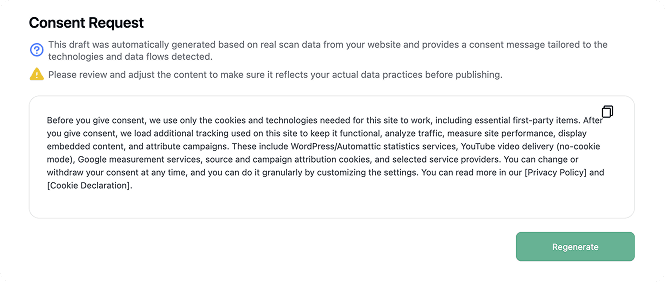
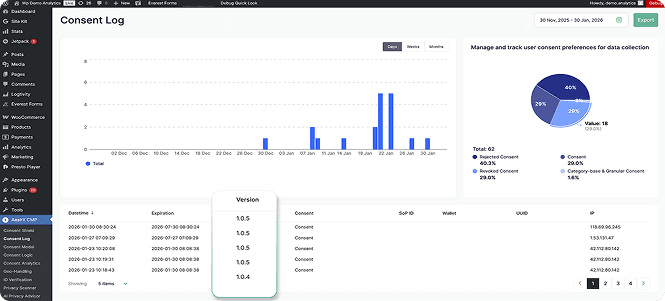
 Use the generated message as a base, then adjust tone and detail to match your brand and data practices.
Note that AI Auto-Blocking works for plugins and scripts loaded through WordPress’ standard architecture. Scripts hardcoded in theme files are not detected and must be added to blocking rules manually


 Generic text mismatches behavior
 Wording reflects real activityHard to track wording changesUpdates follow scan resultsManual writing per environmentFast drafts for every setupInconsistent language across sitesConsistent, structured messagingTime-heavy updates when tools changeLess rewriting as technologies change
 Behavior-based clarity
 Consistent structure
 Real-data alignment
AesirX CMP for WordPress v1.9.0 introduces automated scanning and blocking of cookies and beacons using the new AI Privacy Advisor feature.
READ MORE
AesirX CMP JS 1.0.0 brings first-party consent control to any platform, delivering faster, compliant, and privacy-first data management for all websites.
READ MORE
Explore the AesirX Consent Management Platform Features Guide to configure tracking, block scripts, and stay compliant with global privacy laws.
READ MORE



The Consent Request feature uses the scan results from the AI Privacy Advisor, which analyzes what loads before and after consent. This lets the feature describe essential and non-essential technologies in clear language. It aligns with AI privacy enforcement and supports teams reviewing how AI can block non-compliant cookies, without implying legal guarantees.
Yes, descriptively. The Consent Request feature drafts wording based on detected behavior, helping you communicate what requires user approval under GDPR and the ePrivacy Directive 5(3). It also supports transparency duties for CCPA/CPRA. This fits within AI-powered privacy compliance and reflects automated tracking prevention in a user-facing format.
Yes. The Consent Request feature pulls categorized items from the AI Privacy Advisor, including plugin-based injections, analytics services, attribution cookies, and embedded content tools. This supports AI compliance automation and helps teams understand can AI detect unauthorized tracking, while keeping wording accurate.
Refresh whenever the site changes. Regenerating scans or saving updated content creates a new version of the consent wording to reflect new plugins, scripts, or tracking activity, and prompts users to provide fresh consent. This keeps messaging aligned with real site behavior across environments.
The wording is a draft. The Consent Request feature provides a factual, behavior-based starting point, and you adjust it to match your actual data practices. This supports AI compliance tool workflows and aligns naturally with automated consent detection explained, without implying compliance outcomes.


The evolution of Aesir is Aesir +  (the Norse symbol for Necessity)"Needed in order to achieve a particular result"
♥Join the AesirX Privacy Newsletter. Stay Informed. Stay Compliant.